
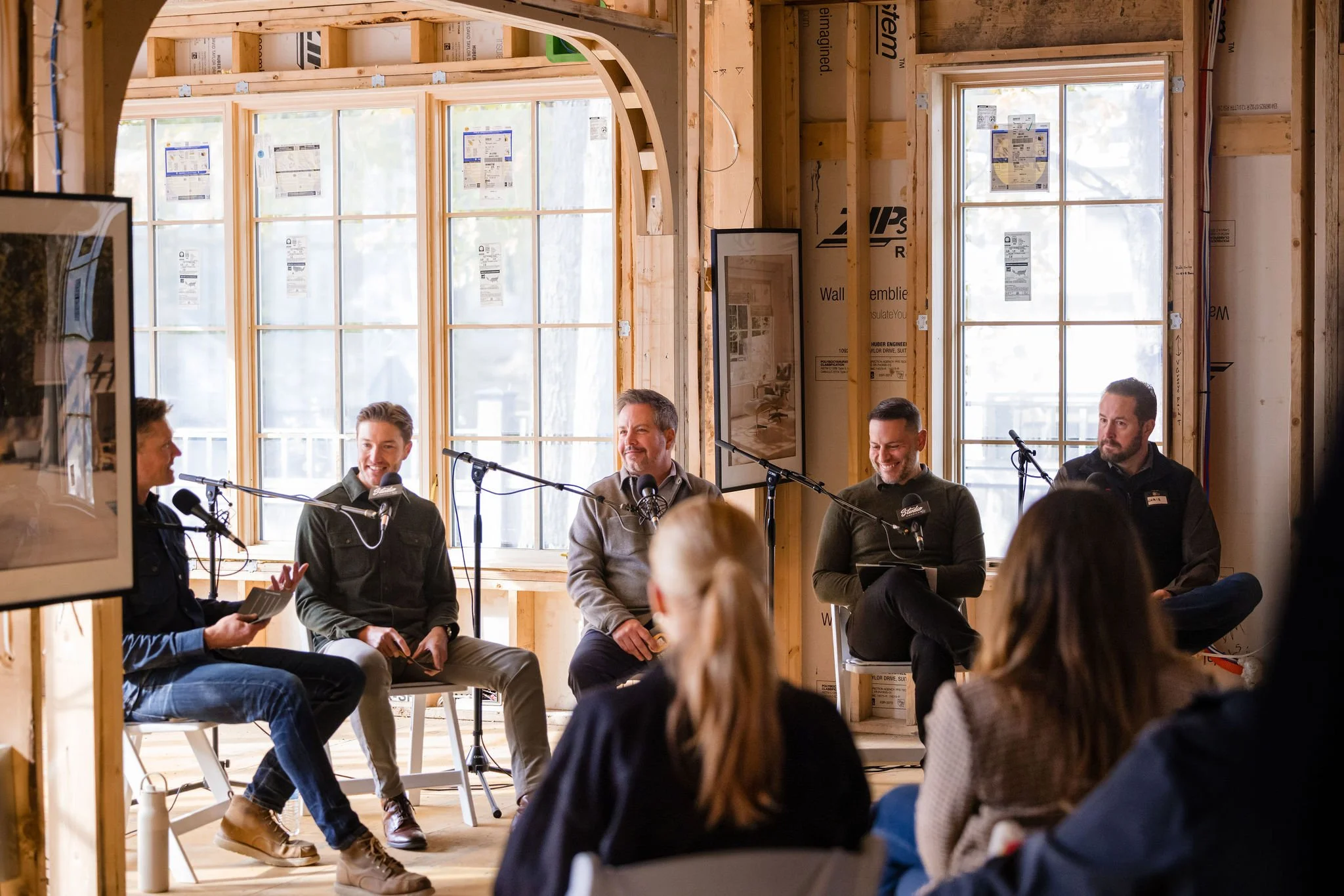

Podcast Episodes
Where the Story Begins
Mysa Hus began as an idea about how a home could feel. These podcast episodes follow the journey behind the build, sharing the people, perspectives, and philosophy shaping the home along the way. Listen in as the vision unfolds; from the earliest conversations to the moments of intention that truly define this home.
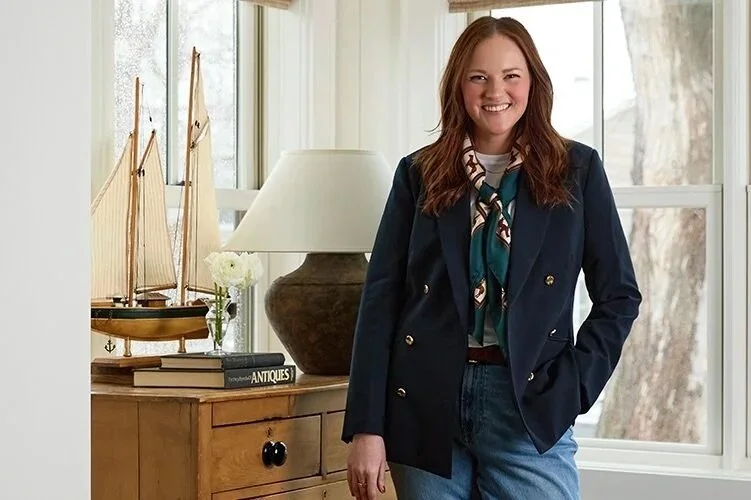




Ep #168 The Finish Line to Mysa Hus with Melissa Oholendt
Five days before the Artisan Home Tour, Mark and Melissa Oholendt of Oho Interiors snuck away from a live photo shoot to talk about what the final stretch of Mysa Hus actually looks like — wrong-sized sectionals, a Hail Mary pass to a UK lighting CEOs, and a third-generation plumber who showed up unannounced and left with chocolate-covered strawberries. They walk through the 60-day countdown, three photo shoots with three different photographers, and what it means to build something hard with people you genuinely trust. It's raw, real, and recorded while the house is literally still being shot.
-
Melissa Oholendt 00:04
In all my years of going to any parade in any state, I've never experienced a house like we have planned for people to try to experience this house. There are so many elements. I really hope that people do what they can to make it to this house, not just selfishly, but I just think it's something special. I can say objectively it's something
Mark D. Williams 00:21
special. Welcome to Curious Builder Podcast. I'm Mark Williams, your host. Today is our Monday episode, and I've got Melissa Owens in studio, just five minutes from Misa Huss. Hey, Mel.
Melissa Oholendt 00:40
Hey, Mark. How are you?
Mark D. Williams 00:41
So, I appreciate you coming over, because we are in the middle of our third and final photo shoot. We will get into it. Don't worry, people, we are crazy. That's fine. Of our Misa Whose home, many of you listeners likely know about our spec home that we're doing with Curious Builder. It's a partnership between Oho Interiors and Mark Williams Custom Homes, and we have past episodes on Miso Whose, you can back check those, we had, I think, four or five of them. Melissa's full story, I think, was back in June or July. We did the full story a while ago. We'll do another one, but truthfully, I called Melissa, because my editor said, "Hey, you don't have any Monday episodes. I've been so focused on getting this house ready for the tour that I've just sort of cleared my schedule of any podcast interviews, and I always like to have something I could have run some old content or skipped, but that's just not.. I was, you could have made the call. So I called you yesterday on my way home, and I said, Melissa, do you have any interest in..
Speaker 1 01:35
no, no.
Melissa Oholendt 01:36
You said, Am I crazy? You can tell me no. I'm like, uh, oh, where are we going?
Mark D. Williams 01:40
That's like a Minnesota polite way of like giving you multiple exits, but yeah, it was basically like, do we take a time out of a week? We literally have six people at the house right now doing our final photo shoot day three, and but with it, let's get over here over lunch, and let's just, let's just talk about what's happening at Misa, who's because so many people are aware of it, talking about it, and so we thought this episode would be really helpful. We have two more episodes planned, one will be with Carl, the architectural designer, and ourselves in about a month, where we just, we've, the house is done, we've had 1000s of people through the house, and we can just talk about how people interact with it, their special moments, and then we thought, what, two or three months from there, we do lessons learned, because we have learned
Melissa Oholendt 02:23
so much,
Mark D. Williams 02:23
a lot of stuff, of things we shouldn't have done, like anyone, you see, all the, as I'm sitting there now, while we're doing all the photoshoots, all I see is all the things, like, oh, that could have been different, and we're the only ones likely to see this, of course, yeah, so today's episode is really, we're going to walk through 60 days before the end, 30 days before the end, seven days before the end, and then show time. So, the day that this episode airs will be Monday, was it june 1? Which that day actually we have a Channel Five is coming to do a TV interview, a blower door test, which is sexy. We've got what we're doing, a drone shot through the house with a flying drone, and then we have someone interested in the house. We're doing a preview tour. Then Tuesday, we're doing our influencer event. I think we have 100 people showing up for the influencer event.
Melissa Oholendt 03:09
Then
Mark D. Williams 03:10
we have the realtor open on Wednesday, where it'll be the first time we disclose the price to the public. And then two days later is the start of the Artisan Home Tour, and it's really the victory lap. At that point, all the hard work has been done. It
Melissa Oholendt 03:20
better be done.
Mark D. Williams 03:21
It better be done. So we're going to dial back from both of our designers' point of view and a builder's point of view, and just talk about 60, 3070, and show time, like our different stress levels. So maybe we'll start with that. What in the last 60 days, what event has been the most stressful for you?
Melissa Oholendt 03:38
Yeah, I.. well, 60 days prior, we're always in install planning mode, so we're thinking about, you know, all the construction finishes, everything has really been specified, and then in the ideal world, everything's been specified. We're really just there every other week, kind of managing site decisions and questions,
Mark D. Williams 03:55
and everything's in the warehouse, just waiting.
Melissa Oholendt 03:57
Everything's, of course, just waiting for us in the warehouse, because then we got lots to talk about there too, but we are planning for install, so we're our brains are fully on furniture and making sure that furniture has been ordered, it's you know on its way there if it's not like what timelines we're looking at, but then also like you mentioned, like we are there still will be because we are who we are and we do order. We do specify a lot of things from Europe. Inevitably, we're waiting on some light fixtures, like we were until the 11th hour of install. And so we're navigating all of those things. Our procurement team is managing that and trying to figure out where those things are. Are they going to be here in time? Are they going to, you know, will the companies fulfill their promises? It's, it is, it starts to get, it's, I would say, for us, it's probably a little less stressful on the scale of things. 60 days out still feels like we have a lot of time to be able to manage and navigate those things, but it, we're still starting, starting to ramp up on the stress level, for
Mark D. Williams 04:58
sure. So, from my point of view. I see 60 days out. I see it's actually my least favorite time of the build, because I see well, first of all, it's coming all together, which I do like, but all I see is the 1000 things that have to be done. And for this particular home, I was never worried about it being done for the Artisan Home Tour, which is what most builders are concerned about. We got real excited a year ago, because I've done the artisan tour and parade homes now for well, almost 20 years, and we have most builders in general, you're done like the day before, like green side is going up on the sod right before people come in, it's to the ninth hour, I just hate that you don't always get a choice, because sometimes a client will start home later and it just is what it is, permitting slow, something delayed, whatever, but if you don't have a deadline, you can't meet an expectation. So, having a deadline, even if it's an artificial one, is helpful. Mine to the team a year ago was I wanted to be done two to three weeks early before the tour to do all of our photo shoots beforehand, so I could shockingly use those photos for marketing, because I want to sell the home, and then two, you get, you're more likely to get free media, like TV, which we are getting now, because we are done. Most of our peers are not done, you know, they will be sweeping out the garage and painting the garage the moment, you know, an hour or two. I've seen, I've literally seen landscapers like landscaping a yard, when you show up to a house, it just.. it happens in spring. Some, we've been very lucky in Minnesota this year for our weather. It has hardly rained at all, which we actually need the rain, but it has allowed us to landscape at full haste. So, with that in mind, the 60 days for me are very stressful, because of all the things we have to do. I think about three weeks ago is when my peak anxiety of getting stuff done for the photo shoot, so my stress was around the photo shoots. That's my point of view. Where, when you have furniture move in, let's talk about the actual day of furniture move in, and even some of the characters on your team, like some are like, I live for this, and that's not your favorite part,
Melissa Oholendt 06:56
100% I actually really hate install days, weeks, and only because they really bring to light all of the things that maybe there's been an internal mistake, maybe there was an external mistake, you know, all of our furniture is going to receiving warehouses before it arrives, so oftentimes we're not getting actual eyes on it until that day when you know Crown Warehouse or a receiving warehouse shows up with the furniture, and sometimes you're like, huh, that didn't get executed the way we thought it would get executed, and so there's just, and that happens times infinity. I mean, we're, you know, we're often putting hundreds, if not 1000s, I mean, Misa, who's 1000s of pieces, into a home at a very high value, and so figuring out, I mean, this one, Misa had a the stress point of the photo shoots and the artisan tour piece that pressure of it, but when we're doing it for a client, there's even more pressure because you're like people have to live in this space with Misa, who said was a little bit alleviated, but we still had the pressure, which we don't normally have of the artisan tour and and of the photo shoots, but I would say that, like, I hate them, but there are members of my team who are like, if I didn't get to do install days, I would never do this job, and so we have such a disparity between us in terms of, and I think everyone kind of hits somewhere in the middle there of those two extremes, and so for some people it's a really stressful time, for some people they're thriving, and so it just really becomes, you know, we had all 10 members of our team at install for two days, because we condensed our install to make sure we could meet the deadline of the first photo shoot, and so it was, it was chaotic. We found out that there was a sectional $25,000 sectional that was ordered in the wrong size. It ended up all working out, but man, that those are those are stressful days for me.
Mark D. Williams 08:39
It's funny, I think this is an obvious statement, but we all have to go through it. I think being able to pivot your emotional swings and being able to pivot some of your expectations, and this would probably show up in the lessons learned episode, you know, a couple months from now, of all the things that we would likely do different, and I think having some grace with ourselves, realize, like, this is a prototype, but honestly, every home is a prototype. High-end custom homes, everyone is a one-off. Nobody ever does multiple versions of the exact same thing. And so we're always learning, and you'd think after this much time you would learn, but I mean, we're human, there's mistakes made. Sometimes it's not even like truly a mistake, it's just an observation. You've literally built something that has never been built before. Then you walk in, and you're like, you know what, I think if I did this again, I would have it 14 inches deeper, or whatever it might be. And even with the best software, you know, walk your plans or 3D modeling and all that stuff, there's there's nothing quite like being actually in the space. And how does it feel? And there's a number of things that change that, furniture, color, textures, all the wonderful things, of course, that we love, but I think also realizing, like, well, this is real, yeah, and and then some things that we think are gonna be an issue are not,
Melissa Oholendt 09:52
aren't
Mark D. Williams 09:52
in the one I'm speaking of, is the master or the owner's best bathroom, I was, I thought, for sure, for nine months, my one of my biggest mistakes. Plan wise, was I wish that that owner's bathroom was about four feet deeper, and when it finally was unveiled, I'm like,
Melissa Oholendt 10:08
it feels,
Mark D. Williams 10:08
it feels great. I don't think anyone's even gonna say anything. No, and I thought for sure everyone was gonna be like, well, man, they really missed the boat on this, and now I'm like, this is great.
Melissa Oholendt 10:16
Yeah,
Mark D. Williams 10:16
so anyway,
Melissa Oholendt 10:17
yeah, no, I think, and it's, I think one thing that has been so, you and I talked about this, but so interesting for me is that because you and I have the relationship that we do, I can, I've been able to kind of ride your, like, in both of our, like, our stress points, like I'm understanding when you're stressed, but because I am on such a different perspective, I haven't understood what it is that is stressing you out at that time, and so I feel like that's been the most interesting part of this project, is kind of understanding there were trigger points for you that would become really stressful, like the light fixtures that we just, full disclosure, there were some light fixtures that we had ordered from the UK that were promised on a timeline, they were ordered in December, and then come what, two weeks ago, we were like, are these.. they were promised that they were going to ship, and we weren't going to have any issues with customs or tariffs or any of those things that end up becoming an issue. I literally got the CEO of that lighting company on the phone. Did I tell you that?
Mark D. Williams 11:13
No,
Melissa Oholendt 11:13
I literally.. I contacted him on LinkedIn, and I threw out a hail Mary of, like, hey, we are working with your team, they promised us something. It's not being delivered. I'm throwing out a Hail Mary here because we have a home that's on the tour, and it's being photographed, and we are all spending a lot of money and time to make this happen. And he called me.
Mark D. Williams 11:33
Wow,
Melissa Oholendt 11:33
and like, he made it happen for us. Now, unfortunately, two of those light fixtures accidentally got thrown away, not by no one's fault, just the chaos of an install day, they got tossed, so we still had to problem solve for that, but he really came. There were 14 light fixtures that we were still waiting on as of when we were installing, and we were that install day, we were on top of electricians, and which is fine, like those things happen, and I think the thing about Misa is like every trade was just so wonderful, and it was such a good experience, but like those are things that you just cannot predict at the 60 day mark that like you're going to be at that point where you're on top of each other,
Mark D. Williams 12:11
and I think it's interesting, like you know, we had a couple things, you know, we have an international photographer who's currently on a three day shoot at the house right now as we're playing cookie for this podcast,
Melissa Oholendt 12:19
buddy
Mark D. Williams 12:20
Patrick's amazing.
Melissa Oholendt 12:21
Shout out,
Mark D. Williams 12:21
yeah. We had Taylor Hall for locally here in Minnesota. He was our first photo shoot.
Melissa Oholendt 12:25
Love Taylor,
Mark D. Williams 12:26
and you know that was the first one, because we knew we'd make Patrick's, but Taylor's was actually the most stressful, because he was the first one up. Yeah, and you want to respect people's time. They book out, like, I understand their currency is, hey, this is, we booked them out six months in advance. Yeah, and that's not easy to do, but it's like, you know, we're installing 16 light fixtures, you know, while you guys are styling and staging, and it's funny because you and I know the full story, and I don't actually blame any of the subs or even people on your team, because there are people on your team that would be like, why are they still doing light fixtures, and then the electrician would be like, well, if we had these two weeks ago, it's like you and I know the whole backstory, but we still sort of have to like navigate all of that, and we, and we're not always at our best. There are times that I'm just like, there are easier ways to build a house, yeah, but like, but there's none that are more rewarding and more fulfilling. And so it's part of that process, it really
Melissa Oholendt 13:17
is. I agree, and I think that there's, despite best planning scenarios, no matter what, there's just going to be things that are not quite, I mean, and not quite right, or that need to be adjusted after they go in, or you couldn't have predicted. And I'm thinking about the metal doors in particular, like,
Mark D. Williams 13:31
oh yeah,
Melissa Oholendt 13:32
these insane, beautiful custom metal doors that Mark and I sat in the house for days with, and then suddenly I think it was like last Friday, we were kind of staring at them, and Mark was like, 'Do you see that? And I'm like, 'No, I don't see anything. And we found out we needed to add an extra piece of trim there, because there was like a gap that no one really could have predicted, just by the way that the doors had to be installed and leveled. And it's, I, it's such an easy solution, but it still has to get done between now and the tour happening.
Mark D. Williams 13:58
Well, and I think, like, painting, right, is a never-ending, like, literally never ends. There's always some painting to be done.
Melissa Oholendt 14:04
Shout out, Ryan.
Mark D. Williams 14:05
Yeah, Ryan, you're doing a great job. But I think, I think the other thing too is, like, a lot of times, like, I had a painter come up to me, not Ryan, but one of his painters, and he goes, "Wow, you really see everything, and
Speaker 1 14:18
they do,
Mark D. Williams 14:19
and I take it as a compliment, actually, and it's.. I don't have a.. I don't have a false.. it's not a false judgment's the wrong word.. I don't.. it's not an accusation. I'm trying to remove anything. I think it's what makes us.. you and I have talked about this.. is what makes us.. I think good at our jobs in our career, in why we're able to execute homes of this caliber. And I did tell the painter, like, I don't expect perfection, because I don't think it's attainable. Perfection, in fact, if a client ever says the word perfect, I actually have this pretty dad moment with them, where I'm like, okay, that's a prototype.
Speaker 1 14:50
It
Mark D. Williams 14:50
doesn't mean that the pursuit of getting it perfect isn't worthy. It's just that I don't believe in perfection, because we're not perfect, and one thing that I've really come to embrace with this home. In particular, is Misa Hus is meant to be authentic, and the whole mantra, the whole story is it's meant to patina, to age, to move, to, because we're humans, to be like, we change, yeah, and so I want the home, so I'm fine with that, but if we can make it better,
Melissa Oholendt 15:17
yeah,
Mark D. Williams 15:18
I don't think perfect, I like the word better, I can make this experience better. I want someone that comes through to love it, and to feel the energy and the care that we put into it, and it is the details. It really is. It
Melissa Oholendt 15:29
is the details. I even think it goes down to, you know, yesterday we were photographing the living room space, and there, that fireplace, that again, future conversations about how insane that fireplace was to come together, but we had the, you know, we, the photographer said, "Could we get a fire in the fireplace? And I was like, "Oh, we're gonna need to ask Mark about that. And so I, I texted you, and you're like, "Let's get burn it, let's get it going. And then afterwards, we were like, "Oh, soot, there is a natural patina that happens the first time you use a fireplace, and you had asked me, like, do you think we need to
Mark D. Williams 16:04
clean it,
Melissa Oholendt 16:04
clean it, and I was like, no, I think that that it feels so much better now that it has a little patina, and I'm so glad that Patrick wanted to take that shot with the fire, because I think it's, it feels so much more authentic now, and no one's going to be afraid of doing it the first time, like they would when they moved, we've already done, we did it.
Mark D. Williams 16:21
Yeah,
Melissa Oholendt 16:21
you're welcome.
Mark D. Williams 16:22
You know, shout out to Renee Keller. She has that great line: burn the candles and use the china.
Speaker 1 16:27
It's
Mark D. Williams 16:27
like, burn the fireplace, because, like, literally, Mark, because you're like, we got to ask Mark. I was like, I got the torch, I'll be there in five
Speaker 2 16:32
minutes. Yeah,
Melissa Oholendt 16:33
yeah, yeah,
Mark D. Williams 16:35
yeah. I think the other thing, too, when you're in a home, and I think this is anyone who sat in a model home or a tour home during the duration, like you just keep a list, because when you're sitting in a home you see hundreds of things that you don't see when you're walking through, because you're sitting there all day, like I typically, you know, picking up my kids every day at 5o'clock so it means I usually leave the office at 420 and I'll make phone calls on the way, but I'm not usually there in the evening, so light is light, natural light does wild things, right? The morning light, so we were there this morning at 645 and that light looks different, and you see different things, and then in that you have the bright sun of like noon, 1o'clock sun, high sun, and then you have the evening sun, and it's I think what's kind of nice about that is is for builders and architects and designers to be aware that their clients experience the home at all hours, but as professionals we often don't, and so I don't really have an epiphany about that, other than just consider that when a client calls you and says, "Hey, I see this thing, a lot of it is the time of day,
Melissa Oholendt 17:38
yeah.
Mark D. Williams 17:38
So anyway,
Melissa Oholendt 17:39
I think that that's one of the benefits you and I have both had some early mornings and late nights there, just in the last two weeks of installing photo shoots, and being able to experience the house in ways that we might not otherwise get to. I mean, you know, I think it was last week I was there late one night, kind of cleaning up after everyone, trying to get prepped for the photo shoot, and we had, I had all the lights on, or at least in a cozy way, I had, I had overhead lights on, people believe it or not, I had overhead lights on, but we had the lights on, and we were working with Admit One on the lighting, and it was like it was beautiful, it was cozy set, and I had them on, it was like 930 at night, it was really late, and then all of a sudden they all turned off and I was like, hello, like just a girl alone in a house, I don't know if the doors are locked, what's happening, and it found out the next day, I mentioned it to Mark the morning after, I was like, hey, I don't know if like there's something wrong with the lighting, or they just all turned off on me, and what had happened is that, you know, one of the admin, one guys was looking at his phone and noticed that all the lights were on, and in a moment of care was like, "Oh, someone must have left them on and forgot to turn them off and turn them all off. It was just one of those moments where I was like, "This is a really interesting.. just because the team cares so much. But I also love.. sorry, that was like a long-winded way of everything. I got to experience the house in the evening, and I never get to do that, and it was really, really special. And actually, like, we joked that I slept over a lot there. I did bring a toothbrush there, that was for different reasons, but I did. I love that house, and I want to spend time in there, and being able to be there outside of normal working hours was just a delight.
Mark D. Williams 19:19
This episode is brought to you by Pella Windows and Doors. I've used Pella for 21 years as the exclusive window company on every one of my builds. When people ask me who I trust for Windows and Doors, it's Pella. Every time, their craftsmanship, their innovation, the top-tier service make them a no-brainer for any custom home builder or designer who demand the best. Whether you're designing something bold or building something with timeless elegance, Pella has you covered. They're also the only window company that has a lifetime warranty on all of their windows. I've gotten to know all their people at Pella corporate, as well as locally here at Pella Northland. I'm proud to call them our partners and our friends. Visit pella.com to learn more and connect with your local reps today. For more information. You can also listen to episode one, where I interview the Pella Northland founders, as well as episode 109 where we talk all about their latest innovation with the steady set window. I love the idea, because the tour is going to be on Saturdays and Sundays too. Yeah, I like the idea. I normally bike Sunday mornings with a group of guys. I like the idea that I would bike out here and then I'd shower, have a change of clothes, work the home, and then bike back. I'm not sure mrs. Williams is going to be good with an hour extra commute on the bike, but I sort of like the idea that, honestly, who we don't know who's going to buy the home. I love because there's so much of my personality and lifestyle wrapped up into some of the design choices and the ethos of it. I just like the idea that I would maybe be experiencing in a way that maybe a future homeowner would, that they would bike to and from the home, the wellness studio. I probably won't use the sauna, although the sauna is magical. That little fiber optic startle at Sky is just incredible. And I think we're doing that photo shoot tonight. Actually, Patrick was saying he was going to shoot it. What you know, as you, is there anything that you've been pleasantly surprised in terms of, like, you have your early preseason favorites of the house, but now that you've sort of been working in it, you're like, actually, I think this might be, this would be a moment where this is a place that I would sit and spend more time in, or is there any sort of, you love to use the word moments of delight, is there any? You already knew there was a lot of them. Are there any that have kind of surprised you in a way that you didn't realize?
Melissa Oholendt 21:26
Yeah, that's a really good question. I feel, you know, Kate and I really tackled the design of this house together, and so she, we split rooms and we kind of tackled our own rooms. I ended up doing all of the furniture myself, and so I had a very direct hand in that, but there was one bath or one room, the primary bathroom, where I just didn't have a handle on kind of what Kate's design really was for that, like I knew what it was, but I couldn't, I hadn't painted it in my head, and seeing that come to life over the last few months, but even on that final stretch, where I, there, I remember standing, and both Kate and I did this, we stood in the bathroom, we were like, I don't know if this plaster color was the right color, but then the shower doors went in, and we were like, that is the piece that put everything together, and we were having that as designers, this like moment of doubt, and so it made me have it, gave me another level of empathy for our clients who go through that moment of doubt, where, like, we had Kate had the full vision, I had a moderate amount of vision for it, like, but our clients would not, you know, it would not have had that vision, and we were having this moment of doubt, so it gave me another level of empathy. I really loved that moment. I will say also, the living room itself, like, there is, you know, the ethos of who OHO is, is really to make sure that the architecture of the house feels really interesting, without any layer pieces of furniture styling and decor, art, any of that. We want to make sure the architecture feels beautiful and construction finishes feel beautiful, so even if nothing else is there, it feels interesting. But having that added layer of furniture made it sing for me in a way like the Mora clock and the gingham sofas, and the, you know, the armchair fabric that feels like it could have been needlepoint, and these antique cricket tables, and it just like it makes it sing in a way that makes the house make sense for me, of like this is the place where a family sits around in a conversational way, but can sit and pull a tape coffee table book, or a book off the table, and sit and read, and enjoy what's happening around them, without having to participate. It just.. it was such a.. it's my favorite place to be. If I on the tour, you're probably going to find me sitting there, maybe a little bit, because I just love it so much. It's just.. it feels so good in that space to be surrounded, but not feel like you have to be in the middle of everything.
Mark D. Williams 23:42
I've sort of enjoyed. I always knew the breakfast nook or the breakfast area was going to be my favorite, but seeing the plaid, the bench, and while I thought I would sit in it in a different spot.
Melissa Oholendt 23:53
Yeah,
Mark D. Williams 23:53
sitting in it, how like you and I've been working together over the last couple days during the photo shoots. Yeah, and you know, I feel like we're little kids, just like, you know, on our homework together, and you know, kind of chit chatting while we're working, but like it's just a very comfortable place to be, and you know, whether it's formal dining, informal dining, I found that like that's just a room I want to stay in. I just love looking back in the light, so that I knew it would be special, but actually working in the space and feeling it, even though I haven't had a meal there, it's a space that I just, it feels very like a refuge, because it's the way it's sort of encapsulated and cozy. It just, for me, really feels like that's a spot I would spend a lot of time in. Yeah,
Melissa Oholendt 24:32
I one thing I've noticed too, over the last couple weeks of being there every single day, which has been, honestly, I loved every minute of it, but I've noticed that both sets of our teams find different reasons to be there, and, like, you know,
Mark D. Williams 24:48
interesting.
Melissa Oholendt 24:49
Angie will come, obviously. Mike's there because he's finishing up things. I, you know, he, poor guy, gets my to-do list, he gets all
Mark D. Williams 24:55
my to-do list too.
Melissa Oholendt 24:57
But even members of my team will be like, hey, yeah. I'll come and like drop off that thing, or hey, yeah, like no problem. I'll swing by and go do that thing, and I think there's something about that house that kind of calls to people once you get to experience it. It really calls to you in a way that I think is really unique, and I don't want to toot our own horns, because that's not the intent. I just think there's a, there's a loveliness there that kind of attracts people that I've found really like a proud mom, kind of sitting back and watching that.
Mark D. Williams 25:25
I'm, it's funny you say that, the proud mom thing, I'm debating how much to tell people when they walk in the house versus letting, letting them experience the house without me guiding them through.
Melissa Oholendt 25:35
Yeah,
Mark D. Williams 25:36
because if it's a one on one, like I could spend an hour, hour and a half going through everything, but but there's also part of me that just wants to watch them, and I kind of feel like we do have a lot of our super fans that come multiple times. I suspect that we'll have lots of people that will come more than once,
Speaker 1 25:51
because
Mark D. Williams 25:52
a lot of times what I've noticed over the tours over the years is the missus will come through, and especially if they're serious about buying, and then they'll, then they'll.. it's kind of like the scouting mission, and then they want to bring their husband, or you know, other people through, or their parents, or whatever the reason is. I was like, people will come back more than once, and it's really interesting, because the app now that the Artisan Tour has, you can actually see what percentage of people are repeat visitors, and so it'll be really interesting to see what percentile that do that?
Melissa Oholendt 26:22
Is there anything you're worried about with the tour?
Mark D. Williams 26:24
Not at all. Okay, that was very fast answer. Sorry, yeah. Like, why would you offend me? No, I'm really excited. You know, a lot of people, you talk about different temperaments for people, and you know this about me, and so does the audience, but like, I'm extreme extrovert. I love people. So, the idea, like, honestly, my favorite part is the iteration, the very beginning, the design, getting the team together, building it is not actually my favorite part, and then the end, showing it off. So, like the middle part, the 90, I don't hate it, I'm just saying it's part, it's a means to the end, right? But, like, now that we're all done,
Melissa Oholendt 26:56
yeah,
Mark D. Williams 26:57
like, my energy, I'm really good at getting, getting people's emotions up, and like, because I'm emotional, like, I'm very excited, so like, I can't wait to get people excited about the house and watch their experience, but it's a little bit akin to, like, having, you know, your kids in the playground and watching other kids play with your kids, or other parents interact with your kid, and you know, and just like the other day, it was just kind of beautiful, like, every parent would like this, my, you know, how, like, your kids are always better for other people than they are for you. Oh, yeah, and so my kids were at my aunt's for the weekend because Mel and I went out to do a little mountain trip together just to get away before you know the tour starts here, and my aunt sent this beautiful text to my wife, and she said, "Your kids are so well behaved, they bring the plate their dinner up to the their lunch silverware or whatever, plates up to the sink, put it away. They'd never do that at home. They said please and thank yous. They cleaned up, and they're so self-sufficient. She goes, "Your kids are amazing. And my wife and I are just like, "Wow, it's a) you want to hear that, yeah, b) they don't do that at home, but my point in saying that is, like, I want to see how people interact with Misa, and just, and just kind of out of curiosity, like, what do you like? I'm just generally interested to hear their feedback, and I, I'm actually fine with controversy. Some people I've talked to builders and designers, like, some people don't want to hear the negative comments. Actually, does it? It kind of rolls off my back. It doesn't. I know it's amazing. I know we've done great work, and it's not going to be for everyone. There will be plenty of people that are like even people on my team, you know, Joel, my controller, went through. He's like, you know, the quality is outstanding. He's like, and he's someone who doesn't BS anybody. He's so black and white. I appreciate Joel that way. Perfect for the controller. He's like, but the style is not a modern. This is not my house, you know. There's too many, too many patterns, too many things. And that's what that's one of the main reasons I chose you, other than you're a phenomenal person, like I liked that traditional layering. There will be people that can't see past that, but it was interesting, his point of view, and his wife's was like, the home quality is unlike anything I've ever seen. The furniture isn't for us, but that doesn't matter, that can always be changed, right? And so I welcome feedback, because I'm just interested in how people receive it. It's no different than cars or people, or honestly, anything. I don't like fake. I don't want people to come in and give you platitudes. Oh, it's great like that. There's nothing there that doesn't help me. Yeah, I know it's great. What do you like? What did you experience? What don't you like? Yeah, what can we change in the future? Am I interested in changing it for you? Maybe, maybe not. That's the decision I get to make. Anyway, that's how I, so I get excited about for the tour, because I like to engage people and see, you know, what their response
Melissa Oholendt 29:26
is. Interesting, I think the biggest.. I think the thing that I am most excited about, I feel like I've gone to tour homes in the past and felt like I couldn't sit down anywhere, or like actually kind of have a moment to breathe within a house, and maybe that's just not what they're meant for. That's very possible as well. I think the thing I will feel like is the biggest compliment is if I notice that people are sitting on the furniture, and maybe you know, maybe that needs to be like a welcome kind of moment for us to tell people that they can do that, but I think that that. It's sort of like that exhale of like I can sit here and I can just spend a minute just sitting here instead of feeling like I've got to run through this to our house because I got to get to the next one like I think that will be the biggest compliment that I ever
Mark D. Williams 30:11
funny you say that I have this idea I haven't brought this out to the tour yet and you have to have a really experienced person to do this I think I've maybe mentioned this to you but I think the home is best experienced with fewer people in the home. It's not that the home can't handle a party or it can't handle a large crowd. There's details on details on details on details, and if you blow through it, even if you're an experience built, you're just going to miss everything. And so there's a part of me, because usually when you have, so we have a trolley, and which is, we'll talk maybe next about the different experiences that people are gonna get, because that's, I think, that's entertaining. I like that part of it, but whenever you have a shuttle, it slows down traffic, because when people are looking at the book, they're like, I have to get out of my car, I have to get into a shuttle, I'm just gonna skip this one, unless there's a special reason. Yeah, so one of the special reasons is, of course, the home, the area, cottagewood store, the cottage would area, but then this open air trolley is just kind of fun. Yeah, you know, so you've got air blowing through, it's like you're in the streets of San Francisco, but by having a trolley it helps it. We're going to get traffic and waves, so that bus can only hold like 2030 people, so you're going to get a wave, and then they come through the, you know, and they come in. But there's a part of me that wants to have someone at the front door, somebody like Angie or my friend Susan, who helps us out, that really can read body language with the ideas that they would engage people in conversation outside in the driveway, and I don't know what our signal is going to be, but something to the effect of, for your the best enjoyment, we're just going to ask you to wait for a few more minutes before you go in. We really want you to be able to walk in and go at your own pace, and right now you know something to like kind of basically meter out the flow in which people come. Yeah, it will see, because I could see some people being like impatient in that role. You sort of have to navigate it very carefully, but I think also we have the coffee cart there, we have live music, so we have other things for people to do, you know, while they're waiting, and so I experience how you experience the house does matter. Yeah, so anyway, just see what people do with it. Yeah, I
Melissa Oholendt 32:10
think it's gonna be, it'll be interesting. I don't think I've ever, you know, in all my years of going to any parade in any state, I've never experienced a house like we have planned for people to try to experience this house, so I think it'll be maybe a little uncomfortable for people from the perspective of, like, there's gonna be so much, there's so many elements to it that we, like, you know, the QR codes and the, you know, maybe the pacing of people, and you know, I think it'll be really interesting, but I really hope that people do what they can to make it to this house, not just selfishly, but I just think it's.. it's something special. I can say objectively, it's something
Mark D. Williams 32:48
special. There's a.. I mean, you touched on it, and I think we've mentioned before, but you have this great term, moments of delight, and so you and Carl and I recorded our own voices, like 90 seconds or less, these.. we have 22 little QR codes around the house, so that you could hear us talk about what's the story behind why we did the fireplace. What's the story behind the brass stars inlaid in the, in the floor? What are the reasons for, you know, whatever the plaster and some of the health benefits and things like that. And so it'd be really interesting to see how many people engage on this sort of audio tour, so I think giving different people different things, because you and I can't talk to five 6000 people in that period of time.
Melissa Oholendt 33:29
Yeah, and some people probably won't want it, they'll just want to experience it how they experience any other tour house, which is great. I think that that's what Misa is going to be so good at offering, is the ability for people who do want to dive deeper, they can. If they do want to sit in the house, they can. If they just want to breeze through it, they're welcome to. Like, I think that's.. I think that's a really cool thing.
Mark D. Williams 33:49
What is.. So, let's talk a little bit about photo shoots. I think early on we mentioned we have three photoshoots. I think people are very curious, including myself. Like,
Melissa Oholendt 33:59
yeah,
Mark D. Williams 34:00
we did three photo shoots, and I mean the reason being is we have three different objectives, and I think you know, without going into too much detail, the first one is to have photos to obviously use in marketing, and that we have a lot of brand partners, you know, this particular home, I think, has 32 brand partners, and so a lot of our responsibilities in exchange for the goods that we received, and what we've done with it, like their marketing departments are going to want these digital assets to market, and so we have to, we have to deliver that, obviously, as part of our arrangement. We have a one photo tour that also is, you know, part of our fees for the Arson Tour, which is amazing. A lot of builders don't, maybe, think about marketing the way you and I might, and so having that service and ability is amazing, and we, we gave them very specific direction for like micro shots or maybe more social clips, so we had a different sort of design, you know, the first one with Taylor is more editorial for us and for our brand partners, and I love different people's eyes, so. A respecter of the talent, everyone's eye
Melissa Oholendt 35:02
sees
Mark D. Williams 35:03
so differently, and I love.. I can't wait to see, like, three different shots of a great room and realize that they're totally
Speaker 1 35:10
different.
Melissa Oholendt 35:10
Yeah,
Mark D. Williams 35:11
I think that, you know, what I just thought that would be an amazing, like, blog or a post of, like, why multiple photographers on it would actually be really cool, wouldn't see the three photos naturally each, and then, of course, the last one, the one with Patrick Biller, is we're we're trying to pursue, you know, publications nationally, and so working those relationships and seeing different stylists at work, so that's why we have three different photographers with three different agendas.
Melissa Oholendt 35:36
Yeah, and I think it's been so interesting to see, you know, we had Leah from Creekwood Hill, and then we have Kate Regan out of Chicago, and both of them beautiful, incredible interior stylists, seeing how they approach each room, and it's been so interesting to see just like what gets moved, what gets tweaked, what florals they use. It's been a like really interesting experience to see how they see the house, because I think you and I have been pretty hands off for both photo shoots, in terms of, like, you know, looking at images and being like, yeah, that looks amazing. I think partially because we hired people we could really trust to care for it, but I think also because from a voyeuristic is not the right word, but from an anthropic perspective, it's been so compelling to watch people experience this thing that we've experienced, and in their own eyes, and making it look even more beautiful in their own eyes. I think that that's just been like such a delight for it, for me personally. I can't speak for you, but it's been so fun. It's
Mark D. Williams 36:32
funny, I literally had this conversation with Kate two hours ago, the stylist, and I was sitting there, and I just asked her, I said, Do you get energy out of what you do? Because sometimes work is work, and it drains you, and for those of us that are lucky enough that love what you do, doesn't mean it's not hard, but if you get energy, hopefully everyone listening, hopefully you can find something that that you can enjoy doing that gives you energy. Now, every day's gonna be easy, we know that, but I love Cave's response. She goes, I love people, I get to be around people, and I don't have to be in front of a computer all the time, so I get to be in these beautiful homes all over the country, and she's like, I love what I do, and I said, from my point of view, I haven't experienced that many stylists, you know, Leah and pretty much Kate is my experience watching how and how hard they work,
Melissa Oholendt 37:17
oh, so hard,
Mark D. Williams 37:18
and it is physically taxing as well, but I love the idea that they're their craft, and they see things like, you know, every one smile, someone will throw the courteous, like, Mark, would you like to weigh in on this picture? Like, I'm gonna, like, I don't think they need my opinion, so, like, I'll walk over, and I'm like, it's amazing that some of the photography makes the.. Is this even the same house? It looks so much more elevated than in the house is elevated, yeah, it's just their gift in lighting and in composition, and all the stuff. I don't even hardly know to talk about it. All I can say is, like, you know, well done, yeah. And so I appreciate watching them work. I think it's really fascinating,
Melissa Oholendt 37:56
yeah. And I think, you know, we, we picked people for these, you know, all of the shoots for a very specific purpose, but part of the instruction that you know I had given them was make sure it feels like people have just left the scene, and they both did that in such different but incredible ways.
Mark D. Williams 38:14
Oh, is that why, like, when I went for the owner suite, like, there's the towel that's kind of like kind of thrown over the edge of the sink, because I could totally see, like, oh, I gotta go get the kids, and you're like, you throw the towel, and you don't hang it up, so that that makes me real sense,
Melissa Oholendt 38:25
yeah, because it leads to that kind of the ethos of what we've had for Misa, which is really that we don't want it to feel perfect, it should feel lived in, it should feel like someone can come and have a glass of red wine, and not feel like, oh my gosh, I'm worried about staining the marble, or you know, it really is meant for someone to come in, put their toothbrush down, and live. And, honestly, I have a toothbrush there if someone wants it's truly unused. I brought it's fine. It's a long story. It's a long story, but I think it is one of those moments that we get to see the reality of this brand that you have created, really leaning into that cozy lived-in feel, and see it in photo form, but get to experience it and know that it feels similar and wonderful.
Mark D. Williams 39:09
When we were talking about stories, you know, think what's fun about being on set, you know, you're together for like seven eight hours. Usually, most of us business owners, I've actually not really.. you and I are both joking how relaxing it is being on a photo set, like, from now on, like, I will always block out my schedule for photo shoots and just stay at the house, because, a, I find myself, like, I don't even want to go the office, I just want, just like, your employees want to come visit you, like, I just want to stay at Misa, who's, and, but where I was going with this is, oh, just the ideas, talking, you know, the one thing that's, I've always loved about other people, why I love the podcast, getting your points of view. I've talked to a lot of builders around the country, as I'm considering, like, how to price this home. I mean, in some ways it's priceless, because there's nothing really quite like this. The story, the wellness aspect, what we've created, where it is, like, no price is really too high. It's a piece of art. You're it's live, like Ben Ganja said today, when we. We were walking about it. He's like, you're it's living art that you get to experience. Like, how do you put a price on art? Like, I know what the physical thing costs to put it together, but how do you put all the other things that go around with it? And so it's been a very interesting journey as I've wrapped my head around what to do. And spoiler alert, we're not going to announce the price right now. You got to come to the realtor open on Wednesday the third, but anyway, kind of, we get so close to it, we get obviously very passionate, but what I was poorly going with this is like Patrick flies all around the country, and sometimes even the world, shooting homes, you know, Kate style all over, and I was just talking to them and asking them some questions, and Kate had this kind of offhand comment that now, of course, I joke with a team, right, about a book, and it was never on my radar. And now I'm like, I want to do a missa whose book. I would love to do.. I don't know what it is, or how you do it, but I love this idea that there would be this, this hardcover book, coffee table book, you know, of the story of what it is, because the story is so compelling, and as other people around the country want to do something along me, Zeus, you know, we're coming up with a plan to engage with other builders and other people around the country. If someone wants to build this, it doesn't have to be this home, of course, like in Colorado or Jackson Hole or Arizona or New York, or wherever they want to build it, like we want to come up with a kind of lack of a better term, the blueprint to sort of license Misa, whose and work with other people, so that they could build this in their own community, and I have to finish this house first, as you know, and then I need to stop, consider what we've done, and figure it out in more detail, but I'm people keep asking me, what's next, and I'm too focused on getting across the finish line, which is, you know five days from now, but when I do have some time to breathe, because June's going to be a busy month of meeting people, trying to sell it, entertaining everyone, but I'm very excited for that next process of, like, how do we share what we've done in a way, because everyone will have a little different take on it, and I'm sort of excited for that.
Melissa Oholendt 41:58
Yeah, I'm curious, is there anything now that you've experienced the house kind of in its totality, and I think for both, and maybe I'm speaking out of place here, but I think for both of us, being able to see Misa, who's to fruition kind of smooths a little bit of some of those edges that might have happened during the project, like, are is there anything that you would have, like, on the side of things like no, 100% Next time I'm doing that differently.
Mark D. Williams 42:27
It's funny. No, I think two weeks ago you and I had a list of about 20 things we would have done differently, and we will. We will for future episodes. I think it'd be helpful for you and I to sort of do a lot of builders do post op, you know, we sit down with our team, and it's more about how you build a better mousetrap. How do you do it better? Miso's isn't perfect.
Speaker 1 42:47
There's 100
Mark D. Williams 42:47
things that are imperfect, that's also what makes it miss a hoose, and the story behind it is so strong and so powerful that even in its air, it's still right, because it's it is what it is, right? It's like the imperfections of a human, of your kids, or of ourselves, or personalities. And so the fact that this inanimate object can take on a personality, in that even the neighbors refer to it as Misa, like, 'Oh, Misa, how's Misa doing? You know, to me, it's like a little 11 year old girl from Norway, oh Misa, or Sweden, if you rather, but no, I think my first, and I think I'm already starting to get rose-colored glasses on, being.. I think I know 30 days from now, 60 days from now, you look back, and even the people, but like, when you are in
Speaker 1 43:32
it, yeah,
Mark D. Williams 43:32
like, oh man, this didn't go right, this don't go.. it's like we've talked about the Misa curse, like I have never worked on a house that has required this much energy, effort, struggle. It doesn't mean it hasn't been worth it.
Melissa Oholendt 43:44
Oh yeah,
Mark D. Williams 43:44
but it has been hard,
Melissa Oholendt 43:46
been really hard,
Mark D. Williams 43:47
really hard.
Speaker 1 43:47
Yeah,
Mark D. Williams 43:54
if you're looking to level up your business in 2026 and beyond, the Contractor Coalition Summit is the place for you? If you've been a listener to the show, you know that this has been the single biggest factor in how I've leveled up over the last couple of years. It's had a huge, profound impact on my business, my personal life. It's what helped me launch the Curious Builder. In fact, our second event of the year is a little change, September 15 in Minneapolis, we are doing a one day event, so for the last four years we've always done three day events, sometimes four day events, and we wanted to recognize that it's a significant investment in yourself, which is definitely worth every penny. I've talked many, many times about that, but for some people it's just out of reach, so we wanted to do a one day crash course event. Obviously, we can't cover all that we can cover in a four day event, but this will be a major, major upgrade to whatever you are doing if you haven't been to one. So, that'll be september 15 in Minneapolis, and then our last one of the season will be another three, four day event in Charlotte, North Carolina. All the details can be found at Contractor Coalition summit.com I didn't know this, but man, am I glad I picked you as my partner on this. I think I told you the other day when we're sitting at.. did I say something like,
Melissa Oholendt 45:14
yeah, and I think you were afraid that I was going to be like, thank you, I don't feel the same,
Mark D. Williams 45:18
because I said something basically in short, it was like I'm so thankful that I picked you to do this, and I wanted you to know how thankful I was, and I am, yeah, and I feel the same way about Carl. It really, the three of us, and Kate, obviously Kate has a huge part to play, and so it just because it's so special, and I think as you get past all the things, you would, you know, once going back to why I said that is when you're in the struggle, knowing that you're with people you trust. There's many times where you called me or sent me a text saying, you know, Mark, I think your tone was inappropriate, or this message
Speaker 1 45:53
many
Melissa Oholendt 45:53
times might be a stretch.
Mark D. Williams 45:54
Okay, like twice. I think it was twice. I can't honestly, I can't remember what it is, but it was something, and I, and I called you, and I apologize, and I said, I'm so sorry, that was not the intent of what I was, but I, the reason I'm saying is, a, I'm glad you felt comfortable enough in our relationship that you could correct me or bring it to my attention, and then two, knowing that, like, I care about you deeply as a person, and Kate as well, and like, and all the people on the team, and when, when not tempers run high, but when, like, when it's stressful, like, like things break, like when the boiler is under a lot of pressure, yeah, like rivets fly, yeah. And so, but then understanding, like, when you're through it, like, okay, if anyone out there is going to do something like this, or honestly, any house, pick people you care about, because it'll, it'll guide you through the storms in a way that you couldn't predict any other way, because there's a number of points in our, in this journey where people could have thrown up the white flag and quit, and there were there were times
Melissa Oholendt 46:52
that are on the border of that,
Mark D. Williams 46:53
yeah, if for whatever reason, we'll talk about that at the future episode, yeah, you know, to unpack that more, but communication, trust, and really, and then letting it go. I think sometimes people can't let it go, and they hold on to it, and like, no, you got to let it go.
Melissa Oholendt 47:08
Yeah, I think that that's something it has given me just, and I think due to our relationship, obviously, you and I have other projects, we're going to work with other people, that's how it, that's how it goes, but it has given me such empathy for the build side of things, because I've never had this kind of relationship with a builder, and you and I walked into this with a friendship, but coming to this side of it, I see more of why the stress points of what might not feel stressful for me but feels very stressful for you, and I have a lot more empathy, and a lot more, I think next time we know doing this with other builders, doing it with you again, like I can pre-plan ways to help them not fall into a pit of stress that I can help prevent. Now, there obviously, there's going to be things that are going to happen that I can't prevent, but like having that extra set of, like, I understand you as a human, I see you as a friend, I see you stressed, I know I could have stopped that from happening with like one quick email, like that. Those are things that to me will carry us through and further improve our process for future projects with you and with other people too, which I think is kind of been a beautiful blessing of
Mark D. Williams 48:14
the Misa curse. I 100% agree. I think it's also I've kind of had this rule of threes for a long time that if I work with a new architect or a new designer, a new painter, Ryan, we love you. I need to do three projects with them, because you don't know if the first one, if it went really great, is that all of them? If it went really bad, do they get redemption? Like, I feel like you have to do it a few times, and then you get to really know people, and someone asked me the other day, we were interviewing for a job, and they loved the fact that a lot of my guys are been with me for more than a decade,
Melissa Oholendt 48:49
yeah,
Mark D. Williams 48:50
and he said on our last experience we had a lot of people that our builder had never worked with before, and so I explained the story to him that it's not that I'm not open to working with new people, I think we get this was asked at the Midwest Design Conference, like, how do builders get to work with designers like you, or designers work with builders like me, things like that. And it's not that we don't want to work with, but, like, for instance, this relationship that we have, like, if it falls in line with your schedule, my schedule, the client, and the design, like, I'd be hard pressed to choose somebody else. But those are three Venn diagrams that could change. Yeah, not every project will be with me, and not every project will be with you, and that's totally fine. But, like, understanding that you have to try it a few times to build that relationship, it does take time. It does take work. It's not going to be perfect on the first time. So, I think when you're, when you're looking at experienced people you want to work with, architects, designers, builders, understand that it's going to take some time to get in and under, and if you also maybe go with someone that isn't, you know, high up on the mountaintop,
Melissa Oholendt 49:46
yeah,
Mark D. Williams 49:46
picks you can make your own relationship,
Melissa Oholendt 49:49
yeah,
Mark D. Williams 49:49
and grow together,
Melissa Oholendt 49:50
yeah,
Mark D. Williams 49:50
and there are plenty of subcontractors that would love to do our work, and I'm grateful that they do, but a lot of it is like, I want to go, I kind of want to go into battle. With people I know and trust, because they can cover my gaps, and then I can get a build a better project, better home. That being said, I told this homeowner, like, there will be someone that works in your home that we haven't worked with before, likely, but I will always tell the home, and that's my new rule. If I work, if I bring someone in that I haven't worked with before, I will tell the owner, I'll say, 'Hey, Melissa, we're gonna work with this, you know, this countertop company, for instance, we haven't worked with before, and here's the reason why. I want you to know, as the homeowner, this is why we're doing
Speaker 1 50:34
it.
Mark D. Williams 50:34
And are you okay with it? If you're not, we will go with the person that we have been working with for the last five six years now, usually it's because of price,
Melissa Oholendt 50:43
yeah,
Mark D. Williams 50:43
and or it might be availability, like in framing, sometimes you might miss a gap, like, hey, it might be six months to wait for that framer that you really like,
Melissa Oholendt 50:50
yeah,
Mark D. Williams 50:51
we can't wait six months, you have to have multiple relationships, but I don't know what, how do you view continuity with some of your vendor partners?
Melissa Oholendt 50:59
Well, I mean, it's hard for us because we do projects all over the country and so often you know we're walking into new situations
Mark D. Williams 51:05
all the time,
Melissa Oholendt 51:06
all the time, but I do, I love that thought process because of you know working with someone three times because I do think you're right that there is that element of if we were to have this you know the misa curse or a cursed project and we joke about it but it it has been very, very challenging, and so if we were to have that experience, and you and I didn't have a previous relationship, I probably walk away thinking, like, oh my gosh, like I don't know if we can do another project with that builder, because like things just went so wrong, and of course it, it literally went wrong on our end, it went wrong on your end, it went wrong on trade sense, like there was no one cause of wrongness, but I probably would have walked away without that previous relationship being like, I don't know if I want to do another project with that builder. I think doing another project together will give us a lot more, and maybe two more projects together will give us a lot more insight. But the reality is, even with all of that cursed nature, it still produced an impeccable project that we are both so incredibly proud of, and I think that is a testament to all the people you brought together, but I think the dedication that each person had to that project, and I think that that speaks just, I mean, not to toot your own horn, but like that speaks to you a lot as a builder, because you had to carry the enthusiasm of the project through in more ways than
Mark D. Williams 52:21
one, I think the word that comes, and I don't think about it that often, but like leadership, I think we're leaders of our company sometimes, without.. I mean, I know I'm a leader, you know you're a leader, but it's not like I wake up in the morning and say, like, I'm gonna be a leader, like I don't think most leaders do that, or if they do, I guess go on the podcast and talk about it, yeah, I don't know, but where I'm going with this is like, yesterday was a pretty flattering.. I don't, you probably didn't know the whole story, but like the two plumbers that showed up.
Speaker 1 52:45
Oh,
Mark D. Williams 52:46
you saw Mitch, yeah, and I saw them, yeah. So the story by that, and just to further your point here, I couldn't do what I do without phenomenal people behind me. So Mitch is third generation plumber, and I'm a third generation builder of the same family. He, at this point, his family and my family are the longest relationship bound. It's over 3045 years between the three generations that we've worked together, and Mitch is probably in his early 30s now, right? And so, for the rest of my career, he will likely be my plumber. And anyway, long story short, we had a system issue, we need to turn our outside spigots, because we have really high iron, which is rust, and the waters interacting with the black siding was a string at orange, which neither you or I want our black siding to be orange. It sure didn't. And so I called Rick Mitches, his dad, who's in the office, and I said I need to change this as soon as possible, and he's like, I'm really busy, and I said no, I get that, but I said it's damaging our siding, and I can't put it on the stone, it'll turn it rust color, like I need to deal with it, it's fine. We have a bunch of events next week, could you at least have it done by the end of next week? He says, let me look at my schedule, I'll get back. I don't even know he was coming one hour later, I came to the house because I came back to the office here to deal with something. I go to Misa, who's and Mitch and his other coworker kept blanking his name, came up out of the basement. Yeah, I said, Mitch, you're already here. He's like, yeah. He goes,
Melissa Oholendt 54:11
and I already did it,
Mark D. Williams 54:12
and I already did it. Yeah, and it took us an hour drive. So, what happened was Rick called Mitch after my phone call and said, I know, pulled them off a job, whatever job he was on, and said, I need you to drive down to Cottagewood, fix this, and come back. So that would have cost him three hours, an hour to drive, an hour to go back, that's two hours plus however long it took him. And so then I joke, because you had delivered, if you ever work on a photo shoot with Melissa, come hungry, because she feeds you really well, so do I. But you had chocolate covered strawberries, and like, you always do snacks around three, 4o'clock like cookies and your Diet Cokes, and everything else, but you had chocolate covered strawberries. I just thought it was such a ridiculous parody that I'm like, "Hey, Mitch, has any builder ever offered you chocolate covered strawberries on a job? They weren't even mine, I was giving your yours away, and he goes, "I mean, no, but he goes, "To be fair, you do a lot of things. That no other builder does, it's always is very accurate, but I, anyway, what I really says, like, you can't put a price on that,
Speaker 1 55:09
no,
Mark D. Williams 55:09
and nor would you want to, and they're not going to charge me anything, for in fact, I bet he won't even charge me, he's doing it because he cares about me as a person, he cares about what we're trying to do, that is a relationship, and when you explain that to a homeowner, why you work with the people you work with.
Speaker 1 55:29
Yeah,
Mark D. Williams 55:29
it's not about price, it's value isn't even value is a part of it, but it's it's a relationship that almost it's hard to describe. Yeah, it's people that show up for you in a way that's flattering, and it's.. I don't know if you ever feel that sometimes I feel like a hypocrite when I think, like, would I do that for Mitch? I don't know the answer. I hope the answer would be yes. Yeah, I hope that if he called me and needed my help, I would be there, and I think I would. Yeah, but I think it's important for us to ask ourselves that question.
Melissa Oholendt 55:54
Yeah,
Mark D. Williams 55:54
just gave myself goosebumps. I
Melissa Oholendt 55:56
love that. I, well, and I candidly, like, you don't.. we.. we were in the house last week, with, you know, we were with the electrician team, the painting team, plaster was there. Gosh, there were definitely 100
Speaker 1 56:09
people.
Melissa Oholendt 56:10
There were a lot of, there were a lot of people, but I distinctly remember we were all sitting, like, our team, we were just sitting, eating lunch, and I think the electricians were eating lunch at the same time, and we were all just kind of sitting there chatting, and just having, you know, and at the end of the, like, two days later, Kate gets a text from Luke, just being like, "Hey, we just really enjoyed being around your team, and Kate was like, "Uh, same, like, we had such a good time, and that, that is, that's the environment that does not often get created, like, said from experience, like, that is not something that we get on every project, and when we do get it, it's such a delight to have those moments where people, you have the electricians being like, okay, yeah, okay, maybe I hated installing these lights, but they're really cool lights, or the, you know, your plumbing team, Mitch, like when they were installing the primary bathroom fixtures, he was like, these are really nice fixtures, and they are, and they're very nice pictures, but it's really fun to see the trades be excited about the design, but also just have so much camaraderie for the project and love for the project, and I just, I honestly, that will go down in my memory as kind of a core memory for Misa, is just the experience of getting to sit around all the trades that we don't usually get to just sit and hang with, and like, having a really good time together.
Mark D. Williams 57:23
You know, it's funny about that food.
Melissa Oholendt 57:25
Yeah,
Mark D. Williams 57:25
and I think since Angie's joined my team about a year and a half ago, she's been just amazing blessing. I call her my little unicorn, because she can do everything, but part of it's just having people, and what I'm about to say is not rocket science, but it's thoughtful, and it's care. We now supply food on our job sites almost weekly, but on me, so it was like daily, and the electricians, and I think the plumbers, like, we've never been so well fed on a job in our whole life, like, you know, we're catering in Chipotle, we've got Jimmy John's, we've got Chick-fil-A, we've got, you know, whatever, and, and all, all I knew is, because my skill set, as you know, is not actually physically doing the things on the house, that's not my skill set, never has been. It's also not an interest of mine. But what can I do? I just know that if people are fed and you can show that you care. So I do a lot of swag, give away a lot of stuff, and then two, I try to feed people a lot. And on the last three weeks of Misa, who's I bet we had food three to four days a week on the house constantly.
Melissa Oholendt 58:20
Yeah, there's food and fridge, like we found the lower level fridge yesterday. We're like, this is from last week, we don't know,
Mark D. Williams 58:28
but I think I think I think it matters. I think people, I think people realize that, like, you care about them, because I'm, we're asking them to work hard, yeah, because we've, we, you can't meet this deadline. I'm not even gonna say how fast we built this house, because I don't ever want to build a house this fast again. It was so hard, but it can be done, and I think the reason why you do it and who you do it with matters a lot. So, anyway, well, we've got four minutes left to hit exactly at an hour, you agreed to do this podcast. Be like Mark, you and I can't talk for two hours.
Melissa Oholendt 59:05
We got to get back,
Mark D. Williams 59:06
we got to get back inside with who knows what they've done without us. What
Melissa Oholendt 59:10
probably better, probably faster job than when we were there.
Mark D. Williams 59:14
That's yeah, probably when we're not there overseeing the
Melissa Oholendt 59:18
quotation marks right now. For anyone who's not watching, yeah, there definitely were air
Speaker 1 59:23
quotes, air
Mark D. Williams 59:23
quotes, air quotes, a little humor. What is trying to think of a good parting thought? You got anything that would be of interest? Trying to think of what would be
Melissa Oholendt 59:34
pressure.
Mark D. Williams 59:34
I know there's a lot of pressure. Okay, I know. Have you given thought to the couple that buys the home, or whoever buys the home, could be a single person, whatever. What I kind of want to, like, meet them and almost have, like, a meal with them in the house.
Melissa Oholendt 59:50
I do too.
Mark D. Williams 59:51
I think that'd be appropriate, wouldn't
Melissa Oholendt 59:52
it? Is it?
Mark D. Williams 59:53
I don't know. It's almost like, are you giving up a kid for adoption? It'd be like, while this child is going to. Live with you, we would like to have one more meal with our child.
Melissa Oholendt 1:00:02
Yeah, I mean, I think it's fair request, obviously at their discretion, but I, I do, I think a lot about, I mean, we think a lot about our clients when we're designing, and that, that you know, you and I talked about it's been one of the more challenging things of this house, is that we don't have, you have been our prototype for all of the decisions that we're making, and so when we're thinking about, like, do you play golf on the weekends, do you, you know, do we have to have storage for hockey, like all of those questions. I want to sit down with them and kind of say, what are what are the functional needs of your life, because, like, can I help you navigate what we have done at Misa to serve your life in that way, like, that, that's where I come from. Like,
Mark D. Williams 1:00:42
mine was a little more whimsical, and mine was more like, I want to sit, I want to have dinner there, but I would love it if, for you, Carl and Kate and I to sit down and have a meal catered, or have it cooked in their kitchen, and, and just have them hear from us, and for us to tell the story. The one thing that's difficult about a spec home and a story home like this is that they're seeing the end product, but they don't - they didn't actually experience all that we experienced, and maybe it doesn't matter to them. I think it will, though. I think someone that buys this home is deeply interested in the why in the story, because I look at all the people that interact with us on social media or reach out to us. I mean, we have a 30 person list that have reached out through our email, or, sorry, through our website, asking for one to one tours. Now, not all of them are buyers, but they have been following this, and they deeply want to know what's happening. So, I think the curiosity is very high, and so I think I'd be very surprised, I'll offer it, I'd be very surprised if they didn't want it, just I feel like someone who's attracted to this type of home is going to want, I would want to know why, yeah, I would want to know about all the thought that went into it, hear the stories, and I have two, you know, people that are very seriously interested in the home, I've sent them the Jude Charles podcast, where I talked for an hour and a half. I said, rather than me redoing this again, and you giving me an hour half of your time, you listen to this when you're walking the dog, or whatever. Yeah, if you're interested, great. If you're not, don't worry about it, but it might help you understand some of the intent. I'll be very curious when they tour the house if they've actually listened to it or not.
Melissa Oholendt 1:02:15
Yeah, I don't know. Interesting. I can't wait to hear
Mark D. Williams 1:02:18
me too. Thank you for your time. Coming on, we will have Monday episodes. Otherwise, Thursdays are 20 minutes losers or winners. Story of the scar. And thanks for tuning into the Curious Builder Podcast. Thanks for tuning in to Curious Builder Podcast. If you like this episode, do us a favor, share it with three other business owners. The best way that we can spread what we're doing is by word of mouth, and with your help we can continue to help other curious builders expand their business. Please share it with your friends, like and review online, and thanks again for tuning in.
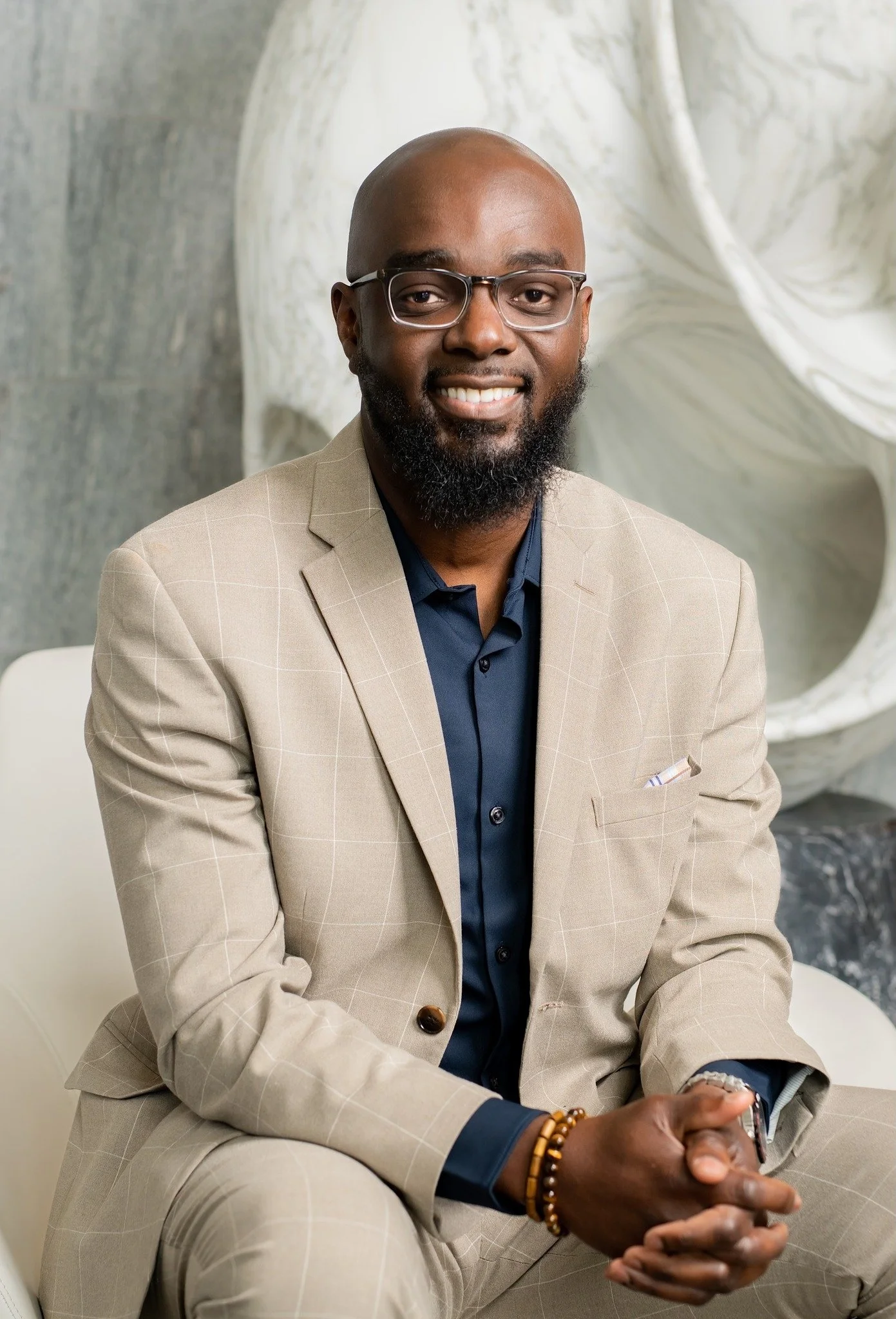
Ep #153 From Burnout to Blueprint:
A Mysa Hus Conversation with Jude Charles
Jude Charles flew in and basically flipped the mic on Mark — and they went deep. This episode of The Curious Builder Podcast isn’t about countertops and cabinet pulls. It’s about burnout, fatherhood, slowing down, and the real emotional “why” behind Mysa Hus. Turns out, the wood-burning fireplace means a little more than Mark thought.
-
Mark D. Williams 00:00
It's a new year, and that means it's time to talk about contractor coalition Summit. We have got an extra event this year, so we've got our Monday night meetup at K biz. That's just a three hour deal at the International Bill of show. It's a great place to meet up at the beginning of May. We are going to be in Denver, Colorado for our first contractor coalition meetup. We're gonna do a standalone event in the middle of September in Minneapolis. It's a one day Crash Course, a much less reduced fee. Tickets are available now if you want that goal here is, it's a significant investment to spend a three four days away from your business and your family, plus just the expense of attending the conference. We wanted to create an event that was just a one day Crash Course. You can find all those details at contractor coalition summit.com. We also, in November, have our three day tail end of the year, which is going to be in Charlotte, South Carolina. So if you're interested in any of those four of events, please head to contractor coalition Summit. Calm. DM me for any information or email me Mark at MD Williams, homes.com, and thanks for tuning in. I was always pursuing this quiet state. Now, a lot of it is because my own personality.
Jude Charles 01:09
Why does that matter to you? Why does it matter to you? I don't want to put words in your mouth, but you love yourself. You love who you are. Of course, don't have an issue with that, right? But you are because you're so aware, so self aware you're chasing the idea of slowing down. Why does that matter to you?
Mark D. Williams 01:24
Though? Probably because I like to do hard things.
Mark D. Williams 01:33
Today on the podcast, we had Jude Charles, straight out of Atlanta, flew in for this interview, and we're gonna do live road mapping. So today's whole episode is really about Mysa, who's from a director's point of view, in trying to get out of me things that I didn't really even know that were there. And so it's a pretty deep episode. I mean, 99% of it is focused on Mysa, who's our spec home here in cottagewood. And one of the things that Jude really challenged me on is, like, what is the why? Like, we know what the what is we know about all the attributes, but, but why? And really, we both have a mutual love of storytelling that's going to come out very strongly in this episode. So buckle up buttercup. You're going to go deep on this one. Without further ado. Here's Jude Charles and Mark Williams diving deep on Mysa, who's Welcome to curious favorite podcast. I'm Mark Williams, your host. Actually, I'm giving up hosting duties today. I have got Jude Charles from Jude Charles co coming in studio. What's up, buddy? What's up? So we've met a couple years ago. You did a docu series with Brad Levitt. You've done a number of other ones, and every time I see you, I just keep finding myself gravitating towards you. And you're like, why don't I come to Minnesota? We were and we're gonna do a live road mapping. Yep. So you're going to take over this podcast. And I think we're we just toured Mysa, who's
Jude Charles 02:45
lovely, lovely. Getting an opportunity. You talk about it all the time. So now I get an opportunity. It's like talking about your kids, yeah. So I want to kind of set the tone for where we're going. We're doing road mapping. You've talked about Mysa, who's it's a brand. It's not just a home that you've created, it's a brand that you've created, and I know that you've seen the Docu series work, and you have always asked me, like, Okay, I know I love storytelling, but like, what would I even do with this if I told a docuseries around it? So normally, when a client thinks about doing docuseries, the first thing we work on is road mapping. Why? Well, road mapping is about alignment, essentially, right? You know where you want to go, you know where you are now, but how do you get there? How do you use those two things, where you are right now and where you want to go, to get you to where you're going? And so road mapping is that we create this story around your vision and then document it, right? But we create the plan. It's kind of like when you're building a home, you need the plan before you could ever build the home. You got to know how many rooms is going to be there, what how many bathrooms? What do they want? How do they live? Same exact thing with road mapping.
Mark D. Williams 03:53
Is that. I mean, is it equivalent? I've always wanted to write a book both. I don't know what I would say, but there's also part of me that wants to write a fiction book. I like sci fi fantasy. It's like, I've always wondered, like, do you wireframe out or roadmap, like, all these characters and all these things, and then you basically create a structure and then fill it in around the story? Yep. I've always wondered how, like, writers write.
Jude Charles 04:12
Well, writers usually will create an outline of like, well, what is this even about? How many characters are going to be in the story? Where are we going to take the story? What's the main plot? Right? So that, again, you don't lose yourself as you're 100 pages in, you don't realize, Oh, I'm kind of off track from where I really wanted to go. Same thing with road mapping. You talked about Brad Levitt project. I filmed that for eight months, and Brad is very much like you. There's a lot of things he has going on. And so without that road mapping piece, we could have filmed a whole lot of content, but not know where this story would go. What did you think? Because I know you've seen Brad's Docu series, what did you think watching it?
Mark D. Williams 04:49
I have a unique it's kind of like watching I mean, he's not actually my brother, but he's my building brother. I mean, we own a business together. I've gotten to know him very well over the last four years. I know a lot of personal. Things that even didn't show up that really added a lot of depth to what I was watching. I watched it as a fan of our industry. So, like, I My perspective is probably different than a lot of others. I just really enjoyed him expressing himself in a way, and Brad's very open. Like, that's the best part about Brad, right from a character's point of view in a film like it makes it very easy for him to just talk authentically about and he's very gifted speaker as well, but it's really just a stream of consciousness. I mean, he's able to deliver which makes him a great spokesperson, of course, and then as he weaves his tail, it draws people in. So I found it entertaining, educational, but to me it was more the humanity. I mean, the part that I liked was there's a lot around his kids and his team. And if you know Brad, you know he has 31 people in his company. When I met him three years ago, was 17, so, I mean, it's almost doubled. And you know, he's a big team first person, so like seeing someone scale and watching them empower their teammates. We just got back from cures builder boot camp, from when we're recording this, it's been, only been five days. Hence, my head cold from being in a airplane for a long time. But the point was, he brought five people on his team. Yeah, that is pretty cool leadership to say that I think this is a lot of value to their personal development as well as my team development. And so I don't know how to articulate better than that, but it just all comes out in that film. And there's more to come, right? I mean, there's more
Jude Charles 06:22
to come, but overall, the goal with that was, you know, Brad does a lot of podcasts, and he does a lot of speaking, as you mentioned, but there was a piece I felt like that was missing, which was Brad the human beyond just the builder. So like, obviously, he has a brad Levitt show, and he's, he's always speaking as a contractor coalition summit, but getting to see him as a dad, and getting to see like, the story that we start with is a story about him having the stroke, right? And like how that affected him, and even how he thought differently about his business because of that, right? It's the human, the human element, right?
Mark D. Williams 06:56
He has his friend and maybe someone who's very open that shares everything, much to my wife chagrin sometimes, is, I don't feel like Brad always shows you all the way the depth to a soul all the time, and I've actually never, this will be the first time he's heard me say this, probably. But like, you know, I don't know if that's deliberate. That's because it could be his personality, and that's just totally fine, right? But like, as his friend, like, I always want to know a little more. I was one a little deeper. And I think the thing that I've enjoyed most about the podcast setting and storytelling is I just like it when people are super real, and some people are very private about it. And there's another gentleman that I won't mention his name because he is very private, and his point being is like he is happy to have these kinds of conversations, but for him, that is between you and I, and I totally respect that I and I just want people to be comfortable wherever they're at. And so I felt like that video showed another layer to Brad, to the people that don't know him. And so for that, I was like, Okay, this is great.
Jude Charles 07:54
Yeah, it's another layer that allows you to realize this person is really human, right? And Brad said the same thing, that he's just not sure sometimes, when are you over sharing? And we are both lovers of storytelling. Story, how I categorize it and define storytelling? It's about a very specific moment in time, but the most important piece is the lesson that you learned in that moment in time. It's like Aesop's Fables. It is, it is, right? So, like, I'll give you an example. 2014 I went to a leadership conference, and I've always known leadership was important to me. This Leadership Conference was in Spokane, Washington, so it's the furthest northeast state, Northwest state. I lived in Florida for furthest southeast state, right? So, northwest, southeast, well, I had this crazy idea, you know, when you go to a conference, you take in all this information, you're writing notes, but then you go back home and it's like none of that even happened, because real life happens at this point. So I had this crazy idea that I would take a Greyhound bus from Northwest.
Mark D. Williams 08:59
This is awesome. Southeast. This is amazing. Just to download all the things you
Jude Charles 09:02
learn to download. Because again, I knew leadership was important. I was 25 years old at the time, and I'm like, You know what? I need to make sure what I just learned actually digest is in my system, so that I don't go back home the same. Because, again, you go to these conferences, you take it in for three days. It's exciting, but then you don't really download it.
Mark D. Williams 09:20
That is such a cool my What up, old soul? Thing to do at 25 at 25 What did you so? Tell me about that. Like, so,
Jude Charles 09:27
how did that get? Was not the smartest idea. Being on a Greyhound bus for three days was miserable. By day two, we got to Chicago, Illinois. Now I had my phone off this whole time. We talked off camera about, you know, having our phones off. And again, it's just one of those things that I'm like, I need to not be connected to anything right now, I had my phone off. We get to day in. Day two, we get to Chicago, and I turn my phone back on. And of course, I'm getting all these I'm flooded with text messages. But there's one text message in particular that sticks out. It's from my sister. She says, Call me back. It's urgent. Now I brace myself, because at this point, this is July 2020 July 2014 at the beginning of the year my mother had attempted suicide, and obviously was still alive. My dad, though had was diagnosed with prostate cancer. So when I get this text message from my sister, it's either mom or dad, so I brace myself, I take a deep breath, and I call her, and she says they found my dad unresponsive in the home. Now I know what that means. They won't tell me, because I'm on the road, that means that he's passed away. I take the first flight from Chicago, Illinois to Fort Lauderdale, Florida, back home, and when I land, my brother comes to pick me up with his daughter, my niece, Ian, I hug my brother, I don't say a word. I hug my niece, and I don't say a word, but I sit in the back seat with my niece, Ian, she's nine years old at the time. I'm 25 I'm staring out the window as we drive to my father's house, and I'm thinking to myself, you know, I feel really lost right now. I'm 25 the youngest of 10 children, so my dad would never get to see me get married. Have kids. Never imagined I would even lose him at this point. And Ian, who's only nine years old, looks over at me, and she's like, Uncle, why did grandpa have to die? And I just stare at her because I don't know how to answer. A nine years old, a nine years old, a nine year old, first time going through death, she says it again. Why did grandpa have to die? That question rang in my ear as we're making funeral arrangements, trying to decide what to do with his things, and I got the answer. August 9, 2014 as we went to go lay my father to rest, my family asked me the youngest of 10 to give my father's eulogy. How old was the oldest child? So she's 19 years older than me, so in her 40s, right? Like I'm not the oldest at all, right? I'm not the oldest male even. But I learned in that moment going through that that leadership wasn't just important, it was leading through difficult moments earlier I told you that my purpose I figured out early in life. It was at that moment I figured out that my purpose is to lead and empower entrepreneurs to have relentless courage. Why that's so critical is because I realize entrepreneurs that I work with are coming to me a very critical moments in their life where they need to have a little bit more courage to show up, to tell their story in a different way that allows them to get to that next level. So why did I go down that route? I just told you that whole entire story, right? I told you about a very specific moment in time that my dad, I lost my dad, but I told you about the lesson I learned in that moment in time that was so critical for me. It's a very deep story, right? It's a very intimate, vulnerable story. And it's stories like that that people think about, should I share that? Like, what's the point of me sharing that? For me, the point is one for people to get to know me, but two to realize I know my why. I know my purpose. Now, normally, in road mapping, I start with that story, and at the end I'll say, Well, I told you why I know I exist. I told you why I know why I'm here. But you tell me, why did you invest in doing this road mapping session? You're going to spend three hours with me going this deep. Why did you decide to bring me in this room? Story is about a very specific moment in time, and the lesson you learned in that moment in time. The lesson is what people remember, but the story is what makes it matter. Now I want to use that to open up with with our road mapping session for me. So who's? Because I've been listening to you talk about me, see who's for a year now, I'm sorry, after contractor coalition summit, the last one in Chicago, you sent me a bunch of information on me. So use, Oh,
Mark D. Williams 13:53
we did the present. Were you there the day? We did the bonders create freedom? Did? Yeah, the me. So use one with Nick for now, yep,
Jude Charles 13:59
I saw the one with the Nick. S, Oh, you didn't see the night before. You have done podcasts on Mysa, who's with Melissa and with the one most recent Drew, right? You've talked a lot about Mysa, who's and here's where I really want to challenge you. And I want to know the story behind me, see who's beyond the tactical why. I want to know the emotional why. Because you've hinted at it, but you haven't really gone deep into the emotional why of MYSA who's for you. And it might be, I don't want to put words in your mouth, but it might be because you feel like, oh, that's just too much to share. You hint that's definitely not I'll share anything, but you hint at it, but you don't really go deep into it. I think a
Mark D. Williams 14:38
lot of times people don't. I mean, Mysa, who's is interesting. I can tell you the whole story. We can we can dive into it here in a minute. I think, for me, as I know I'm a creative person in certain respects, and not like I look at someone like a drew Beason who can do art like I can't do art. I guess I'm a creative thinker, because I'm always thinking like I can't stop thinking of new businesses. I joke that I. I create five businesses between Monday and Wednesday and then Thursday and Friday. Have to tell myself No, and so I'm constantly coming. I like that iteration. I love the dream state. I love forward thinking, and when I get really excited, I the easiest person to sell is the guy in the mirror. I nobody can sell that guy like me, and he believes most of the things I tell him, poor guy, and so. But a lot of times I don't know my why, and I it's kind of a journey of self discovery. It's a little bit, honestly, I'm much better at ad libbing than I am at planning. So if I have to do a podcast with someone where I or even, like, ad reading, like, I don't have any aspirations to be an actor, but, like, if I had to memorize a script, I'd be bad. You know, who's good at it? Brad Levitt is amazing at memorizing scripts. I'm terrible. But you tell me to talk about anything and leave it open. I mean, I can, I can shoot with wider I can go all day long, right? And so, but part of it is I'm sort of discovering how I think about it. I think out loud, okay? And so I don't spend a lot of time in deep meditation. That's why I go to bed in four minutes every night, like I'm out like I just don't that's not actually a challenge for me. In one of the things that we did at Boot Camp is to have an hour of silent journaling. I did that because that's the hardest thing for me to do, for me to sit still, for me to be quiet with my thoughts. It's not that I don't enjoy it. I just don't know why anyone does it. And so it's more just like it's way easier for me to have a conversation with somebody, and I've practiced a little bit on the podcast and monologuing, and I can do it, I just I don't enjoy it nearly as much as I like having a conversation. But back to the why for me, it's like I sort of enjoy the self discovery of figuring out my why while I'm talking my one of my dad jokes is, I like to know. I like to finish what I'm saying, because I want to know what I'm gonna say too. Like There literally is no forethought and what I'm going to say, which makes it pure, but also can lead to mistakes
Jude Charles 16:43
too, right? When you How long has it been that you've been that you created me, see, who's How long has it been?
Mark D. Williams 16:48
Two years? I mean, if I want to get really philosophical, my whole life, but it's it really started. I mean, the origin story is I haven't done a spec home in 16 years. I did a spec home in 2008 right before the stock market crashed, and I was only three years into building. And luckily, I didn't have much to lose, because I didn't have much and so, I mean, I rented out my couch. I slept on the floor. I remember my dad. I've told the story many times. I'll keep this one short, because people can go back and listen to it, but my dad was kind of the first person who told me that failure is not a bad word. Like, like, as soon as that, like, you know, think of a trapeze artist where the net is taken away, where, like, the fear of failure is gone. That's really when my career took off. And I remember, I remember I asked my dad for money, and no one really wants to ask their parents for money because it's uncomfortable. You like, you want to make your business yourself. You think that if you go bankrupt, you're failing. And so for me, the I'm have so much respect for my dad. Someday, I hope to be able to do that if my kids ask, because having a kid look up to you and then and saying no to them when they're in their moment of need, it's got to be a really difficult choice or decision. And But anyway, he said, famously, he said no, because I asked him for $30,000 back in 2008 and he said no, because if you can't fix the problem, the ship's gonna sink anyway. So you got to fix the ship, you got to plug the holes. And he said, and then he this, I love this. He goes, What's the worst case scenario? So I'm what? 25 at the time, 26 whatever. No, 28 and I said, Well, I don't know. I guess bankrupt. He goes, and what's so bad about that? And it's like, I don't know. I thought is that bad? He's like, I don't know. Is it? And he's like, you're gonna, you're gonna, you're gonna sell your house, you'll move home, you'll sleep in the basement. Your mom's gonna make you, you know, Swedish pancakes. And I'm like, oh, that sounds pretty good. So anyway, I say that because it's kind of humorous. But I think when we get a perspective, like, what failures, the reason bringing it up now, it had been six that when you that's the only house in my career I've lost money on. And so fast forward 16 years. I have this lot in Cottage which, which is just five minutes from my office. We had actually had the property sold twice. We won't go into that story. Both of those fell through, and I'm stuck with this beautiful piece of property. I've designed two homes for other people on it. And I thought, and I thought, You know what? What would happen if I entertain this idea of building a spec home? And the reason I'm not good at building a spectrum, or what I tell myself, why I'm not good is I do things too nice and I fall in love with the project, so I lose sight of the marketplace, so I can over invest. And I'm certainly not the first builder to do this, but that's the main reason why I haven't done spec homes in 16 years, because, but at the same time, after I'm now in my 22nd year of building like, I'm really good builder at what we do. We have amazing team. Like, if I'm building your house, Jude, like, I will kill it. Like, we do such a good job of really getting into you, understanding your story, pulling it into the house, and that's a really crucial piece. But I felt that if, and this is just for my opinion, there's other builders that do a good job at this, but I didn't want to just build a vanilla house, because that's not interesting to me. It's not exciting, like, I don't want to buy it, why? I know I can sell something if I'm excited about it, but if I'm not excited about it, how I can't fake it, like I'm just, I'm just, I am what I my emotions are right there for everybody to see. So if I need to be, like, in love with this house, and so for me, I needed a story, and that's something to cure. Builder taught me. So this is kind of all kind of a story that's sort of woven into Mysa house. And so I sat down, I knew that, like, branding is really important. I had considered rebranding Mark Williams custom homes because just a mouth fill, nobody tells you when you're 23 don't name the company after yourself. I'm like, Oh, great. It doesn't fit on signs. It doesn't fit on anything. Maybe a semi trailer. And so because I'm not in trucking, so when I was going through that experience, that's really what led me to the curious builder. And then my life just could dramatically change in my career too, based on that knowledge. And so I think it was just all these past experiences sort of led up to what would become Mysa, who's I took all the things that I'd learned from the curious builder in terms of branding, relationships, storytelling, and it came in. So before I even started a house, before I came up with the floor plan, I'd even look at demographics of what would sell, I met with a brand strategist, and Molly windmiller Is her name, and I and she had helped me with curious builder and boot camp and these other things that I'm doing. And I said, Molly, here's what I want to do. You know, I'm a Scandinavian mutt, you know, my I've got Lindquist and Luckies, you know, which is totally Scandinavian names, but, you know, I'm German and Swiss and all these other things. And not that it has to identify with a specific country, but like, I'm Nordic. Look at me. So like, I love sauna, I love the culture, I love the simplicity, I love nature. I love mountains. I want this to have a and I, like, I was very aware of, like, branding and storytelling, like, I wanted this house to embody all these natural things that I get energy from. And so, I said, so she said, Tell me what you want. And this next sentence is really all of what happened to me. Sous is, is how I describe this. She said, What do you want this house to feel? I said, I gravitate towards natural sunlight. It's It's six o'clock in the morning. The sun is rising. It's cold. The snowflakes are falling. I have a hot cup of cocoa in my hand, or coffee. I've got a wool blanket over me. I'm reading my Bible or a book. I'm looking out, and it's just quiet in the snow is just falling. And she's like, that's Mysa, who's that's what it is. And so I so we didn't know what Mysa meant at that time, but I said, That's what I want this house to feel like. We talked about Maya angelou's famous quote. My wife uses it all the time. Maya Angelou is gonna have to copyright my wife pretty soon. About people forget what you say, but they never forget how you made them feel. And our homes have done that for a long time. Mysa, who's is gonna do that on a level I can't even imagine.
Jude Charles 22:20
What's the moment that MYSA, who's brings you back to when you were growing up like as you walked through that so you gave me a tour earlier today, right? And that's this, is why I say you hint at it, because you told this one specific story before. I don't know that it's the why story, but you've told this one specific story before on a different episode, and you told it today as you were giving me the tour. What is the moment that you go back to when you're walking through me? Suz, I don't even
Mark D. Williams 22:50
know what the story is actually. I'm curious what you think it is. I if I was to think I've never thought about it in this term before, but right now, we had a cabin in Glacier Park, Montana for 25 years, and out the outdoors have been a big part of my life, you know, skiing and hiking and out Ultra running and all these things. And like, when we sat in the front yard at Mysa, who's I had that cool timber, and it has the the sign, like a trailhead sign in Europe, where you have, like, this wood sign pointing to, like I did it all kilometers, because Mysa house is, you know, Scandinavian. So I was like, Hey, it's 6300 kilometers to Stockholm, Sweden, or Glacier Park, was on there, oddly enough, and then it's in the colors of the Swedish flag. And so for me, I love being I wanted to create a I want a home that's urban. I mean, we're in an urban city setting, if you will, a neighborhood. But I wanted a cabin experience, I guess at the end of the day. I wanted that quiet, off the grid, complete detachment from Soraya, that serenity, it's so hard to get that, that full peace and quiet, where your mind is calm, there's no there's nothing drawing on your time. Or that's why that morning is so important to me, in that those quiet moments, you know, Melissa calls them moments of delight. And so I wanted the house to embody all of that and all the things that we ended up sort of the philosophy of, like picking we didn't stumble into wellness till about six months into Mysa, who's we can talk about that maybe a little bit. But for me, it was I wanted like I was going up to a cabin in northern Minnesota, off the grid, no phones, like just a silent retreat. And family is super important to me. I grew up without a TV. My grandparent or my parents did as well. And until just a year or two ago, we didn't even have one in our home, and now we just do Friday Night Movie Night, which is fine. I only give that up for perspective because the first house ever built, I forgot to put a TV in it. I almost couldn't sell the house, because my lifestyle is not how most people live. I'm sure I have undiagnosed ADHD. I have and joke about it, I don't have a TV not for moral reasons or any of that stuff. Maybe that's how it was a choice for like, my parents generation, but for my generation, I don't like the distractions. I want to read a book. I want to do a puzzle with my kids. I want to play a game of chess. I want to I just I need that quiet to recharge. And so Mysa, who's this kind of this? I. Uh, this melting pot of all these different emotions and things that give me so much joy in all these wonderful because I am the archetype of the of the home as well. Because, as I mentioned, though I haven't mentioned it yet, but like for me, I felt like, if I build a house for everybody, I build a house for nobody. In the hardest thing to do is have a blank sheet of paper and say, draw me a house. Well, it could be everything. Could be a two story. It could be a sing. Could be a single it could be and so I wanted a philosophy that would dictate my selections, because I didn't have a client. And I'm certain many builders have built a home for themselves, of course. And that's a very successful tactic, and I am very it is. There's a lot of leaders, Ian, huge amount of me in it, of course. But the philosophy is, a different sort of, like, a very, more purified version of what I find valuable.
Jude Charles 25:46
Yeah, so there's the philosophy, there's the you're really great at telling me the philosophy. You're really great at telling me the what I want to know, the why, when you walked it through. This is the story, and I didn't want to give it to you, but this is the story, because I want you to bring how often do people know the why you do, you do, but I think you It's like what you said earlier. Sometimes you don't talk it out loud, so you don't realize that's the why. When you walked me through the House earlier today, there was, and you've told this story on a podcast before, but it was the fireplace. It brings you back to that moment that you were passing your dad wood through the window, right? What about that moment was so special to you that you had to create, recreate that moment in this
Mark D. Williams 26:29
home. That's a great that's a great point. This
Mark D. Williams 26:37
episode is brought to you by Pella. Windows and doors. I've used Pella for 21 years as the exclusive window company on every one of my builds. When people ask me who I trust for windows and doors, it's Pella every time. Their craftsmanship, their innovation, the top tier service, make them a no brainer for any custom home builder or designer who demand the best, whether you're designing something bold or building something with timeless elegance, Pella has you covered. They're also the only window company that has a lifetime warranty on all of their windows. I've gotten to know all their people at Pella corporate, as well as locally. Here at Pella Northland, I'm proud to call them our partners and our friends. Visit pella.com to learn more and connect with your local reps today. Also for more information, you can listen to episode one, where I interview their founders, as well as episode 109 where we talk about the innovation at Pella, so to frame it for the audience that doesn't know. So when we, when we got into so the house had multiple levers were sort of unlocked into new avenues, the wellness, once I stumbled upon, like wellness, it's a huge part of my natural personal life, and I didn't, it wasn't part of MYSA, who's originally it was about four or five months into the branding, and me talking about it, I iterate out loud, and as I'm getting into it, there was something missing. I felt like there was a burr in the mechanics. There was just something that was just not working. And when we hit wellness, the whole thing unlocked. It was just like yellow brick road all the way here we go. And that's really when things started, really galvanizing quickly. But the reason I'm bringing it up is Carl, who's the architectural designer on he's also my neighbor, and Carl's The reason I got into Ultra running, and so he was the perfect partner on this project, because so much of about wellness is our lifestyles. We bike together, we run together. And so he's so talented, and so all these different things are just, it's just like, you can't even make up the story, just like evolves. So that was the way perfectly. And so we, I could not land the plane on this fireplace, and it was gas or wood, and I must have chosen five different wood fireplaces and five different gas fireplaces. And when we went into wellness, I thought a lot about what we breathe in last summer, we had a ton of Canadian smoke, fire, and it was like, you know, I was just marveling, like, man, what we breathe I'm amazed at how incredible our lungs are to process all this stuff. And so I was thinking, like, in a house that is really tight, one things that often happens with a wood burning fireplace is they Backdraft, and you get that black soot on the front. I mean, that's that's carbon monoxide, that's poison, like, I don't want that in my air, especially if I'm going to make this house about wellness. I was thinking about it in terms of health, and Carl unlocked this for me. He said I told them the story that when I was a little kid, we had a home with a wood burning fireplace. My dad is basically unregistered Pyro and love to burn everything. And so every winter he would be outside in a snowmobile suit, in this orange sled that would be stacked, you know, six feet high and eight feet long. He'd pull it from the wood pile, and I would be inside. Part of my chores to work with that would be, I would grab the logs through the window, and then I would put them in the in the wood box, and I'd sweep up the floor. And it was this, I'm very close to my dad, and I have 1000s of stories, but this is one. I don't know why. It just was just so clear and and when I told this story to Carl, he looked at me like, Can you not hear what you're saying right now? He's like, do you think that wellness might also be more than health like? Wellness might be a state of being like. Wellness might be a. A memory well, and so when he and he's very philosophical, and sometimes I need to be hit with a philosophical hammer to be like, Oh yeah, okay, this is now the easiest decision I've ever made. It's a wood burger fireplace. Let's go. And that is the story. So I mentioned before, we're gonna do like a little audio tour. These little elves are gonna be holding these little q, q, r codes. And I record a podcast like this with three minutes or less, and we're gonna have them around the house for these moments of delight so that other people can hear this story. Because it takes me sometimes a little time to get into the story. I'll have to truncate it up a little bit. But anyway, so now this house has a place where some other family member can hand wood through the window. They can fill this cool metal lined box and then fill up the wood burner. And there is something deliberate, starting a wood fire for sure, takes longer, but I think that's the point of this house is to slow people down a little bit.
Jude Charles 30:48
Why does that matter to you? So I agree with Carl that wellness is definitely more than just health for you, I think it is a state of being, but I'd like to hear more about why. What was it about that moment with your dad that stays in your mind about slowing things down?
Mark D. Williams 31:10
Probably because slowing things down is the hardest thing for me to do this house, in this lifestyle, is something that I need. You asked me, it actually goes to marriage a little bit you asked me, I've been married for 13 plus years, and you asked me, What is the secret of marriage? And I stumbled around because I don't know the answer, but just shared a bunch of experiences. But you know, I'm a better person because of my spouse 100% I wonder if she said to say, what she would say the same thing. I don't know. But the point being is, like I a lot of the things that now I talk about on the podcast in boot camp and Sonic camp and all these things really stem from my relationship with my wife in the sense that I'm very flexible, like right now, if you said, Hey, let's get let's stop this podcast and come back in an hour. Great, no problem. I could roll with it. And so, like the laissez faire works well with my personality and the ad lib version of it, my wife is much more structured. Family Time is super important to me as it is to her, and so I've talked about this a lot, so I'll just reiterate real quickly, like I'm home every day at five because we have dinner at 530 I don't open up my computer again till I get to the office the next day, usually around 830 I think it's unhealthy to constantly on call to your clients, into your team. I just don't think it's sustainable as a culture, as a society, and for sure, myself. So my wife has has helped me get quieter the home. Mysa is sort of embodies some of those principles. Brad Robinson, who we have joint friends with. You know, a year ago at Ian Nash at boot camp, we both joint made a promise that we were gonna leave our phones downstairs so it doesn't even come into our bedroom. I actually had this funny story about Mysa, who is where, I wanted to know if I could click a button in, like a Faraday cage and lock the house down. And I thought I had just stumbled on, like, the next billion dollar idea. I thought this idea, I'm gonna patent it. Parents and people across the world are gonna want this idea. And, you know, I'm gonna make more money with this patent that I could ever make in the home building. Well, turns out it's a federal offense and it's illegal. You can't do it. People save that for another type. But anyway, the point I was always pursuing this quiet state. Now, a lot of it is because my own personality.
Jude Charles 33:05
Why does that matter to you? Why does it matter to you? I don't want to put words in your mouth, but you love yourself. You love who you are. Of course, don't have an issue with that, right? But you are because you're so aware, so self aware. You're chasing the you're chasing the idea of slowing down. Why does that matter to you?
Mark D. Williams 33:21
Though? Probably because I like to do hard things. I don't run ultra marathon distances because it's easy. I do it because it's a challenge. I sort of like, I don't know there i My dad, we have a family quote, and my dad's quote is, and now it's become mine. Is we're comfortable being uncomfortable in that in more like pain tolerance and like your ability to suffer. Maybe that's masochistic. I have no idea why, but we smile while we're doing it, so I don't know what to do about that. I know that I'm better when I have that time to recharge. It's not easy for me to do it. I have to my favorite quote the last couple years has been boundaries create freedom. And the point like you can't wake up at 430 in the morning if you don't go to bed early, but just or you're just gonna crack it's not gonna work. And so what is sustainable? And so as I keep getting older, and I am around amazing people, or I talk to other people, or I just discover things about myself, like there's freedom in those, some of those constraints. And so I would love nothing more than to come home and put all of our phones in like a Faraday box and did not touch them again until the next day. I understand that's probably not reasonable to a certain level, but I do think there's a lot of value in the world that keeps getting spinning faster and faster and faster. I don't think it's good. And even if we can handle it and we adapt to it, which we certainly do, we have to take preventative measures to sort of slow life down and enjoy the moment. And I tend if someone was to ask me, How much time do you spend looking in the future? How much time do you spend in the past, and how much do you spend in the present? I spend zero time in the past. Like zero I mentioned, like, I don't really have regret. Not that I shouldn't have regrets. I just I give it no, I can't do anything about it. So I don't spend any time there. I spend a lot of time in the future. I love dreaming. Airplanes are like, my airplanes and airports are like, one of my favorite places on the planet, because it's like, with a credit card and passport, I could go anywhere I want in the world right now. And I like that freedom of like, I use that as an analogy because I think it's true of life like I love the future state, I need help being present. And so I think by getting rid of these distractions and MYSA, who sort of helps people and hope, I hope, helps a family, helps me, even in talking about it, do that for myself, because
Jude Charles 35:36
when you're present, when you're present in the moment, what happens? What happens to you when you're present?
Mark D. Williams 35:42
What are I slow down? I mean, I stopped writing, I stopped dreaming, I stopped doing to do lists. I stopped creating new businesses. I can read
Jude Charles 35:50
a book in quiet. How do you feel, though, when you slow down like that? How do
Mark D. Williams 35:54
you call I mean, it's calming. It's very calming. It's kind of like a Zen, a Zen state, like honestly, probably one of the hardest things for me to do, because I'm so active and I like to move like you talked about how when you take your time off like you like to go wander the forest, this would be, actually, this sounds painful to do is I wonder if I could sit like at a place alone for like, a day, an hour. I don't know how far I could go, probably not very long, because a it's hard. And so what I've done now is, when I run, I don't have music, or I had sometimes I do a course, but now I find that that's that free. I get all these ideas. I get very rejuvenated, but I have to put them in place. Otherwise, I'll default to, you know, what my something to distract myself
Jude Charles 36:37
with, right? When you were in high school, so you told me about, how old were you when you with the fireplace? You were probably, what, eight or nine years old. Yeah, so when you were in high school, what's a, what's a core memory you have of you and your dad in high school?
Mark D. Williams 36:49
Oh, wow. Remember playing catch by we had a little lake, and so we would play catch, and we just, you know, throw the baseball to each other. That's a kind of a, I don't know. I just remember him squatting with a catcher's mitt and me pitching. I never even got into baseball. That's just the first thing I thought of was that we spent a lot of time hiking and skiing in mountains together. That was something dad's wood shop. Actually, this story is really funny, one of my core memories, mainly because it's so ridiculous. Actually. This actually sums up our whole family personality very succinctly. So my dad was a builder and had a wood shop in his basement. And Don can't remember his last name. He back then a custom home was a round top window. That was it, because nobody could you could build round top windows back then, they had to be done by hand. So if you built with David Williams, you got a round top window. And that was like, Whoa, custom. So anyway, we had this cool wood shop. And my dad's always putzing around building stuff. He's very he'll tell you that he's not a great woodworker, but he's constantly woodworking, which is what anyone who's good at something says. Anyway, he said that Don taught him how to think, and he enjoyed my dad was a pilot, and he loved thinking about stuff, and like how to get from A to B. So anyway, we go down in this wood shop. I think I was six or seven, so my sister's two years younger, so she's five or whatever. And dad gets three cigarettes, one for him, one for me, and one for Ashley, gets them all lit up and puts them all in her mouth. And we're like, what is this? And he's like, these are called cigarettes. And he's like, take a deep breath and swallow. My sister pukes. I start hacking. We've never touched a cigarette since. The point is, is, like, am I'm saying this story that's a core memory, because I've told it many times. I think it's really funny. I joke with dad now that he either would have had chain smokers as kids or, like, what happened happened? But like, I think sometimes we, our family, just does things not for shock reaction. Like, there's a pure, innocent and then pure joy of just like most people say, that's terrible idea. I'm not telling anyone listening to this podcast. Like, go light it up for your kids. You for your kids. It has crossed my mind whether try on my own kids, though, although I don't think I would, but I think trying stuff and failing, like just being creative, being just going for it, doing. I think our dad taught us to just be really, don't worry about what other people think about what you do, like if you're happy with it, if you have peace with it and it brings you joy, that's probably a noble pursuit.
Jude Charles 39:04
So that was six seven. Wait, that was when you were 67 Tell me about your making reference to six seven. Tell me about high school, though. Tell me about high school. What do you remember about home and family life in high school?
Mark D. Williams 39:19
I remember, and this is viewed now as a business owner and a dad, I remember calling my mom and dad and thanking them for just an amazing childhood. You don't realize. You just think your childhood is your childhood. Everyone has the same childhood because you don't know any different, right? And then as you get older, you're like, wow, I had a very special childhood, and it's actually informed what how my wife and I want to raise our kids in two things. If we can do just two things for our children, we will both feel like we've been successful parents. One is that they feel loved and that we love them. Number two is that we instill confidence in them, and where that came from is like my wife says, you are just unnaturally happy at. It gets your Scandinavian upbringing, but like my wife or sorry, my mom is very optimistic, and she's probably even more cheery and rosy than I am, and my dad is very optimistic as well. My wife her confidence. She struggles with her confidence, and part of it, I'm sure it was her upbringing. Part of it is self doubt, like any of us may or may not experience, and so she feels that a lot of my happiness is tied to my confidence. And confidence can be tricky. I mean, you can put yourself in dangerous situations by being overconfident, so you got to temper everything. But I just thought, as a parent, could you teach your kid that you love them and that they feel loved in that confidence? And so I felt like that was my entire childhood, and I've had a number of my friends that have you know over the years and family that are just like, you don't know any different. And they would just say, Do you realize what a special gift you have? And you're like, No, I have no idea, because I these are my only parents I've ever had, and so I I've thanked them as I've gotten older countless times. And I bring that up, it's like, it's the little things. It's I used to play chess with my dad. We'd play one game, and I'd beat him, and I'd say, you want to play game? He said, no one is enough. And so we would play chess together. My they were always at every sporting event we ever did. So I don't ever remember my dad working, which is really interesting. We had that was before emails and cell phones and all those things. But so we had an office on our property, and Dad would meet people. He must have like we were always had dinner as a family, and then it must have been when we were doing homework or whatever. He must have gone, you know, 100 yards to the office and met people at night, because that's what you did back in the 80s and 90s. Yeah, but I remember my dad always being available, and always when we had a question, he would always stop, and he always had time for us. But we just spent so much time together. I mean, again, hiking and skiing and vacations and things together, he always invited us into whatever he was doing. I think that was something I've learned deeply is, you know, even now, when my kids come, like I've had, may interview me on podcast. And so just, I mean, I don't know if anyone wants to listen to that, but I sure enjoy it. And so I think just, I don't need them to grow up super fast, but they can be part of my life, like explain to them. I've kind of came up this idea that whatever my kids ask me, I will tell them the honest answer, because my parents did the same thing. And so actually, the other day, yeah, we had quite the conversation on the way, they were sick, so they got to come to the office, and weren't they? Actually, I think sometimes fake being sick because I have a bunch of Legos here, and my boys love doing Legos, and so whatever my dad did, he included us. So I guess I don't have a specific like memory that comes to mind right now, but I remember, I mean, I guess now I think about training. He wanted to climb Mount McKinley up in Alaska. I think it's called Denali now, and he trained. I remember him in the middle of winter having a green backpack on, and he load it with 240 pound salt bags, you know, like you put your water softener. And he just walked around her late for like hours and and so again, he would, he was demonstrating to us, like, commitment objective. So even at a young age, we saw, we saw it being modeled of just like, if you want to do something, the only whole person holding you accountable is really yourself. And so, like, if you hold yourself accountable, you can do anything you want. Yeah, and
Jude Charles 43:05
so when, so far, we've talked about we've talked about marriage, we've talked about your upbringing, we talked about this core memory with the fireplace. Do you as you're creating misos, and these philosophies are coming out as people are interviewing you and asking you questions on like, what matters to you, wellness is a state of being, but is it also for you, what love and confidence represents that you got from your childhood because you mentioned how much you've appreciated how your parents raised you, but a lot of how they raised you was in that Home, was the time that they spent with you. Do you feel like you're trying to recreate, in some ways, your childhood in the home itself, the home itself?
Mark D. Williams 43:47
Yeah, I think, for sure, I think big, I mean, a big part of just me. Because obviously, as I've, you know, aged and, you know, I guess I'm in 45 I guess I'm in middle age, adulthood, I still feel like a nine year old kid with a bouncy ball at a park, sort of throwing it to myself against the wall, but yeah, I mean everywhere I look in the house. I mean, I even mentioned to you the reason that that dining room Nook is the way it is is because I took myself and like, okay, if I'm up early in the morning reading the paper, having coffee, I want to sit in like a breakfast nook. I've always wanted a breakfast nook in my own home, and we didn't have enough room in this house. And I didn't want the house. I wanted the house. The other thing is, I didn't want the house to get too big. You know, we live in 3000 square feet. I'm a family of five. Our culture like more more, more, more more. And so it was a very deliberate choice to actually put some constraints on Mysa, who's it's odd enough that the cost goes up when you go smaller sometimes, because now you're like, oh, now I'm gonna put more detail into it. But anyway, there's little there's little pieces in the house that have a story, you know, that was another one of them. And I remember my, you know, maybe that I didn't think about it till just now. But like, you know, every morning, why to wake up? My dad was a very early riser, and so, you know, he would be. I always remember him reading his Bible by the lake. Nose with a light on want to come down in the morning for school. And that was just a childhood memory I always saw, I guess I'd be fun to ask him, like, what age did he start doing that? Because now that I go to bed so early I wake up, it's like, every year I wake up a half hour earlier. Like, two years ago, I was to wake up at like 530 right now I'm waking up at like 423 not by choice. It just keeps at some point I going to bed at like, 5pm and waking up at 1am I don't know what's wrong with me, but I love those early, quiet morning hours, mainly because it doesn't take away from from Kid time. So like all the training I do for running or with the guys that I train with, it's like, you know, I'm home at seven. Because every day I take the I wake up the kids, brush their teeth, get them ready for school, so they don't really know that I'm training. It doesn't really impact them at all. Take them to school. I pick them up from school, and so, yeah, I don't know if I answered the question, but there you go.
Jude Charles 45:47
Well, I asked you if you're you're trying to recreate your childhood, but what I'm hearing is like these moments mattered to you. These were moments that you paid attention to, whether it was handing your father wood, whether it was watching him down in the wood shop basement, whether it was him waking up early to read his Bible, and you're you're recreating these moments in MYSA, who's we're getting to the core of why. Why does all of that matter to you? Like you said earlier, slowing down. But what is it that matters to you so much about slowing down? That is become a philosophy of the MYSA who's house, or the MYSA who's project.
Mark D. Williams 46:25
I think this represents, I mean, the house represents all these things that have meant a lot to me. I mean, essentially, Mysa could be mark. I mean, now I think about it, when you say it that way, I mean, like, literally, the house is me, or what I should say, what I aspire to, because I'm obviously not all those things all the time, but I would like to that's a it's aspirational in the I think home builders in general are aspirational. So we're designers like we are creating spaces that we aspire to help people live a better whatever their values are. We hope to create a space that they can have their best lives, their best memories. And so we're very aware of that. I think, as a I hope we are as home builders, as remodelers. In the we affect people's homes, it's super intimate. You know, a lot of times on the podcast we we talk about the things we struggle with meaning, like, you know, difficult homeowners, or difficult situations, or just liquidity and finances and all these things that every entrepreneur has to deal with. But the flip side of it is home building is so emotional in a good way. And like, you know, I've seen people cry. I've seen people, you know, you walked in, you know, outside of our studio here, I've got, you know, 20 Christmas cards. Half of those cards have pictures of them, of those families in their homes. And it's really, I don't know a home builder that wouldn't look at a Christmas card if they see that family in the home that they built. Wouldn't feel something, you know in their heart, like I had a I had a part to play in that family's life. They might never know what the kids might sometimes they have kids, obviously, after you have have built their homes, and so I don't know, we impact people more profoundly than most industries.
Jude Charles 47:56
Do you feel like you're okay? So if someone you're gonna eventually sell this house? Yes, is Mysa, who's making a bigger impact, not taking anything away from the clients you've already built homes for. But this is your personal thesis of life that is implanted in this home. Do you feel like you're making a bigger impact with Mysa, who's
Mark D. Williams 48:20
great question. I do like your statement there. That's my personal thesis. It is, I hope someone else also wants that personal thesis, right? Because there's always the danger that you built something that somebody doesn't want. I mean, if you go too extreme, you know what? If you had a room with no bedroom, so you're, like, we believe in communal sleep, like, I mean, honestly, you go to, like, Native American culture, they had a giant teepee, and you all slept. You know, in fact, this is actually funny. One of the gentlemen that came on curious builder boot camp the second time, on the first time, when we went to Ian, we had the glamping situation. We had all these individual tents. He thought we were all gonna sleep in one tent together. I'm like, I'm impressed you paid $5,000 to come to this thing. You were all gonna bunk up with each other, buddy. But we have anyway. I'm saying that is, like, I think you still have to be mindful of the market. Like, I'm still like, I'm still, well, I'm not, I don't feel like, historically, I've been great at it. Yeah, I'm better at creating something that's artistic and an expression that's really unique. And I was so dialed in under the story, because I feel like the I don't ever want to talk about price. I don't want to talk about even product, although it sounds like I'm good at talking about those, I want to talk about the story because I feel like the story, the goal is that you by sharing so much that's so personal, it's gonna latch one of those stories, hopefully put some hooks into your heart, and you're like, I cannot live another day without being in this home and having whatever aspirations that family wants. I do. Think I'm just a better storyteller today than I was five years ago. I'm a better builder today, too. That being said, we've done really good work for a long period of time. So a lot of the things that we're doing in business, we've done for a decade or more, and it's just I'm better at telling about talking about it now. And so I think the other thing too is it's sort of freeing the idea with. To have the philosophy, the filter of MYSA who's and we're still developing. I mean, the other thing is, it's still iterating. Literally, about every 30 days, I'll get a new idea and it'll somehow we're not done iterating on what Mysa who's is, and that has been why I'm so excited about it, yeah, is because when you're with something that's live and evolving and changing. I mean, it's, I joked today when I left, like I patted it, like it was a little kid, like, it's literally, like, watching, you know, a kid like, grow and change and like, I look back even a year ago at, you know, Simon, I'm like, wow, has he changed in the year, my middle son and so, how
Jude Charles 50:30
have you changed? How it's working on these issues? Good question.
Mark D. Williams 50:35
I'm not sure I want to build a house again that doesn't have a story. I We're excited to announce that we're bringing back Sonic camp 2.0 on March 20, from two to 8pm we had this last year. We had 42 owners. This year, we're maxing out the capacity of the camp, which is going to be 60 people. We're going to have a wellness panel with some Everest summiters, as well as some iron men and women to compete, and all about wellness and how they prioritize their health and wellness, not only in training, but in their lifestyles and in their business. And then we're gonna have a two hour window of sauna and cold plunging in the lake, and then an amazing wood fired grill, Mediterranean style food at the end of that. So if you're interested, please head to curious builder.com under retreats, you'll find everything there is about sauna camp on March 20 in Minnesota. I want to do. I already have my next idea, actually, not surprising. And so I like, I like. I really have enjoyed the journey of creating something that's unique and that has a wonderful story to share. I love collaboration. It's building any entrepreneur. It feels lonely, and so that's one of the reasons why I gravitated so strongly to the contractor coalition's Summit and the podcast and all these things that I'm doing now. I just feel like I've sort of sort of just exploded in my trajectory in terms of, like, what is possible. Because I thought my head was so down. I thought, like, Hey, I'm in Minnesota. I'm just a little builder, and I am, but like, the idea that just a little tiny pebble can have a actually, a huge ripple effect on a pond. And so I think now, as I look up and just sharing, sharing our story, sharing what's exciting, it to me, it's at the underlying its passion. And I think when you just are so passionate about something. How can you not? I don't if you're anybody that's passionate about anything, you'll listen to it. Like, when you're when my kids come home and talk about this terribly colored drawing, but they're so worked up about it, like, you've got my attention, like you didn't hit one single line, buddy, but darn it if you didn't color that thing. Like, you know, nobody's business. And so, like, I think we just really like it. When people are passionate. We're drawn to it.
Jude Charles 52:41
I want to push you on that, though, because so contractor, coalition, Summit, curious, builder, Mysa, who's all of this came after burnout, 100% but Mysa, who's is a whole beast in itself, 100% right? You hadn't built a spec home in 16 years? Yeah, part of it was fear. Part of it would have now you're but now you're doing it? Yeah, right, what changed? And that's why I'm actually, I want to push you on what changed in you, because I think all this was iteration. But from the beginning of Misu, who's when it was just an idea, not even a name, just an idea, to today, where it sits today, I believe you've changed. But what is it? What is it about Mysa, who's that changed you?
Mark D. Williams 53:27
I would say that because of the failure of 2008 and I would tell you that I'm not afraid of failure, but maybe latently, it was down there that you're afraid that by doing a spec home, by doing something like that people are going to judge or look at I don't it doesn't really usually bother me, but I'm sure it's in there somewhere. Like, obviously. It's like, you want people. I keep relating it to like a child, because I don't know what other analogy it is, but it's like, obviously, you love it when people love your kids, yeah. And if someone doesn't love your kids, you're probably not gonna like them very much. And so like, you know, but some people have a deep fear that they don't want to put themselves out there, because if what they put out there people don't like it, like, I will love this house. No matter if no one likes it, I'll figure it out right, like I like it. So I'm not really I don't need other people's approval. I just need my own. But I think part of it is I want to know, how good of a home can I build? How creative can I get when there aren't guardrails and there are always guardrails, budget usually being one of them, but I have to give a huge to give a huge shout out to you know, I have a business partner on this project, a silent partner, and I sat down with him the other day and I thanked him, and I said, I am best when I am not burdened by how am I going to make payroll and how I'm going to make pay for this, and that you have given me freedom to be the most creative version of myself, and that is a gift. I don't think you realized you I didn't even know I was getting it at that time. And maybe he's like, Oh man, shoot. I really wish I hadn't done that either. I don't know the end. The proof will be in the putting it'll all depend on what happens at the end, because I want to do this again and again and again and again. Yeah, but each one will be different. And like, right now, I could not if you told me, Mark, go build a house for yourself. I don't think I could. I am so emotionally into this home. I mean, I dream about it. It's pretty wild, I believe and so so I'm just so tunnel vision, because I have such clarity of purpose on this house, it has really allowed me to just no one else could really, at least in our market. I'm not saying other people don't have creative ideas or anything like, that's way too pretentious, but like, I just don't know anyone that does this. I mean, nicker is the only one other person that I know that is either this crazy or this passionate about his project, and he has totally different reasons for doing his project. We talked a little bit about that at contractor coalition. Mine are totally different than Nick's, but there's a lot of similarities too. And so I have absolutely enjoyed this ride so much, and we still have five, six months to go before we're done.
Jude Charles 55:53
Yeah, you said two things I want to go deeper into. You said clarity of purpose, and then you said freedom to be the best version of yourself. I want you to think about this. I'm give you time to think about this, but I want to know, Are you essentially trying to give that to someone else, the freedom to be the best version of themselves? Because a lot of what you put into this home is slowing down, cutting off technology, even though you can't do that anymore, but you know, like you have created this philosophy, this thesis that you believe in, and all of it has led to you having this freedom to be the best version of yourself. Reason, I'm going down that rabbit hole. I But while we were talking, I pulled out these Jenga pieces in July 2023 I made the very conscious decision to go all in on the design industry. Now I had, at that point in 2023 I had designed, I had created a docu series for Luann igar, who is a podcast host in the design industry, very popular podcast called a well designed business. And I saw this opportunity, business opportunity to niche down into interior design and the design market. So interior designer, architect, builder, from July to November 2023 I had reached out to over 100 interior designers, only interior designers. Not one person said yes to the new offer, really not one person. And in November, I was headed to Luan. She has this event called Luann live, 200 interior designers show up in the room, and I was asked to speak on burnout. So in 2020 I woke up one morning, opened my eyes, but I couldn't physically move my body. No matter what I did for two hours, my body would not move. I ended up later being diagnosed with burnout, depression, anxiety, all of it with burnout, right? And I realized like at that point, I'd been in business 14 years, and I just wasn't happy. It wasn't happy I was working too hard the pan during the pandemic, I continued to work. I wasn't one of those people that slowed down. And so I was looking for something different. And so when I found the design industry, I got really excited, because I'm like, I'm working with Ian iguera. Everybody loved her docuseries. She had a big docus premiere.
Mark D. Williams 58:17
So even after hers aired, you had 150 people that you interviewed after
Jude Charles 58:21
hers aired that Yes. 100 people that I asked yes, some of them I had already known that had said to me, Hey, I want to work with you. But then when I came back, gave them the offer, and everyone, in their own way, said no, so I go to Luan live, and I'm speaking, but when I get there on the first day, what I wasn't prepared for is many of the people that told me no were there. So I'm walking through the hallways and I'm saying hi to people, and I'm like, that name looks familiar, that face looks familiar, and I realized this is person that's told me no. Rejection was easy on a zoom call, right? But now having to face them and so many in the same room, I was just like, What is this? So I almost didn't speak at the event, but I have this in my phone. I have this folder, I have an iPhone, and then I have a photo album. That's a confidence folder. So it's anytime someone has given me a compliment, testimonial, that kind of thing. Just to remind me, on those days I have imposter syndrome, which one of those days was that day I read through that I pray, and then I remind myself of my purpose to lead and empower entrepreneurs to have relentless courage. This is a moment I need courage, but I only need to show up for the one that needs it most in the room. So I do that. Go to speak on the second day, and I do this exercise called the Jenga exercise, which is why I pulled out these pieces. The Jenga exercise is, you know, when you play Jenga, you take out the piece, you put it back on
Mark D. Williams 59:51
top, played it last night with my kids, perfect.
Jude Charles 59:55
Well, the way that I do the Jenga exercise, because in burnout, I had to learn this. I put. Pull out the piece, but I never put it back on top. So on the pieces are words that are written, like, stop creating a new website, or start maintaining control, or start speaking, start sharing your story, stop hustling. There's all these starts and stops that we need to do. The point of the jingle exercise is that when you pull out the piece, don't put it back on top. And so I think, when I do the exercise, I pull out 12 to 14 pieces. There's 54 pieces in a Jenga set, but you pull out 12 to 14 and what you realize the structure still holds you didn't need all the pieces. There's three last pieces that I leave to the end. There's a there's a core values, courage. And I forget the third C. There's three C's, but courage, I always leave last for the person that I feel like in the room needs it most. Always changes who that person is, different what I'm looking for, but I'm just intuitive about okay, who needs this in the room? Well, while I'm giving this talk at Luann live, there's an interior designer in the room sitting towards the front, who is crying uncontrollably the whole time I'm giving this speech. And normally I throw the pieces. So I'll ask people, hey, who needs to, you know, start maintaining control, or start speaking, or start sharing their story. And so they raise their hand, and I throw the piece. It's very interactive and engaging. It keeps people interested, right? Few black eyes, a few black eyes. Yes, hey, you in the back. So this lady that I see crying, I don't want to draw attention to it, so I hold on to this last piece called courage. And at the end, when everyone stands up and claps or whatever, and in my speech, I go walk over quietly and hand it to her. Hand her the courage piece. And so about 510, minutes later, she comes up to me, and she's like, I don't know how you know I needed this, but I needed this so much right now, life has been crazy, and I don't feel like I can continue on, but this is the piece I needed to continue on. I was so worried about people saying yes to this new offer that I have. I was so worried about, can this business even continue? And what I discovered more was purpose, another iteration, another example, another piece of evidence that who you are matters more than what you do. Right? For me, that changed everything and how I approached this Docu series for interred, for the design industry. Because when you look at a brad Levitt Docu series, or you look at Luann igar, or you look at any of the other interior designers that I've worked with, I am trying to show who they are, more than what they do, and more than that. It gives me an opportunity to fulfill my purpose. My purpose is to lead and empower entrepreneurs to have relentless courage. A lot of what happens behind the scenes, it's not really about the Docu series. It's about the one on one conversations where they do need to talk about who they are, where they do need to talk about, I don't know where I'm going next. I don't know how to lead my team. Right now, there's all these deeper conversations that people aren't having we're surrounded by people, but striving for real conversation, and that's what I bring, is that challenge of having a real conversation that you know you need to have. It's much of the way that I'm challenging you now to, like, go deeper, go deeper. Like, why this freedom to be the best version of myself is that what you're really trying to give people, because I know what I'm trying to give people, is that same feeling that I once had that, you know, when I burnt out in 2020 I lost myself because my identity. I started this business at 17. By the time I was burnt out, I was 32 I think it was my identity was in this business. It's all I knew. And I had to learn that who you are is not the work that you do. It's not about that. It's about the being. I'm listening to you talk about all these things, and I feel like with a missing piece from Mr. Mysa Hughes, although you share and like I said, you share it in tangents, but it's not a full No, this is what Mysa, who's is. This is why you should care. I know the tactical why I know like you are, you have created this beautiful home, and so many of what you're doing is very creative, but I think there's an emotional why? An emotional? Why? Knowing having been through the same journey of burnout is in some ways, this gave you new life that you didn't have before, and so like to hear the words of like freedom, to be the best version of myself, or clarity of purpose. For me, it was those same things, and that's why I can understand it. That's why I could care about it more, and that's the pieces I want to push more. Because why all of this matters so much? When you go to create the story, or even do the audios, like you talked about doing where people walk through the house, passion is important, but the passion comes from a different place when you understand this, the depth of what it really means, because then you know the gift that you're giving someone else.
Mark D. Williams 1:04:52
Ian, it's interesting to hear you talk about it like that. I can't decide if I'm not self aware enough to understand what it is, or it's not even on my. Radar. Because I think sometimes having the outside perspective of what it is that drives you, because you're right in the sense of being burned out. So for sure, being being burned out of just building, or business in general contractor coalition, the curious builder, sort of reignited that, so that that was whole. But, you know, I mentioned earlier, I think I'm a marketer who just happens to build right, so, like I Mysa, who's made me fall in love with building again. And so from that standpoint, you're absolutely right, because now I take that creativity, you know, to my other clients. And you know, I've always loved people, and I love them being happy, but like, I like empowering the team. Like I don't need to be a part of every decision. They're better at it anyway. This home was more about just reigniting my love for the craft itself. Because, yeah, I had, you know, after, after doing it for two decades, you just are kind of like, Okay, another piece of wood floor. It's the same, you know, cabinets. And it doesn't mean that they weren't good. It doesn't mean that. But there was more. There's more that you could do. And I think the story in the pursuit of it. It really just gives you, okay, you said it already clarity of purpose. It really made things clear. I'll be very interested to know, like, a year from now, or two years from now, if I do a spectrum, like, can I even do a Mysa who's 2.0 or, well, everything. Because, I mean, I do have multiple plans for this. Like, we copyrighted it. Like, there's another couple other builders in the country that want to build, from a business standpoint, I absolutely want to pursue
Jude Charles 1:06:23
that, and that's why I think it's so much bigger, because you you have, really, you already have the cures builder, which you kind of created a big brand around, but this is the first time you created a big brand around a home that you've built correct to the point that you are licensing It, potentially to other builders so that they can build homes just like the MYSA, who's philosophy, not even just like the MYSA, who's house, but the philosophy of it.
Mark D. Williams 1:06:48
I'm less concerned. I want the I'm less concerned about the actual house, because it could be a different builder, a different architect, a different designer. I would like the philosophy, which I'm still figuring out. Like, honestly, I feel it's not hypocritical. But, you know, I guess we use the term imposter syndrome all the time, like, I speak about it on the fringes, because I still don't know what it is, yet. I'm still discovering, like, when you when you're pushing, and I love it, but like, I'm not sure, like, we're squeezing this, we're squeezing this lemon. I'm not sure what else is left in there, because I'm still figuring out what it is. Yeah. And so, like, this other builder that we're going to do a partnership deal on, I said I need to get through the home because I want to be a value to you, but I honestly don't even know what it is yet. I haven't had time to stop and reflect. I'm still I'm still in it, like I'm at mile 30 of a 50 mile race, like I've got a long ways to go yet, and while we're downhill sledding at this point, there's still a lot going on in the home, and it's still evolving. And the one thing that I love about building homes is that the end is always is aspirational as it is in the beginning, there's nothing quite like reality. And when the house is actually done, there's going to be a moment where I'm I'm sure I'll go have coffee there, because, like, well, I can't I joked like I can't afford my own work, like I'm going to want to go stay at the house, like, I'm gonna go, I'm gonna do a dinner event for like, you know, 10 people where it's cooked, like I want to have. I want to do it also for myself, like, I want to hire a chef. I want to have, like, a sommelier, like I want to have. And then, you know, maybe 1012, people that I think might want to buy the house, like, do a very unique, curated dinner party where someone serves you in potentially your future home. But like, I want to be a guest in my own home, because I want to see what it feels like. I don't know until you live in a house and and feel like it I'm excited for that moment. Or sitting in the backyard. I mentioned this old grandpa thing I had at Boot Camp is like, I want to sit like in the backyard and have hundreds of people at the house, like, just going, Wow, look at this. Or just like mingling, or just maybe they don't even know what they're doing, there will be a deep satisfaction in seeing people experience the home, or touching it and feeling it. That will be a wonderful thing to witness for me.
Jude Charles 1:08:55
Have you tried doing that already? Meaning, because, you know, I thought I had, as you were walking me through the House today, is like, Have you sat back to appreciate where you even are? Right? Now, no building this definitely not because this was just an idea, and we're both the faith based men, right? This was a lot for two other families that it didn't it didn't work out for whatever reason. Oh, sure, I see it. You mean, right? This was a lot that two other people looked at and were like, they started the process. You started design work, and then they were like, Nope, we changed our mind, and now you've got the lot, and this house is almost done. Like, you're only five, six months away. That's not that far away. It'll be here before you know it.
Mark D. Williams 1:09:38
Yeah, my pm would like a few extra months.
Jude Charles 1:09:41
But have you said so the reason I'm asking that I actually just had an experience like that really felt like an out of body, outer body experience. I won't go into the long, drawn out story, but I created this new Docu series called breakfast with Jude. And breakfast with Jude is, I know it now. It is the work I was called to do, like it took 20 years to get there. But. It was the work I was called to do. The thesis of the show is, or the Docu series is the messy middle of ambition. So it's much of everything that I kind of talked about, but I bring people in the design industry around a table to talk about this messy middle that they're going through. So I recorded the first episode in Connecticut. January 10, amazing. That's kind of this is brand new, very brand new. I'll tell you the short version of the origin story. So origin story is that I went through a bad breakup in January. January 5, my girlfriend broke up with me. January 7 is when I did the podcast with Brad, and then Brad ended up becoming a client, right? And in the design industry itself, my business kind of took off, and I couldn't reason in my mind, why was I going through this bad breakup? But the business is doing really well, right? And I'm celebrating and I'm happy that the business is doing well, but personal life doesn't feel that great, and I'm trying to there's this messy middle of all of that. There's other things that happen throughout the year, but October, I go to an event with one of my clients so and this is in California, first time that I have five of my clients in the same room. And I'm like, Oh, this will be nice. Let me put something special together for these five clients. The week before this, I did some filming, and I asked my behind the scenes camera guy, Slav that we talked about earlier, I asked him, Hey, how do you think that went? This was a week before this actual breakfast. And he was like, I think it was good. We got some good content, but you seem more quiet than usual. And I was one. I didn't feel that great about it, because I'm like, we're shooting behind the scenes, and that means I didn't really show up. The week later, when I go to this client event, that actual client walks up to me and he's like, are you okay? You seem more quiet than usual the breakfast. So he says that on a Tuesday, the breakfast is on a Wednesday. And I realized I need to snap out of whatever this is that I'm feeling, because now people are noticing. And so at the table the next morning, I asked just one simple question, what was the hardest part of 2025 and how did you get through it? What I didn't know now I'm asking that question for me. I'm asking that question because I need help, and I don't know how to ask for help. What I didn't realize is everyone at that table needed to answer that question, and by the end of it, we were having such deep conversations two hours later that they all, at the end, were like, we needed this. And there's two specifically, two people specifically at the table who are best friends and didn't know what the other person was going through at the time. But it's all this messy middle of ambition. There's one that's a designer that leads a team of 16. There's another one that leads a team of 14, like, there's all these big companies and they have big responsibilities. And one of the clients at that table text me later on that day, and she was like, I see a new series in the works breakfast with Jude. That was October 8, I think we I ran with it. January 10. We had already filmed the first episode, but last week in Vegas, I went to Vegas market, and then I decided to have this breakfast with Jude, recreating this first time that it ever happened. Is what essentially I was just so the same five people were at the table in California. I had them in Vegas, and before I could even get the episode started, I don't know what happened specifically, there were moments that sparked this, but I I go to sit down at the table of this diner, and something shifts, and I start to have this outer body experience where, not only am I do, I feel like this is the work I'm called to do. I almost don't believe it's happening. And I don't, I can't fathom, why am I sitting here like this is really happening, that I've created this atmosphere in this room for people to come and have these deep conversations. And so I my hands start shaking, and I'm and I can't get words out, and I'm like, I'm just gonna have to tell them what's happening. And so I start to tell them what's happening, right? And for some reason I start crying uncontrollably, and I can't I don't know what's happening, because I had already recorded the first episode. I had already gone through the feeling of, oh, this is the work I'm called to do. But then that happens, and so that's why I'm asking you, like, have you slowed down long enough? Because I know for me, I didn't slow down long enough to appreciate No, this is the work you're called to do, and it's really happening like you're on Episode Two, and there will be more. And it's really happening where, for most of my life, I love the work I do. I know I'm great at storytelling. I know I'm great at helping people tell their stories, but if I'm honest, I wasn't always happy with the business. I was always ambitious, chasing after the next thing, and for once, this was like I was truly happy with it, and it was something I avoided for a very long time. I had spent time as a guest being on a podcast. I'd. Been, I'd been on 150 podcasts as a guest, and people that always ask me, Well, why don't you start your own podcast? Why don't you I just didn't want to do the work. But I know one thing that happened in Vegas, which was part of like, why I had this reaction, is that we went to the diner the day before just to look at it. I'd never seen it before, and I wanted to make sure it looks good, and that my team knew what they need to do with setting up lights and cameras. And as we're doing that, I'm just standing outside on the phone, and this homeless guy walks up to me and he asks me for money, but I don't carry cash. So I was like, Look, if you want food, I can go and get you food, but I don't have any cash on me. He's like, No, I want food. So we end up not actually going to the diner, but across the street to this taco shop. It's nine o'clock in the morning, but he wants to go to a taco shop. I started talking to him, and he's telling me his story. His name is Brandon, and he's from Chicago, makes his way to Vegas. He doesn't he's not married, doesn't have any kids, but there's one piece that he tells me that really messes with my mind. He tells me he's 37 years old. I'm 37 and in that moment, I feel like I'm looking at myself and I'm thinking to myself, we weren't even supposed to be at this diner the day before. What are the odds that I run into this homeless guy and running into him, I'm maxing him like his story, and this is his story. And I realized this whole time, everything that I've been doing is so much bigger than me, that what I needed to let go of is being selfish and thinking, Well, I don't want to do this podcasting Docu series thing for myself, but people need it right when we slow down to appreciate, and not even appreciate all The time, but just to connect the dots of, like, where you are right now, where you've been, there's so many things that had to go right for that to happen, and sometimes wrong, like going through burnout. But like, can you appreciate the journey of that? Can you see, like, stop and look and realize Mysa who's nothing two years ago, just an idea, just a thought. It wasn't even a name two years ago, but now it's almost done. The fireplace that you once dreamed of, that you experienced as a kid will be in this house. The thing that was complicated to create is created in this house. All the crazy ideas you've had over time is in this house, I'm walking you through all of that, because what I think people need to experience is that I think the details is great and that will have its time, but what people need to experience is the heart of what you've created, and that's why I'm asking you, like, have you slowed down to Think through all of that? Because passion is important, but I think what I connect with is Mark and knowing like because I had very much somewhat of the same upbringing. My dad was in construction as well. He didn't own his own business, but he was in construction as well. And what I appreciate about the way that I was raised is what my parents did for me when they didn't have anything. And so again, I'm going through this whole entire journey with you, because I want to understand. I want you. Road mapping is about alignment, but it's also about how do you when you get that alignment? How do you then share that with other people so that this purpose, this clarity of purpose, this freedom that you've now experienced, actually gets implanted into someone else, and now you give to give that gift to someone else, that gift of freedom, of clarity, of like, Yes, I went through this long 20 year journey, but now I'm really happy in what I'm able to do, so much that it's going to be a national thing done for other people, Even if you haven't figured out completely, but you're you completely, but you're there are other people who are going to create the MYSA who's projects based on your philosophy. That was just one idea.
Mark D. Williams 1:18:50
Yeah, I mean, to answer your question, I definitely have not got to the point where I've stopped and considered, and I probably won't till I'm done, and then I'll have to make a mental note to to stop and reflect on it. And I think a as I mentioned before, the hardest thing for me as a personality thing to do is to stop it and to reflect it's just I'm in motion. That's where I'm my best, but it's also where I'm most comfortable. So I'm fine with doing uncomfortable things, and so sort of being pushed to reflect on it. I had two stories that come to mind. One was, I can relate to your story very well, because I feel that I was able to achieve that through the cures builder brand specifically, oddly enough, each iteration leads to another one that is like so boot camp. We just had it. I received the nicest compliment I've ever received from a person, maybe except for my mom and dad, which I couldn't actually tell you what it was, but, I mean, I've got to believe there's there they have one. But this person wrote about the Jefferson Ian dinners that we talked about and seeing people and how they connected. And he said, Whatever led you to be. Be who you are, and to do all of these things that you're doing through the curious builder brand, specifically getting people together and creating these environments where people can be this really like, I believe that's a God given ability that only you have, and you should realize how special that is. And I remember seeing this comment, and it's, I'll tell you off offline who this person was, because you know him. And I was just like, that is like, the nicest thing anyone has ever said. It was, like, so deep. And, yeah, I have not experienced that in the form of Mark Williams custom homes or Mysa house, yet, hearing you talk about it sort of that was never my also was never my aspiration. Like neither one I had no idea what I was doing. It's kind of like the dog chasing a ball and finding five more. It's like, I'm just chasing the ball in front of me. I'm not that smart, and so it's like seeing how it impacts people. I mean, I know I'm aware of my own for lack of a better word, charisma and passion. Like I know I can get people excited about this, because when I'm excited, you're gonna get excited. I'm really good at eliciting emotion, right? But it's real. It's authentic, like I honestly feel that way. And so I do get a lot of laughs, and I'd like meet people. I like to make people laugh. So, you know, my design team is very well aware of my passion and my ideas, and sometimes it can be fatiguing. I mean, honestly, I'm a lot for a lot of people on my team, and so it'll be very interesting to see, when we're done, what they experience out of it. And you know Melissa oland, you know the interior designer on I chose her very specifically for this a I've known her. She used to be a wedding photographer, and she took pictures of my of May my oldest when she was a baby. And so we have kind of a shared story. But like, hearing compliments or observations from her is just really interesting, because she's known me for quite a while, and so it'll be interesting to see how it affects people. And some people are probably like, whether they listen to this far into the episode or not, they're probably with us. But the point is is, like, some people this will go over their head, like, it's just a house, you know, you do, you know. But some people will be like, Wow, we can feel right. And this house is for those people, yeah, and honestly, I hope everyone enjoys it like there's really, I have no judgment, and I do 100% agree with you. And it's a fine line between pouring yourself out into something and wanting people to partake of it, but not having your self identity in it, that if it's not accepted, you collapse, right? And thankfully, back to my mom and dad love and confidence. Like, I don't really lack either one of those apartments. I will be fine if people don't love this house. Like, obviously, I want people to love it, but I'm not doing it for them. I'm doing it because it's a manifestation of myself and all the creativity. And I'm offering it to the world and saying, Hey, this is kind of fun. I'm kind of creating this. It's like, what's that Harold in The Purple Crayon? Remember? Did you read that as a kid? It's a very famous kid's book, okay, I'll get it in the mail. It to You and but I just, I don't want him thinking about this. But basically, whatever he can create on the crayon becomes a real thing. So he creates a spaceship, and then he flies away. And so it's like, anyway, this creativity thing, yeah, so anyway, I'm curious to see where it goes and even the next ideas. And like, I won't stop innovating, because this process has been what I enjoy, and I'm sure the end destination, I've learned so much, but in the partnerships, seeing all, I mean, we have 35 brand partners on this deal, I never, in my wildest dreams, I learned all that through the here's builder. So again, all of these things I can see now, why when you're older and you're more experienced as a business owner, like, why a lot of success comes in those years? Because you're using all of these things that have happened to you in your life to create something. You kind of have to go through that failure cycle. Yeah, that losers are winners. You have to do a lot of losing in order to kind of get, you know, this great idea,
Jude Charles 1:23:37
yeah, but you get there, I want to so normally, this is three hours. We're not gonna do three hours, but I do want to wrap up the point of, like, why all of this matters, right? So normally, when I work with a client, we do road mapping, we will go through three different phases, dramatic clarity, which is where we spent a lot of time today. Dramatic clarity, dramatic demonstration, and then dramatic leverage. Did you come up
Mark D. Williams 1:23:58
with all these words, or is there's like, a philosophy that you follow, like, you have a very like, well thought out like, Well, I've been
Jude Charles 1:24:03
doing it 20 years. Yeah. Okay, so dramatic demonstration is what I before breakfast with Judas, what I called my life's work. There are these five dramatic demonstrations that I look for in every story. So there's behind the scenes, live illustration, like Jenga pieces, social proof, transformation and unique mechanism. I won't go into the detail of each but with dramatic demonstration being the most important piece, then you have dramatic clarity, which was comes before that, and then dramatic leverage. All of this is a roadmap to getting you to eventually what your end goal is. Your end goal might be with miza, who's to actually sell the house, right for someone to buy it, or it might not even be that. It might be these 32 partners, Brand Partners, that you had with me. So who's you want to make sure they get seen right and get acknowledged for helping you bring this project to life? There's different reasons, but that's why we go through road mapping. There's a question you asked me back at contractor coalition, because you've seen me do these Docu series, and you're like. Okay, but what do I do with this? Like I get the idea, package the story, tell the story, go deep into it, but what do I do with it? Every client I work with has a different reason for doing it. You and I know Jen Davidson, who Jen Davidson wanted to connect with more architects and builders by telling her story. That's why she has a six part Docu series. Brad was different. Brad wants to get to higher level homes that he's producing for clients. He works on these really creative, sometimes massive projects, but it takes a long time to get there, to even get the client to trust you. That's what this Docu series does. He sends that Docu series to clients before to leads, before they ever become a client, right? And then there's another interior designer that I'm working with right now. She used to work her name is Lauren. She used to work at a plumbing showroom before she became an interior designer, and she worked there for six years now. Has run her interior design firm for 13 years, but she wants to get back to creating products for plumbing industry. And now this Docu series is a better introduction to that, to her telling her story of one, the credibility that she has, but also how she sees these products being created, even though she hasn't created them yet. Everyone has a different purpose, but this Docu series gives a better introduction that opens the door to these opportunities, rather than passion or rather than you not being able to package this story in a way that makes it compelling to someone like, why should I care about this? Like you said, some builders might look at this and think, okay, great, you built a home like you did a spec home cool, whereas others might look at it and think they might not be thinking about a spec home as much as like they might be thinking, I'm going through that journey now where I've kind of feel like I'm not really happy doing this building business. Mysa who's could give me, or the brand, whatever that brand is, could give me that fire again, that
Mark D. Williams 1:26:50
is definitely something I didn't think. That's not why I'm doing it, but I certainly that is definitely one of the top things that I hope happens, that MYSA who says me, because it's so we already just spent the last hour and a half talking about all these things that I'm not saying. No one could have created visa who's because Mysa who's is just a word, but like how I've done it, how I've created it, I'm unique on myself, so no one else could have done it exactly how I did it. Doesn't mean someone else can't do a Mysa who's however they want and whatever brand they create. Or I love the idea that maybe people could use this to get the best version out of whatever they're excited about, whatever they're passionate about, and and I hope that by having you on talking about, Hey, I didn't know much about road mapping, and I'm just so intrigued by, I'm always curious about how this works. I'm like, What do I do with it? Because, like, what I really need is an endless budget of money just to do all these amazing things. Because, like, I just love the I love the journey. I love learning from from my peers, from you, from other people. I've just like they, I don't know what they do, but I'm just, I'm just, I'm guessing people have said this to you. You have a magnetic quiet about you. I'm very loud in people's faces, right? So it's like they hear me coming. Like, I'll be at the airport and be like, Oh, we heard Mark, you know, like, down the road. But like, you have the tell me if you've heard this before, but I feel like people are drawn towards you. Do you feel like people, like are attracted to you? Yeah. And I think it's if I was to articulate it. I think it's you have this quiet, confident, very safe, like deep and you're also your voice is kind of like honey, unworn bread. So that helps. But you have this very you have this engaging way that people feel very comfortable around you, which obviously makes you perfect at your job, because you're asking people a lot of questions.
Jude Charles 1:28:28
Yeah, what you said to me before is, I could have been a good CIA and Terry. They would just
Mark D. Williams 1:28:32
tell you everything. You wouldn't have to, like, drug them up, or, like, you know, waterboard them. You just be like, Tell me your life story. You know,
Jude Charles 1:28:39
it's interesting. I never really liked my voice, right like yet, I've realized over time that's part of the purpose too, is to lead and empower entrepreneurs to everyone lose courage with my voice, but
Mark D. Williams 1:28:50
it's your cadence, yeah, and it's your delivery. And there's so many little intricate things that go in some people, you just want to talk to them. You are one of those people for sure.
Jude Charles 1:29:01
Yeah, thank you for having me on I want to, like I said, I wanted to make sure to help you with me serious, because I think I love the idea. I think what's been missing is that emotional, why, the why that really draws people in to care about it in a way that goes beyond just the project itself. Because I think what you've again, what you've created, is more of a personal thesis than just a home. It is Mark Williams, and the way that Mark Williams lives that can go beyond you just being a builder. It goes into curious builder. It goes into the curious collective as well, right? Or boot camp, right? That for me, the hardest part for some people to understand is not so much the docuseries doesn't matter as much as, like, what you do with it after, right? This project that you're working on, it matters, but so what happens after is what matters a lot more, right? Because you will sell the home, and you will have a family that lives in there, and it will be because of the philosophy that you've created that wood burning fireplace. It. Not in many homes. It's not done in many homes today. But you were like, No, this had to happen. This is what I wanted. And your team helped make it happen.
Mark D. Williams 1:30:08
It'd be interesting. Actually, tell me if you think what your thoughts on this are when you train for when I two years ago, I trained for a 50 mile race, and so I spent it was my misogy It's a Japanese term for, like, your one thing and my two one things last year was Mysa, who's and the 100 miler, that's a separate conversation. But the 50 miler, I trained like, eight months for it, and I did the race. It was great, and I enjoyed the journey. So it wasn't just about the destination. I enjoyed the journey and but for the next three, like, two or three months, it was like this hollow Fielding, like I've I accomplished my goal, but I didn't. I didn't realize that there was this huge letdown. And when I trained for the 100 last year, I didn't have a letdown. Oddly enough, I actually didn't complete my goal either, because at mile 66 actually, the town we were finishing in was burning. So it was out in Oregon, the wildfires went from 800 acres to 18,000 acres. So they pulled us off the race at 1030 at night. But I had zero regret, zero more. So there was no let down after that race. But I had also learned that lesson that I wasn't if you focus too much on one thing, when you achieve that one thing, you drop up too much of your self identity in it, right? And there's a cliff you can it's not sustainable. Yeah, I haven't thought about it till you just said this, when Mysa, who sells, I predict that there'll be, I mean, now try to combat that, but I bet there's gonna be part of me that's like, now, what? But how can I have
Jude Charles 1:31:33
the now? Yeah, maybe we'll see. Because you've, you've made it this brand that goes beyond the project that sits here in Minnesota. I think you already have that, and I think that's also why it drives you so much more. Is because you realize, Oh, I get to come and not only get to complete this, but I get to continue this. This is not just a moment.
Mark D. Williams 1:31:54
I mean, we are actually right now in the middle, speaking of Molly windmiller, she had she told me to maybe this, I'm better at talking than I'm at writing. I think she told me to write a bunch of me. So who stuff down? Maybe that'll qualify Molly. I'll send you this. But I want a soft pivot Mark Williams Custom Homes, so that basically all the homes that we built going forward really are around wellness as well. They don't all have to be me. I don't know yet on the brand iteration of like, how to I'm still that's why I need a brand strategist to help me sort of work out that road mapping of like now, my marketing director, Leah, had an interesting comment yesterday. We were in meeting downstairs, and she said, she said, I think that MYSA house will be more successful than Mark Williams custom homes, and I think you can sell Mysa who's in what you're doing with it, where Mark Williams, I don't think you can, which is, I've often said that, like, I have a job, not a business, like Brad has a business, right? He's built. He's much better at scale, and he's I've just not, it's not something I've been good at. I need to now, oh, wow. I gotta wake up and figure out a way to make my business so it is sellable. But she's probably not wrong that. Now, if I have kind of this guiding principle around misuse. Can I kind of do this soft pivot? I mean, who knows? Maybe Mysa who's is what Mark? Maybe there is no Mark Williams custom homes in five years from now, maybe Mysa whose is just what I am, I have no idea. I mean, who knows what the future will hold. Or maybe it'll be the next deal I'm holding up my sleeve. It'll be that one. I don't know.
Jude Charles 1:33:18
Well, I'm excited to see. Because what you've done with misuse is it's inspiring. It's inspiring because even seeing the presentation at contractor coalition summit like it really was, although it's been iterations, it's a really well thought out idea, like people have had to pull it out of you. But yeah, it's really well thought out, and you were intentional about, no, this is going to be a brand like you started with a brand strategist before you ever actually built the home or even did the design plans for it, you were like, No, this is going to be a brand. So it's inspiring to watch what you've been doing. 45 white oak is the same thing, right? What Nick has done, and it hasn't been done in this industry, and now you guys are doing it, and that's inspiring to watch.
Mark D. Williams 1:33:58
Yeah? No, I appreciate it. And Ian, kudos to people that can help, even you doing this interview, like pulling it out, because it's in you. I It's a little bit like doing an interview when I am usually the interviewer. When I'm interviewing other people, you know, you want them to give more. I sort of was, I had this like out of body experience where I was sort of appreciating the fact that you're trying to get more out of me, but I didn't know what, how to get it out of me. And I'm like, I was like, Ah, this is what client, this is what, this is what people feel like, give me a little more. Give me a little more. Like, I don't know what they want, right, right?
Jude Charles 1:34:25
What you gave me a lot. And I think, like I said, I want to push you to there's two things you said that at least stick with me. It's freedom to be the best version of myself, and clarity of purpose as human beings. We search for that. We don't always vocalize that we're searching for, but we search for that, that freedom to be the best version of ourselves and what that looks like.
Mark D. Williams 1:34:46
One of the questions I mentioned to you at these Jefferson Ian talks that we had at Boot Camp, one of the ones was, what is the thing that you fear the most? In the most common response, there's three or four people that said this is that they would fail to be, that they would. Fail to reach their full potential, that which kind of speaks to what you're talking about. I just thought that was interesting that
Jude Charles 1:35:06
they were aware of that. Again, that's what we that's what we chase after, right? Because what is the point of six? What is the point of success if at the end of it, you weren't what you did didn't matter, and there wasn't any significance behind the work that you did or the significance behind the impact that you made on people. For me, it's it's been that too. It's Chase is going after? Can Am I being the best version of myself? Am I actually executing on my full potential? Am I showing up? My intention this year, as we're recording this, I have zero goals. My one intention is to be is to show up, to be present. That's it. If I'm present in each moment, because I felt like last year with me in this messy middle, I just was thinking too much about it, versus even when I'm sitting with someone thinking too much about it, versus no I'm sitting across with Mark right now. We're having a conversation. Are you present? Be present show up, and I think half the time we aren't as present, and we are afraid of, like, what could happen five years down the road that we're thinking about that, versus sitting here in the moment. And so, yeah, that's again. That's why I know that there was something deeper, and that's why I wanted to pull it out of you, because I feel like knowing part of your journey now there's something different here, like this is a different Mark than even five years ago or even two years ago before he ever started this. And it's because of this project.
Mark D. Williams 1:36:28
I love that intention. Now it's gonna make me think about, well, I love I love that because when you I think that's why we also gravitate towards deep, thoughtful conversations, or we like those really deep ones, because when you're in a really deep conversation, there's no chatter out here, though. You're not thinking about what's for lunch or what's next, or an email like, and because this has been a, you know, at least for me anyway, like I haven't had, I think for me, it also, it cuts out all the chatter of, let's say, ADHD, or all the other things, right? Because you are super focused thing, one of the superpowers of having a lot of this, probably the hyperactive side of is that you can, when you are full beams on like, it's a lot of full beams, there's a lot of light coming out, yeah, but if you can direct it right, and I think that's what I appreciate about, you know, artists like yourself and other people in my life that were, you know, you might be a shining bright light, but how can people around you help shape it and direct it? Because otherwise it's just an explosion of light, yeah? And that's not that
Jude Charles 1:37:20
helpful. Well, hopefully this is, this is super helpful.
Mark D. Williams 1:37:24
Thanks audience for tuning in to another episode of curious builder. If you want to find out more about Jude, we'll have everything in the show notes. And thanks for coming on, buddy. Cool. Thank you. Thank you for having me. You're actually the first guest. Oh, that's not true. I was gonna say the first guest that's flowing in. You're definitely the first guest that is flowing in. And I picked you up at the airport. I'm taking you back to the airport. There's other people that have flown in, but thank you for making the journey up in person is always
Jude Charles 1:37:45
just Yeah. So much better. So much better. Yeah. Thank you for having me on.
Ep #144 Cozy Spaces and Smart Design:
Inside the Making of Mysa Hus
In this episode of The Curious Builder, Mark chats with friend Drew Beson about the journey of creating Mysa Hus, a cozy, wellness-focused home that’s all about thoughtful design and those comfortable, cabin-like vibes. They swap stories about everything from finding the perfect floor and fireplace to assembling a dream team and leaning into Scandinavian inspiration. It’s an easygoing, behind-the-scenes look at how a house can feel like a warm hug—plus plenty of fun side tangents along the way!
-
Mark D. Williams 00:00
A lot of people have been asking for tours. I've given some architects and some professionals tours. Just everyone knows about it. My the neighbor down the street is one of my other designers, and her and her family refer to it as MYSA. How's Mysa doing today? You know, like a person, like a person got its own life force, yeah. So that's, uh, that's the story of Mises, and it's still evolving. Welcome
Mark D. Williams 00:30
to career splitter Podcast. I'm Mark Williams, your host, today is a special day. Every day is a special day, but today is a very special day. It's the day before Thanksgiving, and I wanted to bring in my good friend Drew Beeson art to be my compadre in talking about Mysa, who's so I have been talking a lot about me. So if you follow our social channels from Mark Williams Custom Homes, I allude to it a lot. We have our own dedicated channel, but I want to spend at least an hour just talking about from the beginning idea, the reason why, what we've learned partners that we brought on and where Mr. Hoos is at today, I've brought on to this date. I brought on Melissa oland, one of our designers, or the designer, Carl Adelbert, his episode just aired episode 140 who is our architectural designer. And so I thought maybe at this point it's probably time for me to come on, share my point of view on it. And so Drew was kind enough to
Mark D. Williams 01:21
give me someone to talk to. I'll be carrying probably the majority of the low, but drew will ask a lot of questions. So Drew, welcome back to the podcast. Thanks for having me. Yeah, we just had a yummy ramen. It just snowed. So I feel like this is very time we toured Mysa, who's together. What was your you've heard a lot about it. Was your first impressions?
Drew Beson 01:42
Well, first impression of the ramen. First. First things, first when the weather dips like it did today, and we go from being pretty mild and doing all the last of the season wrap up stuff yesterday, to all of a sudden, waking up to snow and it being cold and windy and you got to scrape a car, you know, when you when you're able to have lunch like we did today, which makes my cheeks nice and rosy. A hot ramen was fantastic, and kind of warms you on the inside. And doing our walk through just right before that was interesting, because I hadn't seen the space I've been seeing little tidbits on social and, you know, hearing about kind of what's happening, and kind of the idea of some of this. And then I was listening to and reading and learning more about it, but then to see it in person, I think, is huge. I'm a tactile, visual person, and I thought the space was great. A lot of times when we probably are going to talk about scale and why that stuff is important, talk about the setting and why that's important, but feeling comfortable or cozy, which is kind of the principle that this is built on, I think it's a perfect time of year to be talking about this and to see it for the first time was great, and I'm looking forward to knowing more.
Mark D. Williams 03:04
Yeah, well, I mean, just to set the stage for the audience, you can again go to our Mysa who.com's to follow the actual build on the website, and to see what we're going to talk about today, which is the philosophy that we've built around Mysa who's and then obviously our Instagram handle Mysa who's is probably the most up to date stories today, we walked in and we were actually drawing out all the flooring. It's actually from a company called arboni, and we get it locally in Minnesota from a company called Oxbow. It's installed by a company called Alpine
Mark D. Williams 03:35
and but anyway, it comes from Belgium and so anyway, so it's kind of cool from from Europe, and the reason I picked it is it has a lot of linseed oil, or that's how they treat it, and linseed oil is just a lot more sustainable than maybe some of our polyurethanes and some of our water based finishes here that we use, that I've used mostly in my homes. And we'll kind of go back to the beginning, but that's where the house is at right now. We're actually letting it dry for another week, and so they'll start installing the floor the Monday after Thanksgiving. So those floor, the boards that were down, they've been sealed in the linseed oil. Yes, because everything smelled neutral or good in the house, I think the alternative that you mentioned, like polyurethane or whatever, that stinks to high heaven and it stays stinky for days. Yeah, I mean, the old way we used to do it with oils. It did the water based finishes that we most commonly use now, just water base. It doesn't have that smell. I can't remember last time I even did oil. It's been a long time, but this is actually was pre finished in their factory. And then we'll put one coat of linseed oil on at the end. But it's a little bit like soapstone I think you put on for care, like if it loses its it has a really nice, organic matte finish to it. And I think it towards the like, every couple years you would just either have alpine or do it yourself, just put on some linseed oil, rub it in, almost like you're treating the wood, almost like shoe leather, like, you know, a nice pair of, you know, leather shoes, you'd want to buff them and oil them so that they that linseed oil kind of soaks and saturates the wood.
Mark D. Williams 05:00
Well, let's start at the beginning. This property is in cottagewood, Minnesota, about five minutes from our office. And I the neighbor, I was doing a remodel two years ago, maybe, and they called me and said, Hey, we saw your sign on your remodel, and we had a death in the family, and we'd like to sell our home, and the home was way overgrown. You know, really bad shape had been added on, kind of a Frankenstein house had been added on, like, eight or nine times over, probably 5060, years. But it was kind of just hidden. It was so overgrown you couldn't even see the house, honestly. So, long story short, I called a good friend of mine, a past client and a mentor, and I said, I think we should buy this together, and then we'll get a build job off of it. So we did, we sold it, like maybe four days after we tore it down to to somebody in that neighborhood, actually, their mom was gonna buy so we designed a house for them. It didn't work out. They ended up moving to Charleston or Raleigh or somewhere in South Carolina's. And so we got the lot back, and then we sold it again. Four days later, we put some balloons on the mailbox, and we were just out there one day. Carl Adelbert, who was the architectural designer on the first home, was out there with me, and a couple drove by, and they said, We love this lot we've been looking so we quickly designed a house for them, very fast, faster than we ever normally would design, because they were still kind of in that interim phase. They ended up deciding a lot, was it big enough for them, and decided not to build so that we got but that. But keep mind these, this probably took a year. So the first one, we went all the way through almost permit set like we went a long way, six, seven months. And then the second one, that was about three, four weeks. Long story short, we spun a year what looked like a slam dunk. We sold it right away. Ended up being a year, year and a half later. We're stuck with this lot. We can't sell it. And, you know, there was temptation to maybe sell it to another builder. And I was like, Man, I have Carl has drawn two plans that he didn't get. You know, really paid for. I've spent a year of my life designing on this beautiful lot. And you know, I wasn't really upset. I just at the people life happens. I'm fine with that. It was mainly just, this is just a gem. I really got to know it. So I, you know, decided, In for a penny, in for pound, let's go all the way. So I knew that I didn't want I hadn't done a spec home since 2008
Mark D. Williams 07:19
Well, we 2008 and 910, were really bad years for building as a really massive correction, right? So I've really been Gung shy. I've often thought that maybe I've, I've held back my own career. I've seen other builders that maybe have been more okay with leveraging and borrowing money, and I just, I just always ran a cash business and so, and I'm not saying it's right or wrong, it's just more of an observation. And I also knew that I tend to do things too nice. So one of the biggest I'm really good custom home builder. Like, if I'm building for you drew like, I will knock it out of the park, because I really get interested in what you know. I'm curious about you, your family, what you want. And I always say, like, the land dictates it, the client dictates it, the architect, the designer, all that together makes that home really special. But I didn't want, I wasn't interested in just doing like, a four bedroom house that was a couple million like it just, it was too vanilla. I've kind of said that if you, if you build a house for everyone, you sort of build a house for nobody. That's how I feel. I'm not saying it's right or wrong. That's just how I feel. And so I really felt the need to come up with something special, something unique, something that I would love. Because in absence of a client, I sort of am the client. Now. I'm not. I'm certainly not the first builder that has built a house for themselves, except my joke is, I can't afford my own work, so Me neither. Yeah, exactly. And so
Mark D. Williams 08:40
I was like, Well, how do I do this? Because I what I wanted. It's too like, do I build a two story? Do I build a Rambler? Like, and actually, the first client we had, we built the Rambler, main floor, living ranch style. The second client, we built a two story. So we had actually built two completely, like, it would have been easy to do either one of those plans. We'd already developed it. But like, it wasn't, it was their home, so it wasn't the home that I wanted to create. So you could have fulfilled both of the dry runs and seen either one of those to fruition, but instead,
Drew Beson 09:12
you didn't fall back on one of those. You probably learned as much as you could from both of those tests. And then you go, it's a plus b, and it can be X, Y or Z. It could go any direction from there. So what did you learn from the first two that made it into the final cut? And what is, you know, totally different? No, that's a great question. I one of the things that happened in the first home was, is she wanted a really long she was a swimmer, so she wanted to wake up in the morning, exit her bedroom and go swimming in the pool. So we toured it today. The detached wellness studio is exactly where her owner suite was, and that's where the pool. So the location of that, well, we have that. We built a two story. So we built it for a traditional family. I mean, it could be anybody, but.
Mark D. Williams 10:00
But the bedrooms are all upstairs, to minimize my square footage on the main level. But that detach Wellness Center, if you attach, it could easily have been an owner suite, so that, I would say, in concept or lot placement sort of was similar.
Mark D. Williams 10:14
That home was really contemporary, where Mysa, who's is not contemporary. The second one really nothing other than it's a two story. So nothing specific. There was that was more Cape Cod, and that really doesn't play into Mysa Hus. We did play around a lot with Rico orientations. So, but no, I would say nothing, really. I shouldn't say that the golf simulator. We did add the golf simulator. I did that for other reasons. This neighborhood has a lot of ex hockey players in it, and it seems like a lot of hockey players get into because their Ian coordination seem to get into golf. And so the idea was, I'm guessing that whoever buys this home will likely either be an extension of somebody in my network, a past client and someone they know, or likely the neighborhood itself, either someone within the neighborhood, or someone who knows someone in the neighborhood because they come on holidays or whatever, because this community is very special. I think there's only 264 home sites in cottagewood, and just having driven through today, I think I'd maybe been through the neighborhood. It's It's private. Once or twice, I was at a big fundraiser, probably in that 2008 range that that year. I remember it being special and feeling much more like township or like a small community rather than a city. And you explaining to me just about kind of how cottage would works, or that it falls within the larger city of Deephaven, but that it's it's unique because of that, and
Drew Beson 11:42
really a unique community as a result, and with a general store and some other things that are very unique to the article. Yeah, the
Mark D. Williams 11:48
general store is, it's just this old fashioned picture. You went to a local resort town and, like, you're at a hotel, and you walk down the street, like cobblestone street, and there's a little general store that you can get ice cream or toffee or kind of old world things that don't really exist. Here you see it on the East Coast, you know, Kenny bunk pert Maine, or something like that comes to mind, and that's in this little town. It's just the most charming thing ever. And you like, well, as soon as you do it, once, you're like, I want this for my and I have young kids. So I have three young kids I'm thinking like may Simon Tate riding their bike down the streets, like a block away, you know? And it sounds like you put your name on a till, so you just cash out at the end of the season. So you put in, let's say, 1000 bucks or whatever, and the kids can it allows for this really cool community, and they're very we're actually one of the sponsors. I want to be very ingrained in the community, so we're one of the main sponsors each year. And, you know, we support, like we have the Santa Sleigh Ride coming up. They do all kinds of other, you know, pet, your puppy, llama stuff. I mean, they've got all kinds of stuff, because there's a lot of kids. When I first went to the home there was like, I think the neighbor had five kids and two twins. And I was like, Oh, my kids. I really felt this really strong desire that I wanted to be there. And I've always kind of used myself as a litmus test of, like, if I like it, somebody else will. So back to me. So I'm I didn't want to come with just a, you know, blank piece of paper, vanilla. I wanted something special. I wanted when we I knew, oddly enough, I knew the team before I knew the project. I knew Carl. I mean, Carl's my neighbor down in Minneapolis. He's one of the reasons why I got into Ultra running. So, you know, trained for 50 miles, 100 miler. He used to do a lot of Iron Man. They'll come up later in the story, because we didn't figure out the wellness thing till about four or five months into design that actually now it's like one of the primer things of me, so who's but this is very much a discovery of like, not who I am, but it's a big part I look. I mean, I'm all over this house myself, personally, but I've discovered a lot about what I'm really interested in, as after a 21 year building career, and then my personal life, my family life, all these things have sort of melded into this now, this brand Mysa, who's so I had just gone through rebranding with Mark Williams custom homes. I had the cures builder podcast for three years, or at this point, two years. And so I was really keen on branding. I wanted a story that was sticky. I wanted the brand. I just love stories. You told me just an amazing story. Like, I will listen. It's interesting. I wanted the sellability and the brand of this home to be so sticky that it would sell the home before anyone even saw it. Like, how could I create a story? And I don't think people think about homes this way, especially not a spec home. You think about a personal home, maybe like I can do you remember the address of the home you grew up in? What's the address?
Drew Beson 14:25
19690, very memorable, actually, because my uncle made the joke when my dad bought the house. He said, Look, Dave like 1969 the year you graduated from high school in zero. What you were?
14:41
19690, that's pretty funny. Actually.
Mark D. Williams 14:50
This episode is brought to you by adaptive. If you're still chasing checks and juggling spreadsheets, it's time to upgrade. Adaptive is revolutionizing how builders get paid with AI. Powered bill pay, automated draws, one click payments and built in Lean waivers, Faster Payments, fewer headaches and total visibility. Adaptive takes care of the back end chaos so you can focus on what you do best. Building. We've used adaptive for two and a half years, and trust them to keep our projects moving and payments flowing. Learn more at Adaptive dot build and simplify the Pay Process today. For more information, you can also listen to episode 10 and episode 15. I've asked that question before, because as children, now we're adults, we're both 4544 Whoa, boy. Well, man, yeah. Well, you look like you're 34 so come on now, thank you. It must be that ramen. That's the youthful but the point being is, like we have very strong memories and stories with the home that we grew up in. For sure. I had coffee with my dad the other day, and he asked me, What home we lived in was the most memorable, and it was, without a doubt, the address I just mentioned. We moved a lot. I mean, I think they're on home number 19. I remember probably five or six homes, but that home we lived for 10 years, and all my childhood memories are that house. Anyway, going back to story, I wanted, how could I create that in a one off? So I worked with Molly windmiller, with lab Minneapolis. She's helped me with some brand work for curious builder. And I sat down with her, and I said, Carl, my neighbor. He's going to be my architectural designer. He had also designed the other two. So I definitely wanted to reward him for his patience. I mean, having two clients, you know, jump off the ship is rough for any artist. But I knew that if Carl and I left alone, it would probably be very dude, bro. It'd be very and I don't Carl could design anything, but it probably would have been me. I would have gravitated towards something very manly, very, you know, more Scandinavian, modern. I knew also just being Scandinavian myself, you know, I'm a, you know, Norwegian, Swedish, German, Swiss, you know, European mutt, right? Which is fine, but I love that culture. We'd actually done our honeymoon there as well. We went to Iceland, Norway, Sweden, and all these places. And so I just love the culture. My mom, Lindquist, you know, very Swedish name. And, you know, all those stereotypes are true. We like all those foods. And anyway, so I'm like, I want that's a big part of me. And so I approached, oh, so picking the team. So Melissa oland from Ohio interiors is just a lovely human being. I just just adore her. She's warm. She's inviting, very traditional. And I knew that most of my clients are women who pick the home, right, the husband. You know, my one i designer one time that used to say, Happy wife, happy life and and so I was thinking about that, like, if Carl and I are alone, like we need this designer, this tripod, you know, to be really stable in design. And I wanted everyone to have some ownership of this. And so I famously told, or infamously told, Melissa, she has a five to one veto power over me, because I have a strong personality. She got voting shares, she does, and so I wanted her, If I ever got down to it right, would pick something to against the grain or against what, Mysa, who's we didn't know what it was called at that point, I gave her kind of the authority be like, No, she'd wave her fingers like, don't let you use my voting power. She's actually never had to do that. I kind of just joke with her. So anyway, I went to Molly windmiller, and I said, I want to be Scandinavian. I like Scandinavian design, not modern. So I kind of just painted this picture. And she's great at getting stuff out of me. So I, you know, we talked about heritage, we talked about things that I like. I gave her a bunch of images and homes that I like. I used, you know, oh, Ho's brand, you know, just like her as a person like she Melissa oland actually took May my daughter's baby photos. Before she was a designer, she actually took her daughter's baby photos like you can't make this a legacy together. Yeah, there's this huge backstory I needed people I could trust, people that believed in me personally, but also the brand and people that I just really was comfortable with. And I just adore both Carl and Melissa anyway. So it's like I'm assembling this dream love team and so. And I said, I want something. So she said, Well, describe what you want this house to be. And as you know me, as my personal friend, you know this is how I talk. And I was just like, I just start. I just started talking out loud about I said, it's like, today I want a cold, blustery, cold winter day. I want to sit on a chair looking at snow falling with a novel in my lap and a cup of hot coke with marshmallows in my right with a warm, fuzzy blanket, I want to feel cozy like that's I want. Can a house elicit this kind of emotion? That's what I want to feel. And she was like, that's exactly what we're going to do. So we went through a bunch of word searching and MYSA means cozy and Swedish, that's how we came up with it. Was my description of what I wanted the home to feel like in the story that grabs was all based on that. What I just said this warm, fuzzy feeling in a sun room with a blanket. And so as soon as I we wrote, we had a few other names, and high G had been a very popular name for like, the last four or five years, and I just don't like the word high key, and didn't come off my tongue the way I liked it. And Mysa was like, Ooh, Mysa. I like Mysa a lot. It's quick to say. It invites curiosity. I love it when people ask me, like, Mysa, Mysa. I love it when people mispronounce it, because that's when, you know, it's like, they want to say it. And I was like, well, it's Mysa who's and it's cozy. This home is gonna be cozy. So any. That's so we create. They created all the brand assets for us. So now we have a brand. So Mysa, who's is the brand is the story. We haven't started designing the house yet, by the way. This is just all coming out. So then I sat down with Carl, and I just, I, we needed Carl's amazing, but he's like, it's a blank piece of paper. Where do we go? So we have one of the principles in the whole Well, the whole when we're still discovering this. But one of the things that was really important, the reason I spent so much time I never would have thought about this other than I would have been bored to come to market just like, I'm really bad at just matching what other people do, or just going into the market and saying, like, hey, what's selling? Most people do it that way. Who knows? Maybe that's a better way to do. It's just, it's a not interesting to me. It's not my skill set. It doesn't get me excited. It doesn't make me want to get out of bed. I never could have done what I did unless I just the sparks of curiosity were just flying off of me, and so I didn't, I couldn't do it if I wasn't excited. So this other way excites me. We'll find out at the end whether it was a good idea or not. And so I we have to. He's like, was it a is it a two story, or is it a one story? It's like, Man right out of the gate. What do we do now? I wanted a philosophy that when we got to decision making, the philosophy dictated what the decisions were, because I didn't want to go through this build and just do. I don't want to have to have every single decision be my decision. I wanted the philosophy, like independently, to make to decision, to make the decision like it would like. I wanted the philosophy to be our client. I wanted it to be a filter, so that by the time it got to me, it was like, Oh, well, that's obviously what it is. It's that. And so the only thing I really had to pick was this one decision, which is it still, you know, because something that's cozy could be one story, two story. I mean, there's still some variation there. So I said, Well, I'm going to use my life and my family as the archetype. So, you know, pretty simple. People have done that before. So I have three kids and my wife, Melissa, so we're like, tell you what we're going to make it a two story, because that's what I would want. It also helped. You know, there's hardcover percentages. So in order for I knew I wanted a pool, because big, long backyard, the first design we had done with the other client had a pool too. And so anyway, so we knew that if we got too big on the main level, we wouldn't be able to do pools. So that was another reason. So we did the two story. We started laying out things that were important. Like, I love a sunroom so in my personal home that actually the windows that look at Carl's house. Oh, by the way, funny part of the story, Melissa Olin's primary designer, Kate Sikorsky, is Carl's neighbor, so you've got mark the builder, Carl the neighbor, and Carl's neighbor is Kate Sikorsky. So the three of us are literally three homes in a row in South Minneapolis. You can't make this stuff up, no. And I'm very serendipitous person. I'm like, That's cool. That's all part of the story. We did this video. I don't know if you saw it on Instagram, where we all came out and raised our coffee and wave it. Someone asked if we rented homes to do that like, no, but that wasn't in the budget. That wasn't in the budget. Easier to live that method of an actor, right? That's what I would
Drew Beson 22:59
do, that kind of convincement. Yeah, right.
Mark D. Williams 23:02
So anyway, I Yeah. So then I guess the next part was, oh, I wanted things that meant a lot to me. So we started going through because Carl's a very good question. Asker, he's asking me questions. Tell me more about Mysa, who's so I'm like, well, the sun room is I have experienced in 21 years that my clients the most, the thing that they love the most is a small, well lit room in the house that's cozy so it fit all of the things that miso, who's is our The nice part about our lot is it's straight south facing off the back and straight north on the front. It's a right long rectangle, well, the pool, the sun room, everything is just these amazing Windows coming in. You know, I've been a supporter of Pella for 21 years, and there have been a big, big reason for my success as well. So I knew that I wanted to Windows as many windows as possible. And so the sun room was probably room number one. Have to have a sun room. I wanted the rooms to feel cozy. So a bit going back to the philosophy. One of the philosophies for me is, you know, I grew up without a TV, and one of the huge benefits of that is we spent a lot of time, you know, doing games, doing puzzles, going outside, just spending time as a family, reading books, you know. And while I understand that people need to have a TV potentially in their house, I actually my first house ever built funny story. I didn't put a place for a TV, and I almost couldn't sell it, because no one knew where TV could go this way before Wi Fi TVs existed. And I've never made that mistake again. So I'm like, well, we will have a TV in the basement. If someone wants TV somewhere else, whoever buys it can put a TV wherever they want. But that wasn't the spirit of it. I deliberately made the rooms, like the bedroom smaller, not they're nice sized, but smaller. So I wanted I've heard stories my kids are younger, but I've heard stories like, when kids get in their teenage years like I don't want them just disappearing into the rooms. I want common spaces so the kids come spend time with us as a family. I wanted this home to be a refuge. One of the early ideas that I had that made its way all through the home was I love going to like a cabin. You know, in the mountains or up north in Minnesota, there's no cell phone or service. Yes, there's no one around. It's quite it's relaxed. You can literally feel your body just like, relax. Heart rate goes down, for sure. You just it's very cathartic. It's just like, Oh, this feels good. I wanted, I was fascinated with his ideas, like, Could I make a home in an urban environment feel like a cabin? That was very much part of this philosophy, spirit of what I didn't know it at the time, but I was seeking like that, to me, is wellness as mental wellness? Yeah? A retreat, right? Retreat? Yeah, a refuge, getting away from your phone. So early on, I had this idea. Do you know what a Faraday cage is? Yeah? So for those that don't know, a fair day cage is like a electric cage around an object that, if you electrify it, signals can't come in. They use it to protect, you know, like NSA, CIA, I'm sure they have sort of fair day cages. But in old homes, oddly enough, my old, my home from 1919 has lath and plaster everywhere. It's not electrified the metal in my walls. You basically can't call me at home, which is great, except what I'm trying to call someone, it stinks. Where I was going with this is I had reached out to admit one Kristen Reince, who, oddly enough, you play kickball with. I do. She's great. She is and so I asked Kristen, I said, I have this idea. I don't want, like, when my kids get older, when they like, at dinner time, could I click a button not just turn off Wi Fi, because our cell phones will just jump to the cellular network, or just to the neighbor's Wi Fi. I want to shut off all services in the house so that it's like, like, going to a cabin. And she said, that's a fascinating day look into it. And so she spent a couple weeks looking into it, and couldn't find anything. And in my mind, I'm, like, on my way to create Mysa Hus, I just came up with a generational idea that I could make millions of dollars off of because I was thinking, I was already thinking of how to sell this. I'm like, I could license this copyright it. How many parents in America would pay for this technology to, like, have dinner with their kids? Long story short, one of Kristen's, one of Kristen's security experts, called, out of the blue, called her and said, because she had told him this parameter, and she goes, he's like, do you mind if I ask who this person is? Like, you're raising some very concerning things. To me. She's like, Kristen like, Chris Ian, like, Well, what do you mean? Like, what? No, Mark is great. Like, he's like, No, these are, like, illegal things. And she's like, What do you mean? She's like, it's a felony to do what Mark is trying to do here. I am trying to do this amazing thing. Turns out it's a felony. So it would operate on the same technology as, like, a radio jammer, a police jammer. So now no cell phone service, no emergency signals, carbon monoxide, security, emergency alerts. Nothing can get out of the house. So if something tragic happened, emergency services couldn't be notified. Evidently, that's illegal. But he was joking with Kristen, like, Yeah, this is like what the mafia would want, like Hannibal Lecter, like, people want to torture people. This is so far away what I wanted it to be, just
Drew Beson 27:41
trying to have quiet dinner. I just want a quiet dinner. You want to just tune out for
Mark D. Williams 27:45
a little bit? So does Hannibal Lecter, Yeah, apparently. So anyway,
Drew Beson 27:48
fava beans and a bottle of Chianti.
Mark D. Williams 27:52
So evidently, apologies to the audience. So evidently, that was off the table. Okay, so I said tell you I was laughing my head off. I'm like, Oh, funny. Is there a light version that isn't a felony? Well, this is what I'm gonna do. I am working with a metal company to make like, a metal platter that says Mysa, who's like the, you know, like the graphic on it, and then you'll just put all your phones on this metal thing. I'll just put a lid over the top of the metal be like, three quarter inch steel. Nothing's getting through that so much cheaper, by the way, I'm sure, I'm sure. So, yeah, anyway. So anyway, we're still on this journey of trying to figure out what is we haven't broke ground. We're not done with design. This is probably for the audience right now. It is. We're recording this the day before Thanksgiving of 2025, so this was about a year ago. This was probably October, November of 2024 somewhere in there. You don't have exact timestamp on that. And when you were digging. Was there snow? No, we weren't digging at this point. We're still designing. We didn't break ground till June of 25 got it, yep. So this is still, you know, this a year ago from their podcast, but it was still covering Ida show phase. Yeah. We're designing the house. And so the other things that were important, and I give Carl a lot of credit for this idea, when we were designing the so I the sun room was me, the main floor, the living arrangements. One thing that was really important was I'm not a private person, so I didn't want a lot of blinds or shades. So the front quarter of the house is actually the staircase bisects the house, so all the windows in the front of the house could stay windows, because most women don't want to be seen in the kitchen. If someone comes to the front door, FedEx, UPS, neighbors, whatever, if they don't want to. But I still wanted all the natural light to flow freely through the house, so Carl cleverly came up with the staircase left to right versus, you know, in a different orientation. That's why it's done that way. It came from a very direct request from me. That's what's great about our architect partners and design partners, is we give them the ideas I would never have thought how to put that together. But it's all sort of a manifestation out of these, these thoughts and ideas and philosophies, and then they sort of interpret it in their own way, and that's how that came
Drew Beson 29:48
to be. So as a unique solve it is for that need, yeah?
Mark D. Williams 29:53
Cool, for sure. I mean, very deliberate. It did just randomly happen, yeah? We played around with maybe moving the stair, but it always was in conflict. Right with my goal for it to be open, but yet also be private for the future, eventual Mrs. Homebuyer, the big thing. So obviously, we have four bedrooms up laundry, all that basement. I wanted a game area I showed you. So I love games. If this was my home, I would have ping pong, foosball arcade, probably a hockey bubble Dart room, a place to set up the puzzles. Like, I just love tactile games to play with my kids, because that's the age that we're in. I just love plus, I just love it in general. So we deliberately made an area in the basement that could have all that stuff, but we still had, we didn't forget, there's a big place for a TV or a screen or whatever, and then there's a walk up bar. And then we did the golf simulator. So that we did the golf simulator, as I mentioned before, it could be, it could be a It's not tall enough for football, or, sorry for football, for basketball, but you could do hockey rooms. You could do a place for the kids, you know, whatever they want. It's just all purpose rec room. You could honestly use that as an exercise room if you wanted to. And here's Carl gets a lot of credit for this, because, as I mentioned, Carl and I spent so much time running and biking together outside. Together outside. He and I both just love being outside. He said, most people like I was just doing you're telling me, I want four bedrooms. You want a guest bedroom in the basement, all these things, and then exercise room, which is I exercise, as you know, every single day for multiple hours. Why? Why is it the last thing that gets prioritized in the house when based on time other than your bedroom and maybe the kitchen. Like, what else do you spend that much time in? And why is it always an afterthought in a dark basement, the big key word there was dark. So Carl was the one that said, and he just threw it out as an and this is what's beautiful about architects, where they'll they'll tease out different ideas. And then, you know, they may have done seven or eight editions, and then show you, like, two or three. And so anyway, he pulled this out, and he said, what about, what if the wellness, what if the Wellness Center, or what if the exercise room was detached from the house, instead of a pool house? It was, this is, so you have all this natural light, so we're doing these big Pella multi slide doors. You've got your, you know, peloton, full weight rack, sauna, cold tub, kind of this whole little Wellness Center, and by the way, it's right adjacent to the pool. So after you work out, you know, you've got a saltwater pool. I didn't know it at the time. You got your your grill, your pergola. I'm like, Well, yeah, this is, like, the Garden of Eden. Let's go and so that that really unlocked a huge portion of of the design. And so now I've brought it up for other clients that I'm working with is like, you know, depending on how much the exercise, like, what do you think about seeking natural light so and featuring wellness, right? Yeah, yeah. And I didn't know what at the time, I find I found this out much later, but the wellness industry currently United States is $1.8 trillion it's going to double in the next nine years, so it's a priority for my health and my life and what I love. But I didn't realize what an economical advantage, and honestly, just smart thing to focus on. So back to the house. So I knew I wanted natural products. So now I'm starting to think, we haven't jug anything. We haven't picked anything. This is still all iteration, right? And we wanted, or I wanted, we're still haven't, still figured I haven't figured out the philosophy yet. This is right now we're getting there as kind of going backwards and like how this all came to be. But I thought, I asked myself, What do my clients want? Like, energy efficiency? Because I really wanted, with it being a spec home, I could do some things I've always wanted to work with. Wanted to work with Rockwell, but in the past, my clients hadn't been willing, but I had reached out to, you know, Chris Jessen and the Rockwell team, and they're like, Absolutely, we're here to support you. Let's do it zip Huber. I'm really fascinated with we usually do an r6 so that's two inches or an inch of insulation to the outside, and our 12 is two inches of rigid foam to the outside. So they're on board. So I got to try some new things that have to really push our local market or local industry energy performance to a different level than normally I probably would have been allowed to a client would have asked me, Well, Mark, what's the payback? Mark, what's the and I'm not saying that those aren't good questions. I certainly asked them, but I knew I wanted to go well above that to also say that I've done it, I do it. And we were one of only the like, I think there's only, like, four homes in Minnesota that had done an R 12 at that time.
Drew Beson 34:07
And so just the idea of exceeding expectations, if the expectation doesn't exist because there isn't a client, you're building this on spec, you're basically just have to scratch your own itch at this point, and you're thinking, what's important? What are things that I would do or would tell someone to do, if I didn't have to convince anyone that it was the right thing or was a good idea to exceed whatever expectations might might be out there. And certainly it's the kind of thing where somebody looks at the ROI and goes, well, can we get that and we scratch back some of that cheddar? And the answer is, of course, a person could. But because you're doing this ahead of someone asking for it, you can, you can do it better than what would be expected, or what the industry even above average is. And I. A result, you go, this is a premium product. This ends up being much nicer than most people would would ever get if they were building it for themselves, and it'll be more efficient as a result, 100%
Mark D. Williams 35:19
This episode is brought to buy Pella windows and doors. I've used Pella for 21 years as the exclusive window company on every one of my builds. When people ask me who I trust for windows and doors, it's Pella every time. Their craftsmanship, their innovation, the top tier service, make them a no brainer for any custom home builder or designer who demand the best, whether you're designing something bold or building something with timeless elegance, Pella has you covered. They're also the only window company that has a lifetime warranty on all of their windows. I've gotten to know all their people at Pella corporate, as well as locally. Here at Pella Northland, I'm proud to call them our partners and our friends. Visit pella.com to learn more and connect with your local reps today. Also for more information. You can listen to episode one, where I interview their founders, as well as episode 109 where we talk about the innovation at Pella. You hit on a really key thing. I mean, you know, we both love good food in restaurants, but like, you know, when a when the food is served to you, you the experience the maitre d, how they treat you, the hospitality of the space you're in, the food you eat, but you didn't see the fat being trimmed. You didn't see how it was prepared. You didn't see how it was brined for 15 weeks in a cellar in Northern Africa and then shipped over on a on a handmade skull. So to be tenderized in the Atlantic Sun, like, what
36:36
that'd be amazing. It's like, ah, that's rotted meat by now.
Mark D. Williams 36:40
But like, the point is, is like, when you see the how the sausage is made, you're less likely to, you know, say you want the end. So when someone comes through this house at the end, remind me, at the end of this, I'll tell you, like, what my plan is for marketing and stories at the end. But I get to do all this stuff, because right now, at face value, they're like, how does this benefit me? Because when most people come through the home, they see the cabinets, they see the windows, they see the jewelry of the house, but all this other stuff. To a lot of people, some people, it's sexy, but a lot of people, they're like, yeah, they're not that interested.
Drew Beson 37:08
It's more the skeleton or the behind the foundation system or whatever else that that. People go, Well, if I see a finished house, I wouldn't know anything about that. In fact, there could be whatever back there, and as long as it looks pretty, they go, great. The last time someone
Mark D. Williams 37:22
came to you and be like, you and be like, drew you have a phenomenal rib cage. It's been a couple weeks. Been a couple of weeks, no, but, I mean, we're looking at the show. We don't, you know, the ribs support, you know, the rest of us are bones or whatever. We're using this for analogy. So, you know, back to the house, that was really important to me. And so, you know, I am. I'm really good friends with Nick Schiffer out in Boston. He's one of my partners on contractor coalition Summit, and he's about a year ahead of me on his kind of prototype house called 45 white oak. And I didn't you were just out there. I was, I was just out in Boston a couple weeks ago, and I did a whole podcast episode about that visit. Nick's work has had, definitely has impacted me. For sure, it wasn't the root cause of it, but it's interesting how we both got to similar paces places for totally different reasons. You can tune into that episode to learn more about it, but that was really interesting how we both arrived at very similar like, ethos and philosophies to some degree, but we got there so differently.
Drew Beson 38:19
I think it's called Parallel thinking, Okay, it's where things are, like invented at the same time, oh, sure, without any nefarious activity, they just arrive at the same destination, like land on the same shore, whether it's electricity or, you know, some sort of big leap in technology or philosophies, yeah, Someone comes up with an invention, and they could be on other sides of the world from one another, and it's just parallel thinking, whether it's vibrations or whatever it could be a multitude of things that makes that happen. But the idea that you guys ended up doing something with a similar mindset at similar times, maybe as an indication you guys are moving the right direction, yeah.
Mark D. Williams 39:03
And I think, you know, we love to innovate, back to the partners that I was picking, or even the house. So, like, you know, putting this together with a zip in the rock wall. The rock was definitely influenced specifically to Nick. I mean, Nick does all of his he does. I chose zip to have two inches. Nick actually does, like, eight or 10 inches of rockwool the outside. I knew that in my market, I couldn't afford the labor to do that, or I didn't want to, so I went, I put Rockwell to the inside. And I love Rockwell because of its sound deadening quality. So one thing I became very obsessed with later on, once I unlocked the wellness and maybe we'll get there right now, is I, well, we'll go there right now, and I'll come back to the rock wall. So I asked myself, this home is becoming very energy efficient. I'm putting insulation to outside. I talked to Pella and I wanted to do triple pane windows. I've never done triple pane windows in my 21 year career, and I really wanted to, and they said, We'll support you. Let's do it. And so as I was going through the energy performances, I started thinking, I'm really good friends with Paul crumrich from Greenway solar. And I thought, well, let's. He wanted me to do solar panels. He does Tesla roof. So I went around, drove around, and looked at Tesla roughs. I'm like, I don't like the way they look. They're too contemporary, they're too modern. They're too they're not me set, they're not cozy. They don't they don't give me off the same vibe that I want. So I wanted the technology, but I didn't want the look for me. And then, and I was thinking, Well, do I do geothermal? But I was thinking about all the costs started ringing up really quick. And I thought I just stopped myself, because my dad has always been someone who builds economically. He builds what the clients want, and he just and he's done very successful career, probably more successful than mine in terms of financial freedom and financial I've always been more of the pursuit of curiosity and interest of like the art form, for better, for worse. That's just what interests me. And so I thought, this is where my dad is. Like none of my clients, I've done one geothermal in 21 years. I've never done a solar. And I thought, Well, then why am I putting on a spec home? And once, and then here was what unlocked the whole thing. I can't, I don't know, honestly, I can't remember how it came into my brain, but somehow the word wellness came into my brain, like live. Well, oh, I know it was we did some mnemonic phrasing, or not mnemonic, but like, play you on words, like dwell well. And I think when I saw dwell Well, or like Mysa, who is dwelling well. And so that made me that came from Molly windmiller. Somehow it was in this washing brain, it just came out that wellness that was the missing link for the whole house. When I stumbled on that this house, because I knew it was going to be cedar exterior because I I've always liked biophilic design, anything that resembles nature or is nature is real. We as humans, it seems like we gravitate towards fire to water. You know, I used to always joke with Sven Gustafson, who owns Stonewood. He has the best name in the business, Stonewood. Like, that's such a powerful name. And I joked on the podcast I had with him, I was like, Well, I can't you have Stonewood. So I can't be fire and water builders. Who wants fire and water, builders like that does the very negative connotations to a structure, but we do love those things, and so I when wellness hit on me, it unlocked for me. It was like the magic key. The whole house coalesced together. Now Mysa, who's had its philosophy intact, wellness is my filter for everything. So now, like the cedar shakes, those are natural the product we're putting on them are natural based, no like VOCs or any chemicals, things like that. I then pivoted away from spray foam as much as possible, because spray foam off gasses. Now there is some spray foam because it's really good at air sealing, and there's some flat roof center that so sometimes you have to, it's like, I think what the one thing else I learned during this process is that wellness means different things to different people, like the wood floor. We talked about the linseed oil in the very beginning, like that is much more of a wellness based product. Honestly, the triple pane window stayed not because of their energy efficiency, but I became really fascinated with the pursuit of quiet. Back to the refuge thing. So a triple pane window, that extra pane of glass, really quiets things down a lot. Now I became, like kind of obsessed with it. So all the interior walls have rock wool. Now rock wool has been often used for deadening sound. It's great at that, but I did it in all the exterior walls. I did all the interior walls. You were walking in the house with me just a minute ago. We have 90% of it sheetrocked, but the Owner's Suite, we're putting wood so in it just you walk, it sounds like a sound vacuum. It just sucks up sound well.
Drew Beson 43:14
And there were fans and heaters and all the things on that were trying to get the humidity right in the in the flooring. And we would leave one room and go into the primary suite, and it was so quiet, and that's with noise down the hall, which is that's so strange. I mean, I live in a house built in 1951 if somebody's walking in the living room, you can hear them on the other side of the house. This is the opposite of that. And the just because I was going up and down the stairs too, I was seeing 18 inches between the levels of floor and and insulation in between there too. So, I mean, just the entire thing sounded so quiet and felt peaceful as a result. I mean, it really was, there's a cool sensation to be, to be in a space that's like that
Mark D. Williams 44:06
one thing that, and we obviously have to put sheetrock on. But when we had none of the sheetrock on, it was only Rockwell and I was downstairs. Have you ever gone scuba diving or snorkeling when you know, when you first go underwater, and all the ambient outside noise like you go underwater and you can hear like it just deadens everything. That's what it felt like coming into the house. You almost feel like the air pressure on your ears change. It was, it was kind of wild, actually. And it almost felt like you'd have a down pillow over your ears. That's kind of what it felt like. It was just really muffling and sheetrock ads, of course, echoing back on. So what we did is, we have all that sound insulation, but we also it's called Silent RX. It's actually a rubber fiber in the sheet rock. We didn't do it everywhere, but we did it between the main floor and the basement floor. So the whole idea is, like, Could I be in the kitchen or great room, and if someone's walking on a wood floor? Because traditionally, if you have wood everywhere, because the whole The other thing is. Down to wellness is like, I didn't want a lot of carpet in the house, because carpet is notorious for dust and bacteria and things like that, so I wanted as much hardwood as possible. So the whole main level is hardwood, the whole second level is hardwood. But you know, impact rating is different than sound rating. I've learned a lot about sound transfer, so I knew that the rock wool in the rooms, the way we compartmentalized them upstairs, would stop sound waves, but would it stop the impact of a shoe through wood? So what we did to help with that is we have our extreme Advantech for our subfloor. That's our subfloor that one of our partners as well. Then we have 18 inch floor trusses that we netted and blowed. We do that on all of our homes. But in addition to that, we have the rubber in the sheetrock. And we also did a 16th inch layer of rubber on top of the subfloor, so that the wood floor would sit on top of the 16th inch rubber. Then you've got subfloor, then you've got 18 inches of net and blown then you've got sheetrock with a j channel clip. Then it also has rubber in the sheetrock. So I've gone almost as far as you can go. You can go. You can go a couple steps further, but it became so cost prohibitive to go any farther that this is about as far as I would could reasonably go to dead and sound. And I'm really excited when it's all said and done. Plus, when you add fabric and couches and rugs, I know that someone will walk in and within 10 Steps, they'll say, this home feels different, and I'm just going to smile. They won't know about the year long process that I went through to sort of get there, but that's what they'll say, and I'll just smile. So that was, that's the sound. So that's the sound part. That's been a huge, huge, huge, huge part of all of it. I could go into all the selections. You know, the we're using a lot of antique white oak. It has that really just organic. It makes you want to touch it, kind of a natural, dry feel to it. I didn't want anything shiny. The hardest thing to do in the house, oddly enough, by far, not even close. The hardest thing that we struggled with around wellness was the fireplace. Hmm. So I knew I want to talk about that, yeah, so I knew that the I knew I wanted electric appliances. So we're using Fisher Pakeha, New Zealand, and we went with all electric because I had read an article a couple years ago, and luckily, all my kids are very healthy, but that the amount of people that have respiratory illnesses and asthma, there's a huge correlation between natural gas being burned in the house and that. And this was an article that was very pro electric appliances, and so I don't have any gas appliances in the house. They're all electric, even the washer and dryer. And we have two sets of washer and dryers, one by the pool house and one up above. They're kind of the European style. So smaller, spin faster, those kinds of things more economical, or, sorry, more efficient, but the fireplace, I wrestled with this for like, four months. It was the hardest decision, because having a gas unit, well, first of all, I should back up at one point I was gonna have electric. The whole house is gonna be electric. And then someone came up. I think it was someone just practically said, What happens if power lines go down? Then what? Like, oh, that's a good question. He's like, having a redundant fuel source is really just smart. And this area in cottagewood, you know, there's a lot of trees in shorter wood and surrounding areas. And whether we do a generator or not is yet to be determined. But even if you do an electric battery, like a Tesla battery wall, they're only good for like, a couple days. And so I said, You're right. So we did, do we have gas boiler in the basement, but that's all the hydronic heating. Everything else is electric. So the idea is that you could heat your house in that slab. Would take week, you know, many, many days to cool down, but electric could still have a furnace. So having that dual fuel source is actually just redundantly smart, but no appliances in the house that would like, open atmospherically, you know, gas or anything that people could inhale, like a, you know, obviously a gas burner while you're cooking things like that. Back to the fireplace. So I'm like, well, gas fireplace is easy. I could just point my remote at it, start it up, and Bob's your uncle. Instantaneous, instantaneous. And I went back. We picked designs. We didn't like them. I mean, all our images were wood burners, everyone. It was like, you know, oh, ho and I, you know, it's very traditional, very Carl would put a couple modern, cool Scandinavian and ones like stove and whatever. And we kept, I kept going to appliance stores and picking ones that I liked, or picking a stove, and I just none of them really felt right. And we just went round and around and kicked the ball and month and like, Finally, Carl was like, we have, you have to tell me, you have to decide like that is, that's a decision. Mark had to make. Oh, whole couldn't make it. Carl couldn't make it like that. Was when, you know, the, how does the philosophy dictate that? And I struggled with it is, does the philosophy because a wood burning fireplace, when it starts, it often, it often backdrafts. So, you know, like, you've seen the front of a fireplace where could sit on it. That's carbon monoxide. Well, that's not healthy. So that I felt like that was betrayal of the philosophy here. I thought, man, we spent all this time developing this philosophy, but it's failing me. It's not it's not doing what I wanted to do. And then I thought, if it's gas, then it's great, but it's also like, well, it's just easy, it just point and shoot, and doesn't really fit the vibe. You don't hear the fire crackling, and Carl was the one that really. Helped draw my attention to it. He said, What is wellness? To you? Mark Williams and Ian, I love stories. I said, when I was a little kid, we always had wood burning fireplaces at our house at 1535 the very choice drive. We had a wood box behind the fireplace in our great room, and my dad would get dressed up in his blue ski suit with white diagonals, you know, very 70s. And I would be inside Chevron. Yeah, totally. Chevron's 100% man, you nailed it. And I'd be inside with my dad's leather gloves, or whatever. He would have an orange sled, and he would load up the sled, he'd pull it to the side of the house. I'd open up the window, January, minus, five degrees cold, and my cheeks would get all rosy red like yours are right now. And I would and I would bring him in, he would hand him out, and I'd lower up the wood box. It was like this memory I have that's very strong, of my dad and I, and when I thought of that it was over, I said, That's decision, the decision made. That's what we're doing. Because wellness isn't just what we breathe. Wellness is also like a place of being, like a place of how we feel, how we're balanced in our universe, our world, our house or family. Like that's wellness, too. And so from that point on, I was like, it's a wood burner. And now, because our house is so tight, because of all this insulation back drafting is a real concern of mine. Now we have this really cool glass guillotine door, so you can shut it, so as it cools down, that it'll probably billow and stay in there. But we it cost eight grand. It was pretty expensive. We actually have a fan in the top of the chimney, so you can click the fan and it will power vent it out. So that was my way around. It cost me more money, but I got the wood burner and I can eliminate backdrafting To the best. Because the other idea was like, we'll just crack open a window to let it not vent. I'm like, very analog, yeah. How am I going to build a multi million dollar home? And then just seemed like, that's not gonna fly. Or if they sold it and forgot, what am I gonna have some poor little kid get carbon monoxide because of that? Yeah. So we solved that issue anyway. That was the heart. That was honestly the hardest, hardest decision. And once we made it, just felt right. Yeah. So that's the design. So wow, this is gonna be a lot longer than this is great. So just
Drew Beson 52:16
let her I found myself chopping logs wood last couple of weeks, just right before the weather turned and, yeah, we had a big sack of cut down birch and couple of the hardwoods up the lake, and I thought it made sense to go out there. And it is true that burning or doing a fire like that will warm you three different times. Have you heard that? I have heard Yeah, say it again though. Well, it's chopping the wood, the stacking the wood, and then burning the wood, yeah, and it is hard work, but the truth is that being having a reason to go outside when the weather is cold, and that experience that you described, I mean, I don't remember feeling as good this year as I did right after chopping and stacking a big thing of wood, and whether you want to go through all of that or you just want to hear the crack of the fire, I love a real fireplace, so I'm on board with that.
Mark D. Williams 53:10
Well, I remember when May was little, we had a we had an old home, like a 1926 home down in Minneapolis, and my wife wasn't as thrilled by it. And so I would May was like six months old, she'd be in a little, you know, snuggly blanket, sleeping in my arms, and I would light up a fireplace fire, and I would sit by the fire and let it crackle while may just slept on me as a little kid. So that was, I mean, I wasn't thinking about the time. I just thought of it just now, yeah, you get a warm the fourth time when a little kid is snuggling. Yeah, kids are warm too, right? So anyway, that's the fireplace. So we have the plans, we have the design. So, oho now is making the selections. And I kind of stayed out of I let them make their selections, because I wanted to have them inform it. But we knew the structure. I was very involved with the structure from rockwool to Huber Da Vinci is that we synthetic slate. So I wanted that to feel very European and very just love the way that looks. We worked with Pebble design on landscaping, so I'd never done a living green roof before. So the back of the home actually has a living green roof. It's all the flat roof. You can't see it now, because it'll happen next spring. It'll all be green grass on the flat portion. Wow. And so I can't wait to see because Ian, how you feel like you want to look at a black tarred mat out of your bedrooms. How about a green field? That's cool, pretty amazing. So that's gonna feel really good. And then plaster. I should go back to the inside the plaster. I love plaster. I've always wanted more plaster. And so on the East Coast, oddly enough, I was just out, as you mentioned, seeing Nick All they do on the East Coast is plaster everywhere. So you don't have to tell them anything. It's like, what's sheet rock? Everything's plaster. So I love the way it feels. I love the way the light hits it in the way it feels when you're in it. So I'm really excited. That was a kind of a kind of a bit of a budget buster, because I had a lot of it, but I felt it was really important to what I would want and how you feel. So at this point it is, let's say December or January. The team is working on permit sets. We haven't final priced it out or any of this stuff. It's now brand time. So now I've used what I've learned from the curious builder and. Having brand partnerships and trying now understanding how that works with bigger companies. Of like I want to I have a story. I have Mysa, who's I have a very well defined philosophy around wellness. I have a plan that I needed really good rendering. So you know, nicker, shout out to him. Vincent of on possible is the architect he works with. They have insanely amazing renderings. They're not even renderings. They look like photos, like you would think. The house is done. And so I use that as a I think those ended up costing him. I think he said like four or 5000 per image. Yeah, no small tasks. They're very expensive. So I worked with a local company, Jake Williams, no relation, from nomen. I found him and interviewed him, and we're about 2000 to 3000 per image. I knew that I couldn't market or sell this. I didn't want to wait till the end like I wanted to be telling the story all the way through. I have this great logo, I've got this great brand, I've got this great story. But people need an image. People need something they can sink their teeth into. So, and I didn't want to do, you know, if I'm working for you as a client, we would never spend that much money in a rendering, because renderings are really there to inform like, Hey, do you like this? They're moving too much. I kind of you need for rendering of that quality. You have to make all the decisions on the front end, all the way, like, every single stain color, pink, color, piece of furniture, everything has to be selected. It's the only way you can get these renderings to look that good, even, you know, AI, it's good, but it's not that good. So we spent a couple months getting it's worth
Drew Beson 56:23
it, because you have to be selling the dream at this point. It's not executed 100%
Mark D. Williams 56:26
Yeah, I'm selling the dream. So, so that's all done now. So we did that over the winter. So the international builder shows coming up. It was last February's coming up again this February, but at the time, so I made these little cards with the QR code, and I said, Now I put on my marketing hat. I've got to go sell this dream to all my brand partners. So I created a website, or I had already had a miso who's website, we'd copyrighted it. I had big plans for this, you know, for this dream. I mean, I maybe should put a pin in it. My big dream for this whole thing was not just to sell a house. I wanted to. I want to sell this house. Obviously, I want to build two to three homes off of this house, because it's gonna be the artist at home tour in June of 26 but I would like to build between 10 and 20 Mysa Huss in the balance of my career. Meaning, and it doesn't have to be the same architect, the same designer. It doesn't have to be the same builder, like, if it's in Minnesota, I'll build it. But my big, big plan is to figure out how to license this and sell it to other builders in other states so that they can do a Mysa Hus. And so we kind of have, we kind of ownership of MYSA who's and so I've actually got two builders that want to do it. So I have one in Atlanta and one in Bozeman. Oh, sorry Missoula, Montana. And they're both, we're both right now in early stages of what that looks like. And so I kind of need to finish this house to sort of prescribe what this is. But that's the big dream. Don't know how to get there, but I'll figure it out. And so back to IBS. So I'm going to these brands. I know that if you go to pitch a brand, this is last February, last February, at the International builder Show in Las Vegas, there's millions of people that come to this convention every year, and hundreds or 1000s of exhibitors. All my normal brands that I already mentioned to a lot of them already knew ahead of time, had ahead of time, had a big kind of conditioning that I'm coming to talk to you about this. But Melissa oland came because cabez, which is the kitchen and bath section of so there's the building side, which is like concrete and windows and fasteners and hammers and every other thing that goes into a house. And then cabez is kind of like the glitzy, fancy stuff. It's the appliances, it's the countertops, it's the plumbing, it's all the pretty stuff. And so anyway, we went there together as a coordinated effort. I spent one day just courting all my sponsors for the shell so like, Huber, zip, DaVinci, M tile, everyone that I had relationships with already, I sort of solidified them, and I came up with, like, three tiers. And say, Hey, here's the three tiers. Here's the deliverables that I'll do for you. So at tier one, this is what I'll do. Tier two, this is what I'll do. Tier three, you get all the other tiers, plus this. And this is where I leveraged the curious builder podcast platform and Mark Williams custom homes. So years ago, I had someone that worked with me that was not real impressed with my love of the curious builder. He never saw the value of what it could become. But I never could have done this without the curious builder platform, because these brands not only want builders, and doesn't matter if you have a platform as big as mine or not as big as mine, doesn't really matter. It's just that having a coordinated plan where they all together is just much more attractive to a brand partner, because they can see, they can sell the clients, they can sell the other builders, you know. So you know, so you
Drew Beson 59:20
have multiple so better package, it's a better package, and it's hand in glove. One helps the other 100%
Mark D. Williams 59:25
Yeah, so that's so I've made it really simple, just three, three tiers. I was blown away, but I still am blown away at how the brands responded to what I came with. I'm too close to it to understand why. I guess we'd have to ask them. But a big, big, big, big, big, big part of it was the wellness side of it. They already knew these big companies. They're not idiots. They know where the trends are going. They knew that this was the tip of the spear for kind of the wellness and we're having a huge day with thermal culture. I mean, the lie if you if you haven't seen a sauna cold tub or a sauna ad on your. Instagram the last three years, you must not be on social media because they are pushing that hard. And anyway, that's just a part of it. There's so much more to wellness than that. But anyway, so we went to Vegas, landed a bunch of brand relationships, kept pursuing them, kept talking to them, finished all the design. Melissa helped me on the interior side of it, like House of roles, one of our big partners on the inside, so plumbing and sinks and things like that are amazing. I could go through all the brand partners, but we will save that maybe for another episode. We did do well. We ended up doing a live podcast in Mysa Hus at the framing stage. So one of the things that I've tried to do is get creative on marketing. And so I had, I did a live panel. We did a blog, and it was an episode, I don't know. Yeah, it aired about two weeks ago, so I think episode maybe 138 somewhere around there. And it was, we had two people from Pella, someone from zip Huber and someone from Rockwell. And then I had, I had a closed audience of just my sponsors.
Drew Beson 1:00:56
I did see a little snippet of that, yeah, yep.
Mark D. Williams 1:00:58
And so we'll do one at the end, when the house is 100% done, we'll do a closed door room, or now it's just, it'll be like the finished products. And then we'll do an open to the public one that'll be quite large. Anyway, back, so we anyway, so we started construction Ian, I think what May or June of 25 and and really just been pursuing that. I'm sure there's a lot more to it, and there will be a lot more that we talk about. But we're about halfway through the build now. We're currently the exterior is all done. The pool is in filled. All the siding is done. The pool is filled. We don't want to do without the spring. We have road restrictions, and we only have about one month to get ready for the tour in June. So we got really lucky. It snowed today and we got just enough done to it took a lot of pressure off us for next year. So right now we we've got basically all of December will be tile, January and February will be cabinetry and trim. March and April will be painting and plaster, and then April will be, I guess across over there, April will be all the finishes, and then it'll be, we'll do a photo shoot beginning of May, and then you have a completed Mysa who sits done to sound a shame, yeah. So that's that's kind of, I'm sure there's something I'm Forgive me if I've missed anything, but that's the lie. I spent a lot of time in the front. I really wanted this episode to be about how it came up with the idea, how it nurtured, how it evolved that wellness thing. Oh, two things that came out, the wellness thing. What's cool about brands being attracted to wellness is they bring forward process. Forward products I didn't even know existed so pent air, I think, is the second largest like filter company in the world. They do a lot of pools, and they're doing our Mysa who's pool, but they're they realize that water is one of the is the most precious resource on the planet, and they're developing a self contained system that will purify your water ro it reverse osmosis, but we'll also add minerals back into the water on a whole house system. And our house will be one of the first in the country that beta test this. And so that'll, in fact, they've done it on a few other I put them in touch with Brad Levitt down in Arizona, he's building his own personal house right now. And Brad Robinson, down in Atlanta, Georgia, he's building a house too, but ours would be the first well. The other ones are on city water, so they've got a Jahan. Is my contact there? I'm like, how's the well? The well purifying coming? Because it's coming in hot. You better get this thing ready. So Ian Sheila should be fine. But so brands come to me and say, Hey, we're excited about this. We have something that's in the wellness segment segment, and if it aligns again, the philosophy be like, Yeah, let's grab that.
Drew Beson 1:03:21
What I think is so impressive about what you're describing, and having seen the house and heard about the house, is that there's a tremendous amount of technology that is involved in making this house great, but it's not like a technical project. It's not the kind of thing that as a user, that you need to be a engineer in order to live here. I think it's fantastic that you're getting kind of the leading edge stuff in the house. The efficiency stuff is premium level. But at the same time, it's not the kind of thing that's going to be a complicated place to live, if anything, it's more simplified. It's a kind of place where you want to live your ideal day.
Mark D. Williams 1:04:08
No, I appreciate you saying that when you just said simple, like the house is not simple. But if the outcome could be simplicity, I would feel like that would be a goal worth accomplishing in a place called, you know, it's not too big, you know, it's all relative, right? I mean, it depends on what big everyone's, you know, I think it'll be 52 or 5300 square feet total, if you include the wellness studio I live in, 3000 square feet. So for me, that's a pretty big house. For someone that's, you know, building a seven, 810, 1000 square foot. It's small, it's just relative, but it feels very cozy, and people will come in not knowing what the size is. The likely in past that people have always said the home is bigger than it is. I don't know if this will be the case on this one, because we've deliberately made all the rooms feel very snug, or they're really right sized. One thing I noticed in going on a tour recently is these homes were beautiful, well executed. For me personally, this is no shade on the homes that I walked through. They were out of balance. They were too big. I don't like being a little pebble in a big box. I was out of state recently, and I was touring some monster homes, 1015, 24,000, square homes. I'm just like, I have so I have zero interest in that. Yeah. How many places do you need to sit? You know, it's weird. Some of them are like, three bedrooms house. How could you have a 24,000 square foot house with three bedrooms? I house with three bedrooms? I don't even know how that's possible, like a hotel lobby. Yeah, I just I feel a refuge. I feel I want to feel comfortable, I want to feel relaxed, and that this home is what makes me feel that way. Maybe for somebody else, it's it doesn't work, and that's okay. I think that's what's beautiful about it. Is this is my litmus test, you know, and hopefully it appeals to
Drew Beson 1:05:41
somebody else. I think it will. And even to see how the outside can kind of be in, with the big doors in the wellness space that opens to the pool, and even being kind of in that L shape configuration with the pool in the center, I think Vantage makes a big difference which way you're looking. Having a lot of light, all that stuff, makes things feel bigger, right? Without actually having to have additional square footage, agreed.
Mark D. Williams 1:06:09
You know, the other thing that was, I am, as you know, I'm not a very subtle person. The front of the house is quite subtle. It's a, you know, some people call it a salt box Cape Cod, where it's very simple. I knew I wanted the form to be simple, understated. It's hard. It's I can appreciate it now that it's been built. But at the time, when we were designing in a paper, I was like, oh, boy, that's Is it too simple? Is it too it's a it's a credit to Carl who drew it. Like, I don't know, you get that wrong, and it falls bad, you get it right. And you're like, they know what they're doing. Like, it's hard to be, I think, of like an Apple iPhone. Like, its beauty is its simplicity, you know, in terms of, like, its shape and just like, clear, clean kind of thing. Or even, like, you know, these Mysa whose tiles I'm, you know, I've learned some things along the way that I've just become obsessed with. So I'm right now. I'm holding up on camera, you know, shout out to Melissa oland. I didn't know what a Delf tile was. Turns out it's from like, the Netherlands, a little town. And so these are hand baked clay tiles with Indigo handwriting on it. And there's a local artist up in Duluth who's making all these. So I actually made I love gift giving and I love marketing. So here's the combo. So I'm handing these out to clients, architects, designers. I work with little QR code on the back for miso, who's website. But, you know, they're coasters, they're little pieces of misuse, if they're not super inexpensive, quite expensive. I had thought, because we're going to get 1000s of people that come through this house, I had wanted to make 1000s of these and hand out one to every single person that came through. I still want to, but the cost is, would be a lot. So I don't know. I thought maybe that's one place I could save some money. And anyway, so you know, back to the house where we're at right now, there was something I wanted to mention.
Drew Beson 1:07:54
Well, you were saying that if it was simple from the front, that it, if not executed correctly, that it could fall flat like a plane or something, or, I have heard that the thinking about when the Michelangelo's David was being carved, that it was just more removal of what wasn't David, rather than than an addition, right? So it's, in my estimation, a similar thinking, right? You go, what doesn't need to be there more than what needs to be added. Just that's extraneous, right? No, I think
Mark D. Williams 1:08:29
that's extremely well said, and I'm excited the landscaping will help shape and form that as well. Oh, I know two little things, just on marketing again, extracting things from my own personal story into the home, the fireplace, that whole story, the Wellness Center was a big part of it, just because it has, you know, some obviously Scandinavian inspired roots and some European influence. The sign I showed you, it was covered in snow, so I came up with this idea just out of the blue one night, and I wrote it down and did it the next morning. So manoma and Risan timber shout out to them. They gave me a big reclaimed timber. But you know, when you're hiking in Europe, or honestly, anywhere in the mountains, they have those little wood arrow signs, that's like 5.3 kilometers to the next for way finding, yeah, way finding. And like these cool little directional arrows. I see them in Europe all the time. So I wanted to make one for Mysa Hus. And so I made one that said, like Excelsior, where my office is 4.3 kilometers. General Store, 200 meters. Stockholm, Sweden, 6300 kilometers, Glacier Park, where we had a cabin for 25 years, had meant a lot to me. Forget the distance, 1200 miles. I don't know what that is, in kilometers. And then the last one, the coup de gras, was 20 meters, Mysa Hus. So, like, kind of like your home, that was kind of the play on that. And so I've really enjoyed thinking about marketing, you know, I mean, this water bottle here from Lark. It's got a, it's the first self cleaning UV filter. Oh, so this light here, can see it on the camera. It filters. So just anything I can find around wellness I'm putting in the house because it fits the story so well. Yeah. So anyway, I'm really, really enjoying and we still have a long ways to go. I mean, right now. We are looking at furniture, and, you know, I'm thinking about Final photography and then selling it. I think, you know, kudos to our buddy Ben Ganga. You know, I brought, you know, him and Aaron through a couple months ago, because I'm not a private person, as you know, and I like to show I want to sell this. The goal was to originally have all these tiles, all these water bottles, interact with every one of my past clients, bring every one of them through the house. Through the house. Interact with all the neighbors, bring them through the house with the idea that they would then go forth and dispel the gospel of Mesa and sell it. And after Ben looked at the house, keep in mind this at the skeleton phase. And Ben knows Holmes. There's a no shade on Ben. Ben knows he's an amazing, you know, purveyor of architecture and design and whatnot. I told him what the price was, yeah, or sorry, I had him guess. After I spent an hour telling him what it was going to become, showing him pictures, showing him the renderings that I hadn't walked the space, and he was off by over a million dollars. And I told him what the cost was, and kudos to him. He looked at me and he said, don't show this house to a single person, not one, until it's 100% done, until the flowers are in the vase. The wind is blowing, the sun is coming through. That cup of coffee, you know, is on the in the sun room, because only, there's only, like three people that know this house that see it being Carl, Melissa and I, because we're we've been in it for a year and a half that time it's done. And I've used this analogy of like, you know, if you sat in a Ferrari, well, it was just the metal phase. It's just a metal chassis. How is this different than a BMW or a Ford or a Ford Focus or anything? It's just metal. You know, sure you could maybe recognize parts, but that's about it. But if you sit in at the end and the black leather stitching, and you've got a little line of red stitching on the leather seats. And by the way, you put your hand on the leather, and it's been like lamb hide Tanner. I don't even know, because I'm not a car guy, but something amazing, like, when you feel it, you feel the difference. You don't know about all the other thing, but like, if they took this much care on the stitching that has this red and the black stitching. Did they do that? I can't see and so, yeah, so we're gonna, well, we're gonna wait till the end to bring prospective clients through. A lot of people ask about it. A lot of people have been asking for tours. I've given some architects and some professionals tours just so that they can see it. But they're not really my client. And I Ben, kind of, was one that says you've got one shot, you know. And, you know, the neighbor, everyone knows about it. My, the neighbor down the street is one of my other designers, and her and her family refer to it as MYSA. How's Mysa doing today? They refer to it like a, you know, like a person, like a person got its own life force, yeah. So that's, that's the story of Mises. That's how, like, my kind of, came to the whole brand, the whole story, and it's still evolving. You know, my I don't claim to be Walt Disney, but I am inspired by him, and I listened to on the founders podcast, he had a great episode about Walt Disney. They asked him, how much would Disneyland cost? You know, his answer was, I'll let you know when I'm done in I'll let you know when I'm done innovating. And I've said that a few times a because I want to copy it, because I think it's really cool. Ian to say, but two, it's true. We every week that goes by the home takes a subtle change. You know, we added something the other day that wasn't on it. We moved the cold tub to a different location. We added an outdoor shower. I mean, it continues to evolve, which is also a good reason not to say the price, because the price keeps changing, right? And so does what we're going to do with it well.
Drew Beson 1:13:27
As the project improves, right? You add things that are different, you do. You see something that can be adjusted or improved, you go, it's going to have to take a little bit of a turn, right.
Mark D. Williams 1:13:39
There was two companies that I've got to bring up around wellness that were super cool. One is visium. So Jonathan Kramer, C, R, E, M, E R, not John Kramer, as people in Minnesota would know him, oddly enough, I told I looked him up one time, thinking I was speaking with John Kramer locally here, and it was Jonathan Kramer. And everyone was very confused, because John Kramer was like, I'm not speaking at anything. And Jonathan Kramer is like, yeah, I am. And it was just this really funny thing. So I like to give them both hard time now. Anyway, Jonathan Kramer has a company called eversphere, and they do a lot of commercial testing around the around the world, actually. And they have a lot of cool wellness, health things. We even talk about the HVAC system in terms of like UV light, purifying your air filters. Well, that's all we can talk about that some other time. Anyway, he comes with this vis Iam light. It's just light. It's a UV light that you put above the bathroom. And UV kills bacteria up to 99% the light. And so in a bathroom, you obviously people poop, news alert. So it kills fecal bacteria in the air at the point of source. And so we're, we're, they're pretty expensive. They're $2,000 per light. So there's a lot of we put them in each bathroom. But it is going to again, it's going back to that clean, that that health aspect, it's a new product. People have never seen that light because it's brand new. The other thing we're doing is, I've always really wanted to do a bidet, so toto makes the best bid. Days there are. I was in Chicago. We worked out some brand deals. With them. So we're gonna have, I think, three bidets in the house, and we're putting one in the powder room, because I want everyone to have a chance to use it well and very on purpose. And because it was super funny, because the total guys, of course, this is their life, right? He's like, it's the difference between, like, you know, if you do you want to take a shower with like, a wet toilet and just wipe your sweaty arms, or do you go take a shower like a shower feels way better than like, why? When we poop, do we use paper? Guess what? How about washing it with water? When that? Would that be a lot more hygienic? And so he's like, I have no idea why. In the US, bidets are such. It's a cultural thing. You know, in Europe, it's completely the opposite. So I'm really excited I will be one of the first people ever, usually on your on your toilets. You say, do not use. I'm gonna say, on my toilet, please use. And so I actually have this really funny idea. Social media is gonna love this. I'm gonna do a deal where I'm gonna have, like the project manager, Carl myself, you can be on it if you want. And everyone's gonna go, just take a picture of their face, a video of their face while they use the restroom and then do it, and then flush the bidet. And it's gonna be like, just your face going like, oh. So be like, you know, one of the most successful ad campaigns of all time was in the cities, was faces of death. Remember the old meth commercials? Are the meth boards? Yeah. So they would show like a normal person, and then as they use meth, their teeth would fall out, their face would fall off, and all that. And mine, it's gonna be, I'll come up with some plan where it's like faces of the day or something like that, like astonishment, or whatever. That's the idea. Don't know how that's gonna work, but I love it. It'll be funny. No shortage of ideas. No shortage of ideas. I actually have my next idea, yeah, but I'm not gonna tease it here. But this has made me think, like, I don't think I'll ever build a house without a brand around it. And I've already got my next I think I was talking to you today. I've got the next site for Mysa 2.0 I'm also developing, potentially a cabin property where that would embody the MYSA philosophies as well. So I've, I haven't been this excited about building house since probably my first house is completely after being sort of burned out a couple years ago, I said the curious builder sort of saved me and gave me the life to want to build again, talking with other builders, designers, entrepreneurs around the country, but a Mysa who's taught me to love building again. And so for that, I'm thankful.
Drew Beson 1:17:10
Well, thank you for sharing your enthusiasm and all these creative solutions and and what a cool project.
Mark D. Williams 1:17:16
Well, thanks for sitting and being, being a very good listener. I love it. I'm curious too. Well, you are. Thanks for tuning in everyone here. If you want to find out more, you can head to Mysa, who's calm Instagram is also Mysa, who's Mark Williams custom home sign up for a newsletter. You'll get all kinds of information. If you want to see the house, it'll be on the artisan Home Tour in June of 2026 and also available for for someone that wants to live there. So if you're interested in the home and you want it to be your home, please reach out to mark at Mark D Williams Custom Homes, calm or any of our many social channels, and I'll be sure to put you on our waiting list and give you a tour in May. Thanks for tuning in at the cure spider podcast, and thanks for Drew Beeson with Drew Beeson art for being such a amazing co
1:18:04
host. Thanks, Mark. We're
Mark D. Williams 1:18:08
excited to announce that we're bringing back Sonic camp 2.0 on March 20, from two to 8pm we had this last year. We had 42 owners. This year, we're maxing out the capacity of the camp, which is going to be 60 people, we're going to have a wellness panel with some Everest summiters, as well as some iron men and women to compete, and all about wellness and how they prioritize their health and wellness, not only in training, but in their lifestyles and in their business. And then we're gonna have a two hour window of sauna and cold plunging in the lake, and then an amazing wood fired grill, Mediterranean style food at the end of that. So if you're interested, please head to curious builder.com under retreats, you'll find everything there is about sauna camp on March 20 in Minnesota. Thanks for tuning in the curious builder podcast. If you like this episode, do us a favor. Share it with three other business owners. The best way that we can spread what we're doing is by word of mouth, and with your help, we can continue to help other curious builders expand their business. Please share it with your friends, like and review online, and thanks again for tuning in.
Ep #141 Backyard Buddies to Ultra Running: The Mysa Hus Story with Karl Adalbert
What happens when your neighbor becomes your running buddy, your architectural designer, and your partner in building one of the most exciting homes of your career? In this episode of The Curious Builder Podcast, Mark sits down with longtime friend and collaborator Karl Adalbert of KA Design to talk about architecture, wellness, and the magic of designing Mysa Hus.
-
Mark D. Williams 00:00
For those have been following the podcast, you know, we're very interested in the wellness space and promoting wellness among our entrepreneurs and our community. Sauna camp is coming up in Minneapolis on March 20, from two to 8pm tickets are now available online, and the whole concept will all be about prioritizing your mental health and your body. As business owners, after two hours of Sonic we have fumo, which is amazing, Mediterranean style dishes by wood fire grill, head to curious builder.com under retreats under sauna camp that is going to be March 20. You have
Karl Adalbert 00:37
a bigger picture mindset, you know, and it's less in the weeds and the details, even though you see it and appreciate them, but it's kind of under, you know, remembering where things were, whatever it is in the in, in the house or the project. I mean, that's, that's less important than kind of the big picture. I think
Mark D. Williams 01:02
Shane could gears better podcast, we had Carl Adelbert Ian from Ka designs, and this is a really special episode, because I've known Carl for five and a half years. He's actually my neighbor, a very good and dear personal friend, and really has just affected me in so many personal ways. And so stay through the whole episode, we talk a lot at the end about Misa, who's the spec home that we're doing together right now. The first part of the episode is all about, you know, really Carl, our relationship, how it's evolved, how we work together in really, Carl's journey into architectural design. Without further ado, here's Carl, welcome to curious butter Podcast. I'm Mark Williams, your host today, I'm joined with a very good friend. I've got Carl Adelbert from Ka designs. Welcome, Carl, thank you. It's great to be here in studio. So for the audience, we I always like to laugh that I've known you exactly five years and six months, because it's exactly six months plus whatever my son is, because we are neighbors Exactly. So is it 2020 Yeah, 2020 or 2019 right before covid, we moved across the street from you, and you know, anyway, we had a covid baby trapped in her house. And I don't even know, how long do you recall? How long did first first impressions? First impressions? Yeah, I was like, Who's this guy? He's running every morning at like, 5am I don't actually remember our first encounter. It was obviously during covid, too. So I don't even remember. It's like the covid time warp. I mean, do you remember, like, moving? I mean, obviously you remembered the neighbor. We bought it after like, two days on the market.
Karl Adalbert 02:30
I do. I Well, construction happened before I met you. Okay, I think of the house. Yeah, you did a, you pretty did a remodel of the house, and so your sign and your name was before I was like, you know, I had no idea if that was just a builder doing the work, and it happened to be, you know,
Mark D. Williams 02:54
you moving in, right? Well, that's super funny I remember because I give it as I think I was out in the
Karl Adalbert 02:59
backyard. Actually, I might have been. It was pre major landscape project. I do most of the work on my house myself, before I, before I, you know, my, my now wife said, No more. We've got to hire in the big guns to do some big war, major work. I think I was out in the backyard doing some stuff and, and I think you waved, yeah, from then
Mark D. Williams 03:26
on, it was interesting because, and we'll, we'll go into your story a little bit, but part of it because audiences heard me talk a lot about, you know, the wellness, cures, build, boot camp, all these things. And I've been a lifetime athlete, just as you have been, but like, my life has definitely changed over the last, I would say, three and a half years. And it's really you are the catalyst for all of it, because you're, you know, you know, Iron Man's ultra marathons, all this stuff. And all I knew is that every morning I heard your car turn on like clockwork, like literally every day at the same time you'd leave the driveway. You still do and and anyway, so I was like, after a year, year and a half, you're like, hey, we run at Highland. And I was like, What is this all about? Like, I haven't run cross country forever, you know, I was born to basketball, hockey and tennis, and I think after about a year and a half, somehow you finally got me to go. I can't remember, was a bike first or a run first, but I think I did a couple runs, and once I did a couple runs, met the met the guys, yeah, and then you convinced me to do a bike Thursdays and Sunday mornings. And now here we are, three and a half years
Karl Adalbert 04:23
later. And I think I said just, just so you know, if you start, start this, you're gonna get sucked in. You did tell me, then this is, this is a good, good group. And I guess we're, we're all fortunate to have each other keeps us motivated and
Mark D. Williams 04:36
and going. So, I mean, honestly, it's life changing, yeah, and in a very good way. I mean, you think now of like, how much time you know, we spend together? I mean, you and I now are lucky enough that we get to work together quite a bit. I mean, you probably do. I mean, you probably do 100% of my remodels. And we've done three new homes together. And we're working on Misa, who's together, which the audience knows quite a bit about. And we'll probably do a future episode where we talk only about Misa, who. Yes, but I kind of want to introduce you to the audience and kind of your backstory. But enough about that. What I think this is kind of just a cool part for me. Yeah, you the home that you live in is the house you grew up in, exactly we're, you know, we're on the parkway, obviously, you know, it's pretty recent news, but you and I are half a mile away from annunciation where the shooting was, yeah. And, you know, I've got little kids, and you're close to our family, so you're over there a lot, and you're always out walking the neighborhood and, and, I mean, it's, you know, you've lived there. You're, you know, off and on your whole life. You obviously love for college and whatever. And, yeah, now we're sort of, you know, back into the community. And I don't know, I was talking to Todd Milburn, this the city chief of police from Edina about it. And just in general, like, I get a lot of questions about security. Like, you know, my mom, obviously, whenever she comes over to babysit the kids, you know, she locks the back door. Like, you know, Minneapolis is some scary place. I'm like, Mom, there's this, you know, this can happen anywhere, you know, out in or no, there's, you know, you know, yeah, stuff like that. And then we're just trying to grab we talked. The whole episode was about security. Like, you know, how as home builders for me, and, you know, architectural designer, you like, how do we we're not first line defenders, but in some ways, we're first line design defenders. And, like, what do we do for safety? How do we design, you know, lighting, or whatever it might be. And I think what I came with it as a dad is, like, my community, you being one of them, absolutely, and, and, you know, looking out for each other. I think that. And Todd even mentioned a little bit, like, lights dog. We got the dog covered with you. Yeah, and, but really, just community and just, there's so much solidarity in Minneapolis. Like, I have a hard time. We've certainly thought about, you know, someday, do we move or not move? But we always come back to the same reason, like, Why have I already been here for 20 years? It's I don't see myself really wanting to move and so who knows what the future holds, but you're a big part of it. I've told you this, that if you I told my wife a long time ago, if Carl wasn't my neighbor, I would be gone out of here. I mean, you've had such a huge impact on my life, probably personally, more so than professionally, but both mainly just because of all the people I've met and become such close friends with because of you.
Karl Adalbert 07:06
Yeah, well, I'd say like, likewise, you know, maybe on a professional level or design, you know, just the relationships for me, building those are kind of critical to my business. It's usually how I how I get most of my work is word of mouth, through past clients, working with builders, contractors, you know, realtors that I collaborate with. So that's kind of the majority of my business. And so it's likewise, I mean, I, I maybe to a fault like, you know, don't separate. Separate everything in my life. It begins to kind of blur between, you know, friends, clients and and my business. And I guess for me, that's worked, or it's just how I operate. You know,
Mark D. Williams 07:57
I think you know one thing that people can hear in your voice, but for sure, when they meet you, you're one of the, one of the most warm and approachable people that I know. And it shows up in your work in a really positive way. Because I work with lots of people, and you don't want to, there's really no shade on any other person. It's just like, everyone has certain pros. It's not even really cons. It's like, but your biggest asset, I've, you know, you know this, I you know, or, let's say, a couple years ago, you know, I'd have you interview for jobs, and you'd get all of them, yeah, and the feedback was always the same. Carl, listened. Carl, we felt like the emotion. So I would actually argue, obviously, don't change what you're I mean, a It's who you are, sure, like you trust me. My wife has tried to change me. It doesn't work very well. I can't even change me. And so I think that really, that empathetic, that deep feeling, yeah, is really what makes you such a great, you know, architectural designer, and really a person. It's just like, you, I know you wrestle this stuff, because I'll, you know, we'll do something, whether it's, you know, the kids tree for it. We got to talk about that straight at some point, art sculpture and but like, you come back the next morning, you'll show me. I see the work, and I'm like, Oh, my word. You've been, you've been working on this all night, all weekend, like you're just, you're kind of in sketchland because you want to figure it out.
Karl Adalbert 09:08
Yeah, that's another maybe fault. I think it's, it's, it is. I really, I want to try to figure things out. And it sometimes goes down a rabbit hole. I'm truly interested. I mean, I talked to you before we started here today. I think I'm, you know, was really more interested in seeing how this operates than perhaps doing the interview. But everything about sort of, kind of design and construction and just, you know, life in general, if I, if I'm interested in something, I try to really learn about it, understand maybe the history behind it, and then kind of just, you know, figure it out. I think one, which is a lot of, you know, it's, it's maybe something I think comes from my, my father, about him, you know, he did, he did everything, kind of around the house, everything on the cars and. Everything himself. And, you know, I think that that was just kind of the way he was, and that was taught, taught to us as well, like you kind of figure it out.
Mark D. Williams 10:08
So I think one of the reasons why we're such good business partners, or why we're so simpatico, even as friends, is we are so different completely, and so but I appreciate, I'm sure there's parts of you that annoy me, and there, I guarantee there's parts of me that annoy you. But as I talked about this, I never said your name, but I was alluding to our friendship. That I think what makes us really well good as a builder and an architectural designer is I appreciate your thoughtfulness, and I know that you'll dive deep in the details, and you know that I just get crippled by details. Like, the idea that I would have to noodle on something for a long period of time is like, I'd rather hold my breath and, like, swim to the bottom of motion and so, but I also, like, also push you, probably, and drive you. Like, hey, we need to go. Let's do this. And like, I'm probably my frenetic energy. There's a lot of, well, there's just a lot of energy emanating off of me. And so it's like, but it gets jobs done. And so I it's like, I go fast, you go slow and thoughtful, and by both doing it like, I feel like we've been very good business partners. Yeah, that's my, you know, quick take on it. I don't know if you agree. I don't know
Karl Adalbert 11:13
if it's quick or slow, but it's, I think it's also just, you have, you have a bigger picture mindset, you know, and it's less in the weeds and the details, even though you see it and appreciate them when you do. But, you know, it's, it's kind of, oh, the memory of of under, you know, remembering where things were, whatever it is in the in the house or the project. I mean, that's, that's less important than, kind of the big picture, I think, you know for for you.
Mark D. Williams 11:41
So one building the team. I mean, again, I know, like, I trust you implicitly. Like, I know you're gonna and I appreciate that. You know, there are some times where there's an idea where, like, I'll pause and be like, Okay, this is, you know, you're bringing an idea forward. And I know you well enough to know like, Hey, this is really important. I need to, like, slow down a little bit and hear this slot. And like, you know what? That's a good idea. We should do that. And I like that. Like any relationship, you you learn the nonverbal cues, but also you can respect each other enough to be like, Hey, Mark, can you slow down for a second? I think, or like, I know you know me well enough to say that you can either bring something for and say, No, this is important to the project, and you know that I'll respect you and listen to it. And I think, like any good relationship, that's fundamental, and I think it's led us to, you know, a lot of success, and hopefully a lot of future stuff too, yeah. And I think we
Karl Adalbert 12:31
just say, you know, for myself, I think probably both of us, as far as pushing each other, you know, I think we have, you know, pretty strong ideas, or, you know, maybe kind of a strong vision, but are maybe both willing to kind of test, test it and look at that, and maybe, you know, maybe change, you know, kind of shift the shift the shift the ideas, or shift the thinking, on on, on certain things. So
Mark D. Williams 12:56
the thing I probably noticed the most in direct comparison, is the amount of homework and due diligence that you do ahead of the first meeting. I've never seen anyone prepare for a meeting like you. Yeah, I'm actually kind of curious about that. It's probably a good topic. You know, a lot of times people are interviewing and, you know, they don't do work until they're signed a contract. I don't, to be clear, like I don't do, I do a pre construction agreement until a I have a 15 minute phone call, a one hour meeting, and then they either sign our pre construction agreement for design work or whatever we're trying to do for them, or new home stuff. But if they're not paying me, like, I'm not like, that's a it's also a way to sort of like, see if they're serious or not on a bigger project. And every time that I've brought you to interview, you've already, like, done work. And it works, because every single time the client's like, whoa, like you, you kind of show like, Oh, sure. I mean, obviously it's deliberate, because you do it, how long have you been doing that? And do you notice the same visual reaction when that happens, like, what is your what is sort of, what is sort of your intent? Because you haven't really sat down with the client to learn their whole programming or learn all of that, yeah, how are you able to come up with something like that in that first meeting?
Karl Adalbert 14:06
Well, they've kind of varied, I think, you know, in some of those interview meetings, I mean, some, some of the people maybe I've met, maybe I've met before, but partly it's kind of looking at the site and, you know, I'm just talking more about kind of basics of, of, you know, kind of massing on the site, or orientation things that I look at, that I would be looking at for any project, you know, kind of the basics of orientation, of the of of the site, where, where's the sun going to be? Where is it in the morning and the afternoon? And, you know, what are the kind of the critical things about the site and those, those, to me, are sort of like sort of starting points, are also truisms. As far as kind of doing that work, I think it's a, it's a way to engage with, obviously, with, with the clients, or the prospective clients. You know, if it's. An interview, and kind of, you know, test the waters for me as well, see how, you know, engaged they are with with those subjects. I mean, for me, I can also say, are, you know, you excited about these things? Because this is the way maybe I approach the projects. And if you are on board as well, then there, there's, there's a connection there, and I can see that as a positive thing moving forward for my, for myself as well on the project. So I can kind of see how this, this path, might, you know, work from this point on, which also kind of gages like, how much time do I need to spend on pre design or concept design, or things like that. So yes, maybe the majority of it is, kind of, is, is, is to sell myself for that interview. But also it's kind of testing, testing things for myself as well. I mean, I mean, it works extremely well, yeah, and it's, it is a lot of work. So that's, I agree with you. There's, there's a lot of time that's, you know, kind of put into some of those efforts early on. Never thought of this,
Mark D. Williams 16:06
you know, like the signal, when you when in baseball, they bring out the closer. They do the tap, yeah, that's you in an interview, bring out the closer. Because, honestly, you're like, 90 99% like, yeah, it was just, you know, don't face off against Carl. You're gonna lose. He's bringing in. He's bringing the heater.
Karl Adalbert 16:20
Well, I mean, I think, I mean, what was something you mentioned before? It's just, it's also kind of who I am, as far as you know, doing the work, but also trying to connect, really listen, and trying to connect with clients, the people that I'm working with, in general, you know, from from builders to all the subs, I want to connect with them. I want to learn from them. I want them to be engaged in the in the project, in the story. I want them to bring their best, you know, out. I mean, I've coached. I was used to play soccer. I was captain and coached for many years. And, you know, it's kind of that side of things, of like trying to bring the best out of the team, even though I work as a solo practitioner, if you will. You know, I office with a small firm. We've collaborated on several projects together. We kind of borrow, you know, we talk about projects and ideas, and sometimes their staff have them work on projects. So it's, it's, it's, it's that those relationships and kind of building that, that team,
Mark D. Williams 17:31
I think, you know, I mentioned it, alluded to it before, and you know, you do have an ability to make people feel comfortable, mainly because your affect is very approachable. And I think especially when we go into people's homes and we're talking about something that is big, unknown and expensive, yeah, like, the two best things that you and I can do, I mean, I usually try to get them excited, because that's, that's kind of my role. And you're like, Okay, I'm here to make you feel comfortable. It's like, perfect, great. We got electricity and a nice glove. We'll leave it. And so it's like, you know, again, I think a lot of it is team because, you know, big part, because I often will meet them first, and I'll say, okay, so this is what we're looking at, okay? And a big part of what I do is try to assemble the team right, because not I'm not the right fit. I mean, there's been projects where, you know, even recently, I was let go of the project, I the client, didn't feel like I was a good fit, but you remained on, which is great, and they feel like you're a good fit, and which is fine. And I think, you know, a big part of whoever's in the door first, whether it's the architect, the interior designer or the builder, in my case, is we're really doing the personality test of Like, who do we think is the right partner? Who do we think is, you know, what are they looking for? And I feel like our non verbal skills, our EQ has to be super high in the home space, because we're it's very intimate. Is very personal being in people's lives. And, you know, I think you only have usually one misstep, like, you know, even a project I'm thinking of is like, you know, I introduced an interior designer that was the wrong one, and I had reasons for it, but it wasn't a good fit. And that was fine. They let me know. And then when the second thing came, then that was, you know, that was kind of the end of it for me. But that's fine that it's either we as, you know, owners or entrepreneurs or business people, you know, you know, Your vibe attracts your tribe, and it's okay. I think, as I've gotten older in my career, kind of being comfortable with who you are and being like, I'm not for everyone, and that's okay. Like, I don't, you know, not getting offended by it. Of course, we're all conscious. We're competitive, we're conscientious. Of course, we want to do it. It's no different than a sport. Like, yeah, I don't want to lose on that last hill climb to Tony. Tony, I know you're listening to this one. I beat you last week, but you weren't. You were sleeping on that hill. But anyway, you get the point. It's like, you know, there's you got to have some fun while you're doing it too. Totally.
Mark D. Williams 19:51
This episode is brought to you by Pella windows and doors. I've used Pella for 21 years as the exclusive window company on every one of my builds. When people ask. Me who I trust for windows and doors, it's Pella every time. Their craftsmanship, their innovation, the top tier service, make them a no brainer for any custom home builder or designer who demand the best, whether you're designing something bold or building something with timeless elegance, Pella has you covered. They're also the only window company that has a lifetime warranty on all of their windows. I've gotten to know all their people at Pella corporate, as well as locally here at Pella Northland, I'm proud to call them our partners and our friends. Visit pella.com to learn more and connect with your local reps. Today for more information, you can also listen to episode one, where I interview the Pella Northland founders, as well as episode 109 where we talk all about their latest innovation with the study set window, you know, you mentioned competitive soccer, walk me through like, why architecture? You know, you're, you know, you went to minha Academy, I believe, and you went to play at Wash U and very successful college career as a soccer player. And then, you know, you went into Iron Man's and all this other stuff. But why architecture? Where did that?
Karl Adalbert 21:01
Well, I attended the architecture school at Washington University in St Louis, and actually started off in pre med, but always had an interest in art. Grew up doing a lot of artwork, took an architecture class, just more, just drawing and architecture, like, gosh, like eighth grade or something, and poured myself into this dream house project and built this, like, you know, massive model we did. We learned kind of plan drawings, uh, perspective, different. Axos, at that time, was all hand drawn, and so poured myself into this final presentation. I remember there was a there was a student, a father, who came to look at everything, and was wondering, you know, if this was done, you know, professionally, like the the actual drawings and work like, you know, what is this? I mean, I would just lock myself in my room and just kind of pour into into these drawings. So I knew there was something there. I just it wasn't, kind of part of the high school curriculum that I had. So, you know, kind of was interested in a lot of different things and and so ended up switching over in in college to the program, like, after freshman year. Like, when does, yeah, you know, I took some kind of intro classes my my freshman year, and then just said, you know, this is, this is for me. I want to, I want to go all in here. And it kind of never looked back, if you will. Yeah, it was a really strong program. Had fantastic professors there. And, you know, it's just a strong, a strong class and strong, strong student body there. So it's, it's great.
Mark D. Williams 22:59
Did you come back then, after college was over, did you come back to Minnesota, or did you
Karl Adalbert 23:04
I was, yeah, it's kind of a mix of stuff. A little bit time in St Louis, I traveled abroad for in Europe for about seven months, helped teach a studio there, and trip was just a long, a long summer trip. And then spent some time in Chicago, and then came back to Minneapolis, had an offer at a kind of a big corporate firm here, Ellerby Beckett was the was the firm who met a number of people that you have now met from that time, and maybe we've all said the same thing. It was just, it was a really strong time for architecture in general, for building for the firm, and super talented, super talented design staff there, and that was kind of their, their focus.
Mark D. Williams 23:54
So, I mean, I think we alluded to on the other episodes, because we've had Mark Osterman from droid collaborative, you knew him there, and then Christopher Strom, and what was the connection with creative, yeah, with the Rainforest Cafe, because, because that was kind of, wasn't that was elderly Beckett, the firm that was doing that, or what was, how did that all play in the
Karl Adalbert 24:12
story? So I was not, because you weren't on that one, not part of those projects at all. But I think maybe Mark was, he worked with the
Mark D. Williams 24:19
interest was too. So okay, I knew the three of you knew each other, but I didn't know, like, what, where everyone was passing,
Karl Adalbert 24:25
yeah, you know, I was focused, focused mostly on kind of corporate projects, a lot of international competitions we were doing, office towers all over the place. So some build a lot not Yeah, no, but seriously, like, yeah, competitions, but these were, like, really quick burn, super creative efforts and tons of work, 70 hours a week, you know, for, you know, two months.
Mark D. Williams 24:53
Did you ever feel, I mean, just reflecting on my own experience with just being a cross country coach, I always felt like, if I was. Ian a entrepreneur. Especially after that experience, I was, like, I really liked being a coach. I really liked kind of, like, in I was just kind of like, everyone's cheerleader, like, I just wanted the best out of them I could get out of them. And, like, I didn't care if you had lots of talent or a little talent. Like, I was just so excited for seeing people's progress. Like, it was really fun to me and I I wonder if, like, if being a teacher, you know, maybe mentally has, you know, we think of coaches, or I do differently than like teachers. And I get they're probably somewhat similar so many things, but I wonder if it's the same high that you get of coaching someone through math class or science or whatever, did you feel? Did you was that a similar sort of dopamine hit or fulfilled some of your emotional bucket, like seeing like you enjoyed coaching. Oh,
Karl Adalbert 25:44
absolutely, yeah. I mean, I love seeing the progress of all the, you know, all the athletes or girls at that time, you know, and, and, and to see the team kind of work together. You know, that was really important. It's, you know, 11 players on the field. And we definitely had, probably, you know, a super strong five players. So you've got to, you've got to motivate the kind of the rest to, you know, to do, to do their work as well, or kind of, find, find what their assets were going to be for the, you know, for the for the team, where did you go? And mostly, mostly, of course, having fun, yeah, at that, at that, at that age,
Mark D. Williams 26:26
particular, yeah, no, it's important. When you left Ellerby, you stayed in commercial sector as well.
Karl Adalbert 26:33
I did, yeah, I kind of worked for a few, few firms and then, or kind of one firm for a little bit, and then, kind of worked, started working at a firm that had both residential and commercial work. And that's kind of the first time that I, you know, started doing more single family and there were smaller commercial projects, but, you know, the single family work for me, you know, especially compared to the big commercial projects, completely different type, but it was really that connection with the client, kind of the intimacy of The design work that you're doing, and the maybe immediate sort of reaction, there's still long projects as as you know. I mean, it's not necessarily immediate gratification, but when you're presenting and the work itself is just more personal and and more intimate. I mean, get quite detailed and and into people's lives. You have to,
Mark D. Williams 27:42
when did you because, like, today, would what would you say? You're probably what, 80% residential, 20% commercial?
Karl Adalbert 27:49
Was that? Yeah, right, yeah, at least 9090 2090, 20. Yeah.
Mark D. Williams 27:53
It seems Do you still enjoy because a lot of it seems incorrect me, if I'm wrong, but a lot of the especially architecture schools really celebrate, you know. And even, I think the path through it is even through, you know, commercial architecture. And I've always kind of like, you know, especially a builder being the only thing I know. It's like the field sort of cannibalizes itself a little bit with how it treats residential architects and designers. It's like so much is given to the commercial space. And so many architects I've interviewed on the podcast. You know, it's kind of like they find their calling in residence, and they love it for a variety of reasons. What was, what's your observation on, sort of how the industry views itself, both commercial architecture and residential architecture? What has sort of been your experience as you've sort of started with, you know, commercial architecture and have gone now more residential,
Karl Adalbert 28:43
as far as the the kind of the industry, yeah, kind of more, just like,
Mark D. Williams 28:49
more like your perspective on the industry only, just like, you know, so many of the wards nationally are commercial. They don't have as many. It seems like there's a lot more celebration of commercial architecture, from what I understand. That's why I asked the question to each architect. I kind of let them in their own let them, in their own way respond, compared to residential, you know, the residential
Karl Adalbert 29:06
space, yeah. I mean, I think that just, there's different categories, usually with with awards, you know. And I think there's, I don't, I don't really, I don't, I don't ever felt that, you know. I think there's a mutual respect. I mean, I, you know, personally love sort of all design and and commercial could be, you know, small scale to, you know, it means a lot of different things. There's just, you know, different levels of complexity within, you know, each of the projects, and I would say so they, they have different, different categories and different awards for for each
Mark D. Williams 29:40
I mean, I love it. I mean, I think I'm a fan of just all architecture. I was just, you know, I just got back from, you know, Chicago, and I was telling you on our bike ride the other day, like, why don't we have a Chicago River Walk? Like it was so it left such a huge impression on me. It's like, the restaurants are down on the water, you know, it you've got these big buildings. It's nighttime, like, it's kind of romantic. Like you're walking around, like the vibe is so great. And, of course, that's all, you know, commercial city planning and all these other things. So it's like, I, I think a little bit like, you like, I just, I'm a big fan of our industry, you know, architectural, residential, like, honestly, I just love it all. And so yeah,
Karl Adalbert 30:14
and I think you kind of see that as a kind of the power of design, something that I really appreciate, just in design in general, whether it's residential or, you know, I guess you could call it commercial, which can mean a lot of different types of projects. Is just, you know, how engaged, how it engages the site. It's something I talked about, you know, early on, River Walk, maybe is one of them. More on an infrastructure level, you know, it takes advantage of that kind of in between space of of, you know, the borders of the river and, you know, and builds things kind of in and out, and allows sort of the path to kind of meander and be able to, you know, see the river differently, see different highlights or buildings differently, as Well as, you know, inserting commercial spaces, you know, little restaurants or bars or things like that, kind of into, sort of the wall, if you will, below the street level. I don't know if you notice as well. I mean, I was there, you know, few years ago. But there's just a different there's a different feeling and a different level of sound you can have, you know, traffic going on and sound and cars horns blaring and things like that. And you get down just, you know, 30 feet or 20 feet below, and things can it begins to quiet down and dissipate, and you're just at this other level, down there. And so that's, I mean, hardly designed. I think it's all, it's all these senses, which is part of design for me. Yeah, I love that.
Mark D. Williams 31:48
This episode is brought to you by adaptive. If you're still chasing checks and juggling spreadsheets, it's time to upgrade. Adaptive is revolutionizing how builders get paid with AI powered bill pay, automated draws, one click payments and built in Lean waivers, Faster Payments, fewer headaches and total visibility. Adaptive takes care of the back end chaos so you can focus on what you do best, building. We've used adaptive for two and a half years, and trust them to keep our projects moving and payments flowing. Learn more at Adaptive dot build and simplify the Pay Process today. For more information, you can also listen to episode 10 and episode 15. Well, I'd be remiss if I didn't bring up the two most important things that have happened in your architectural pursuit of design. One is your wife. I only recently found out this story audience, this story is too good to be true, so you start so there's a real estate agent, as I understand it that. And then a client who needed to sell their house, and so this nice young lady, Carolyn, needed some help. You got to tell that story. That story is so good. You basically, you basically came over and started helping, because you've helped other real estate agents. I mean, that's a big part of some of your relationship. Or, hey, we need to, you know, what can we show we know we have to either make this house better, or at least show a prospective buyer what it can become, yeah, how did that really unfold?
Karl Adalbert 33:06
I mentioned that I was doing this today. I wonder if this is gonna come. Oh, this is it's
Mark D. Williams 33:11
too good. It's a great story. It's like a movie. I'm telling you, Hollywood, if you need the rights, I'm telling you, curious, Bill is your agent?
Karl Adalbert 33:18
Well, now, and now it's better be a really good story. Ultimately, yes, I was called in. It was an old house. I'm actually fairly close South Minneapolis, Close to close to mine. Interesting thing is, the owner of that house, they were selling it. Think she had lived there for or the house had been in one family for 60 years. Oh, my, I think it was a two or three owner house. You know, this is a similar age, more than 100 years old now. So there needed to be some updates. It was an elderly lady that had passed, and so I was called in mostly to eliminate the pink, all pink bathroom, which I know they're sort of coming back. This was, this is before that. It had violent yellow tile, as my wife likes to call it in the kitchen. The Pink was not the best pink, and it was everywhere, floors, wall, ceiling, all the fixtures.
Mark D. Williams 34:26
I just think that, like the Pepto That's the worst.
Karl Adalbert 34:30
So that was the project. That was the start. You couldn't move in until that that got done. And well, you know, presentations were, were good and went well, I should say, and everything you know, it was, it was a we kept it very professional. She was wanting the project to be finished as quickly as possible, so perhaps we could move on for. I'm that, and maybe I did too. So we'll just, we'll leave.
Mark D. Williams 35:04
I love this story. Yeah, such a good story. I'm glad, I'm glad it worked out and it worked out. Yeah, it worked out really well. I mean, Carolyn is a beautiful person, and we love having her as a neighbor. It's funny because now I see her, you know, all the time, especially for whatever reason, her new walking path, I seem to see her more now this summer than I have in recent years. She's out walking Moby And sure, anyway, just the kids and anyway, just That's, yeah, it's great. Was gonna ask you the other one that you know, the probably the crowning achievement of your career, as I might say, is our play structure that we designed together. So to set the stage, I've got three young kids. This was
Karl Adalbert 35:40
three years ago. Yeah, sorry, at least
Mark D. Williams 35:43
time flies anyway. Long story short, we're just coming out of covid. I'm bored. My kids are running around at this point. They're sort of nine, seven to five now, so they're they're probably seven, three and one. And I'm thinking like, if how long Cove is gonna last, I need something in my backyard. So you and I basically sat down. Didn't want to do one of those rainbow playsets. Yeah, so you and I schemed one afternoon over at your house, like, let's come up with a cool play structure, right? We had a big tree, and anyway, we won't roast all the neighbors that were involved. But I may have gotten a little excited with how big I made it once we got the design and had to do some 75
Karl Adalbert 36:18
foot climbing wall. Everybody knows, Mark got really big that that was down from 150 so that was being moderate. Yeah, exactly moderate. Giant Swing. They could swing over to your
Mark D. Williams 36:32
house. So to be clear to the audience of builders, you know, I have to say I don't always love codes and regulations. I'm like, it's a playhouse. So, like, No, I'm not getting a permit. Like, honestly, I didn't think I need we actually looked it up. Remember, you think you are, thankfully, the architect looked it up, and was like, hey, you know, it's a it's kind of this gray area. And it was like, anyway, long story short, we build this beautiful thing. It's way too big. One of the neighbors complains that we had to cut down a tree, had to get a crane to move it, but we had to go in for a variance. And we went. So I brought my daughter in at the time, may came with us to the city council meeting, yeah. And we're like, you know, it was you me, Carolyn and and May, and we, you know, oh, man, May's here. This is shoo and, I mean, who can say no to this girl? I mean, she's, yeah, you know. And so we walk up there, and you were going with, you went up and spoke on our behalf, saying, you know, I'm a neighbor as well. I don't think that you said that you designed, I think you just said you came as a neighbor, and you're like, This is a play structure, like our place sculpture, I think is the word you use anyway. They were not buying our week. That was the one, you know what? That's the one sale that we could make. We could not, evidently, your my energy and your warmth could not win over the Minneapolis Planning Commission.
Karl Adalbert 37:35
Yeah, was we
Mark D. Williams 37:39
didn't get a variance. We just didn't get the variance we wanted. So ultimately, the tree house ended up not being a tree house because I cut down the tree, took the crane and then moved it in the yard, and now we just have a play structure
Karl Adalbert 37:49
and a great grassy area, and we love it. Yeah? It's great. Anyway, now they can play soccer in the backyard.
Mark D. Williams 37:55
I know it's perfect. Or now the boys are into kicking the ball. How high they should get over the fence? Yeah, I'm just waiting for them. You know, I'm like, I'm always yelling at them, but when they come running, when they come running across the street to your house or whatever, like, Look both ways, because the boys are just dumber than a box of rocks, they just want to run straight and, like, one of these days I'm gonna hear a screeching brake tire and your heart stops. But anyway, hopefully that day never happens. Yeah, what is, how would you say? You know, wellness or, I mean, obviously, because I want to go towards misus, a little bit like, why we work together on misuse and, I mean, I can speak from my point of view, and I have in the past a little bit about this, but your journey into, you know, Ultras and, you know, endurance athletics, how does before we get there, how has that sort of impacted your work? Or does it complement it? Does it reinforce it? Is it, do you view it for yourself as, like, a separate thing? Is it kind of together? Like, how do you how do you identify your professional self with like, you know, you're such a driven, organized person. I mean, you're in and you're out. I mean, you just did, like, what your ninth or 10th, 50 miler in a row? I mean, you're a very committed person. And you like, I would assume you like structure, because you have a very your flow is somewhat well. You allow spontaneity in it with like, your trips out west. But you like that flow of your seasons. And as someone who sort of observed that, I'm like, it's very consistent your flow, how would you sort of self analyze a little bit like, how has that helped or reinforced architecture? Or does architecture sort of reinforce the personal? Or is it impossible to really comment on the
Karl Adalbert 39:27
two? I guess the first thing that would just come to mind is, yeah, I mean that that that aspect is, has always been part of my life. I mean, one, it just makes me feel better, you know, and more energized for the day kind of sets me up. Sets kind of balanced me a bit, helps me with stress. You know, the it's, it's, you know, it's less about the time, time, you know, result for me, part of the reason why I like trail running, it's. It is. It's different every year. It's a lot about the weather and a lot about the trail conditions. And it's, it's, it's more about kind of being out in nature when I'm choosing to do, you know, these things and these sort of rhythms through the year. It's, you know, from trail running, you know, in the summer biking, everything is outside to cross country skiing, which I picked up? I mean, I Alpine skied and raced in high school, and then picked up cross country skiing later in life, part of the endurance group, you know, kind of we're doing that never, never did it before. Did the Berkey my first year of skiing, you know, which, again, it's, it's more about kind of being with, you know, a group of people that I enjoy being with, but also being outside and connecting with with nature. I mean, that's what really feeds me. Was really important to my parents, my mom, especially, it was part of her life every day and and I would say, if there's anything that that aspect of sort of nature, and again, connecting with the importance of that as wellness. To me, again, maybe back to the site. And you know, whether you're just viewing it, or taking in the view, or being able to be exposed to, you know, sunlight, breeze, you know, anything, those, those aspects will probably be the, you know, kind of the important, important things to me, and maybe that I that I would see as a as a crossover from, maybe, if that makes sense,
Mark D. Williams 41:36
yeah, no, for sure it does. I mean, my, actually, my answer is very similar to yours. I mean, people ask, like, well, I try to make it more a little splashy reaction, I like to say that I don't like to run. I just like the people and so, which is actually partly true, like, there's a lot of other things I would like to do, but I I have. I just love people and I like, it's, you know, it's all the things we talked about. It's your therapy, it's your community, it's your it's all a thing business and life and marriage and kids, and it's just having a community, especially personally and all the other health benefits from just exercise. I mean, that's why it's, I think it's, it's sort of life changing, because you have a community that sort of reinforces all the things and makes you a better version of yourself, which is super but honestly, so is, so is a home, you know, I think about it's only been through really the pursuit of MISA house and kind of this creation of this brand and, and I kind of are, we kind of stumbled on it, sort of at not accidentally, because it was always in us, but, like, actually, it was about a year ago right now. So we were, we had this lot. We had painfully designed two homes, and lost two homes. And, you know, you and I kind of looked in the mirror, and we're like, Man, this lot is special. Like, this community is special. And luckily, you know, we had someone who was, you know, is very close to it, and said, you know, why don't you guys, you know, do something with this? And so, you know, big shout out to, you know, our partner there. And so it's funny, because as I picked the team, you know, this story, but for the audience, you know, we created miso, who's, which means cozy and Swedish. And I was like, this home at first was going to be more eco friendly in terms of, like, you know, solar panel and a lot of the things that were going to be geothermal and all these things. But then, as I reflected on 21 years of building homes like my clients have never once paid me well, I should one time, I've done geothermal, never done solar, never done a lot of the things that I was going to do. And I'm like, wait a minute. Why am I going to do something that the market doesn't want, or at least my market doesn't want, and so that's kind of right. And then somehow, along the lines, I stumbled into but it could be like, What about health? And that's when it clicked for me, and maybe it clicked for you earlier on, but for me, that's when I really the MISA who's really took wings and I and I was laughing, because when we were putting the team together, it's, you know, obviously Melissa Olin spent on the podcast. And, you know, I kind of jokingly told her, but actually, it's true that she has a five to one veto power over me, because I knew if it was just you and I doing this, this thing would be a dude bro home. Super cool, super modern, super clean, like, you know, cool bikes, like this. I mean, it would be me to be clear, like, because you can design anything, but I would just totally go off the rails and geek out with, you know. And I was like, I told Melissa, I'm like, You need to make this very warm and very, you know, approachable by our female clients, because that's who buys our homes. And so I've loved working with the three of us. So anyway, I'm just painting the backstory for the audience that doesn't know about Misa, who's what, and we just did this really funny video, as you know, on Instagram, yeah, head to Mark Williams custom homes, if you haven't. But we Kate surkorsky, shout out to her. She's a principal designer at Ohio interiors, and so I am your neighbor and Kate is your neighbor, yeah? So we have builder, architect, designer, all three homes in a row. I mean, it's just wild. I can't tell you how many people have like this. Can't be you. Like, someone thought we staged it, someone thought we rented a house to do that, right? And I'm like, No, you can't make this up. Like, I could never even thought of an idea like that.
Karl Adalbert 44:57
Yeah, it's, it was wild. It's a It's. Own little video. So, yeah, unique situation, and they have both been Melissa and Kate have been great as a as a foil, maybe to us, yeah, with different perspectives. But you know, the our overarching, you know, concept, again, you know, is wellness, and that means, you know, different things to everybody, but we're really trying to be considerate, you know, and, and I guess, to the name itself, which Misa, who's, you know, being kind of cozy. I would say ojos style, if you know, if you want to call it that, you know, really embraces something that I would would feel, I would think that is much more kind of part of that esthetic, and they're doing a great job, you know, kind of with that, with that piece of it, and embrace kind of what we've, you know, somewhat analyzed or carried over from kind of looking at, sort of the other projects on, on the property. I made a lot of those ideas terms of siting, I think were really valid, and we've kind of held true to that completely different design, but kind of looking at, you know, kind of looking at how it engages the site, and, you know, the street front, the neighbors and everything. So,
Mark D. Williams 46:19
yeah, what is, from your perspective, I've mentioned this before that I haven't been this excited about building a house since maybe my first home, like I am. I think you know, the podcast you know has been, we're actually our third year anniversary right now, almost December 5. I think of 2023, 2022, whatever three years is and, and we actually just crossed 100,000 downloads. And I bring it up for context only, like, I feel like the curious builder, sort of, you know, call it midlife crisis. Call it whatever you want. Like, I was just burned out of building. So between the curious builder, yeah, kind of relighting a fire under me, but the I was ready to be like, honestly, if I could, you know, do well enough to, like, not build, I'm like, okay, the curious builder could do it. But then this, the origin of this Misa house, has completely re energized me to build along brands and story lines. That's my journey and where I'm at. And I'm so in love with this house and a way to, you know, complete it and showcase it and brand it all the wonderful things. Yeah, what does it mean to you? Like, what excites you about this house? Is it different than other homes that you've designed? Is it What's your sort of emotional attachment to the house, if you will?
Karl Adalbert 47:35
I'm, I guess I'm just, I've been really enjoying the process, you know, at this stage in it, and really kind of excited about, you know, from a systems level, I mean, the sheathing that we're using, super insulated. It's going to be a super tight house. So from, you know, just a purely, like, sort of a science building science side, very interested see what the results are. I mean, could be almost, very close to a passive house. So if super interested on that side, then the layering of this, which I call kind of design layers, to all of the interiors, and the feel of that to the landscape. And we've got an incredible team, and see how, you know, this settles in to the site, and see how the landscaping has, you know, followed this line of thinking. So it's, it's kind of for all levels. To me, I'm really excited to see how, how it you know, how the process, you know, unfolds, and and, and to see the final, you know, the final result, you know, and I think it's it final being, it's, it's a house that somebody's going to be in love with and really enjoys, but it's going to continue to, we're using materials that, at at, you know, will naturally kind of show a little bit of, you know, weathering over time, if you will, and the house itself. The intention is, is that it's not just static, you know, it is something that, you know, it's, it's, it's living and breathing and and it's a, it's, it's part, it's going to become part of somebody's life, and it's going to be a pretty amazing place. So,
Mark D. Williams 49:20
you know, I love that. That makes no, it makes a ton. Obviously, to me, I'm, I'm Ian, you know, I think of the organic materials the way a patina is all that you know. And you know, you have a deep understanding of how things patina. And you you're even like, when we look back at, like, crafting the pictures and like, what were some inspirations? And, you know, things like that. You know, we're using the zip R 12 for the audience, that's two inches of exterior insulation and Rockwell on the inside for sound. And like, there's so many things that we're doing in this house that are not part of my normal protocol, but it's funny how quickly they become sort of my normal protocol. And you know, working with Pella on these windows, and they're triple pane, and yes, they are more energy efficient. However, the main reason was because it's quieter. Yeah, I became sort of obsessed with this idea that a quiet house was a well built house, or, like, wellness. And I think you and I bonded over this, like you and I both love to be in nature, to run, to get away, to kind of calm the mind, but, you know, camping in a tent, or camping, you know, or going somewhere where you can't get cell phone reception is honestly a huge North Star for me, because we live in an age where we just have so much, you know, outside stimulus. And so it's like, Could this house be in an urban envelope, urban area, but sort of have a rural feel to it? And hence why we named it misus Cozy. I mean, like this idea, I think I've mentioned this to Melissa, and I think I mentioned to you, like, to me, if I was to, like, paint a picture for the audience right now, like, what is, what is this house gonna feel like? It's like a cold February afternoon at like, five o'clock, snow is coming down. You've got a hot chocolate and a few marshmallows and a furable Blank wool blanket over your lap, and you're reading, you know, The New Yorker. Like, that's if I was to, like, describe, that's what it means to me. Yeah, I don't know if anyone else wants that, but, like, I don't know, sounds pretty. Sounds pretty nice. Kickback. Oh, yeah. And the fighter, the fighter play, sure
Karl Adalbert 51:16
kick back in the sun room, or Ian, or kind of the dining nook. I mean, it is. There's a lot of those moments and special places. I agree with you. And equally, I think it's gonna, you know, sing in the summertime with the quality of light we've got a pool in the backyard is, is substantial. So a great, you know, great play area. You know, it just as it has some breathing room, which is really nice, but I agree, I think that how it exists through through the seasons, and there's a side of just wellness. I think for people, I'll say we were just visited a client's house recently, I was and my wife was with me. And, you know, she just had mentioned, kind of, to your point, kind of how quiet was, and how a house, there's a newly built house, how it just felt. And there was a sense of kind of peace and calm with that, you know, for her and I, you know, I feel, feel the same way, you know. And so those aspects, it's tough to describe, but you know, once you're once you're in the space, you know, you'll get
Mark D. Williams 52:31
it for sure. Ian, I think what you know, there's so many things, but this one that comes to mind, one of the things that I give you so much credit for, specifically on misuse, is every time I look at the Wellness studio, I it's, it's you, it's 100% you. Now we've become together as a team, but I remember very clearly you kind of made this comment where it was like, Why in home design and from client, like, why is the basement like the leftover space? Like we have, you know, we have the bedrooms, we have the kitchen, we have the mud room, we have all these wonderful spaces. And yet, you know, especially for you and I like, wellness is such a huge part of our lives that we've already talked about. Why is the exercise room or the wellness studio, whatever we want to call it, that, you know, people want to talk about it? Is it in the basement with no windows, like in a concrete slab in a dungeon, like, who wants to run on a treadmill, looking at like a black wall, or whatever it is, but it's like the leftover space. Now I feel like, over the last couple of years, doing a budget like that has become a cooler space, but even so, more often than not. I mean, I probably 95% of homes have ever built my career. It's in the basement. And there are some reasons for it, but in general, like, why? And you came up with this idea where it was like, what if on the so we have this pool running horizontal across the back of the yard. There's this beautiful wellness studio. And I love that. I keep saying wellness do, because it could be, it could be so many different things, but for us, it's got the sauna, the cold plunge, the weights, and then it's got these beautiful multi slide doors that open to the pool. And it's like, once you did that, like, I almost became more excited about the wellness studio and the whole rest of the house. I'm like, yes, yes. Like, I want to live in here. Yeah. Anyway, I've said that story to so many people, because this is the benefit of a team. Sure, it was your vision, it was your lifestyle. It's why I chose you for the project, honestly, is because I knew you would get the commitment to wellness in a different level, and it means something a little something a little bit different to every person. And that's fine anyway. Big shout out to you for that, because honestly, it got on, it was on the chopping block, or potentially because of budget, yeah. And you're like, oh, because as we got preliminary budgets back, you're like, where do we cut? I'm like, Well, the easiest cuts is the pool and the wellness studio. And I remember pitching it to some people earlier on, and I'd tell them this, and they said, and I was high level, going with where the price might come like, ooh, we don't like those numbers. You got to get it down. And I'm like, well, like, and, but then, before they said anything, but you can't cut the wellness studio in the pool, right? I'm like, Well, you just told me to, like, run fast with, like, a weight on my back. I can't do that like, that is. And so it's like, whenever I've been facing with a decision. And I'm like, No, this is what makes the house special, and take this away, and it's not, it's, it's not the same house, and not even close, in my opinion. Anyway, sorry, that was my soapbox.
Karl Adalbert 55:10
Thank you. I mean, it really is. I mean it, it is a multi purpose. I mean wellness, wellness studio, call it. It's a pool house, you know, it's kind of in line with the pool it's kind of a really be beautiful space, kind of a vaulted ceiling. It's all going to be wood and clad kind of in the inside. And so great place to work out, but great, great pool house as well. So, however, however everybody wants to use it is, is as part of sustainable, you know, architecture as well. It's like, you know, the spaces can be used for different things and can be repurposed. I'm sure it's gonna be a great party house. And we talked about, you know, an adu or, you know, is it, you know, can it be converted to, you know, potential, like, you know, bedroom space? I mean, we didn't want to go there in terms of the design. But, you know, thinking, thinking through those aspects,
Mark D. Williams 56:05
yeah, it's funny, because I brought someone through, and they were like, I just want to, I want to make this. I told the wellness and like, No, this is my couch, my TV room, my man cave. I'm gonna sit here. And this is my room. You know, the sport court underneath that garage that could be the exercise room. Was like, great. And I said, I laughed. I was like, I mean, if you want to buy it right now, we can make that change immediately.
Karl Adalbert 56:24
Yeah. Anyway, you go through covid. I mean, somebody might move their office out there. We have two. We have a dedicated sort of office space right now in the house. But, yeah,
Mark D. Williams 56:37
yeah. I think, you know, going back to the wellness thing, other things that have come out in this, and we'll, we'll document all this, and we have big plans for what we want to do with this. And what, you know, again, the nice thing about being a a home that we get to design, where, I think the biggest challenge, I think, what's why we created the brand, was it's really hard to design a house with no client, because the client gives so much clarity to what it, you know, their lifestyle. And yes, we use my personal family as sort of like an archetype of, you know, a family of five and things that I like. But ultimately, you if it becomes like, if it becomes a home for everybody, it kind of becomes a home for nobody. In my opinion, that's I'm not, there's no judgment for anyone else that does it a different way. But I couldn't get excited about a house that appealed to everyone. I needed the house for me to get super excited about it. I needed it to be this house. Unfortunately, now I can't think of any other house. Like, like, if I was designed, like, a 2.0 it's like, yeah, I was like, or a different I was like, I can't and, like, actually, this is gonna be my question for you later. I'll come back to it is, like, how as a as a Home Designer, do you you fall in love with a project, get so invested in, how can, how do you? How do you go to another project without other just always seeing the other project? Like, how does it not I'll just go there now. Like, how do you? How do you design something new? So let's say we have another client and we're building just somewhere else. It doesn't matter. How do you sort of unsee all that this house is, or is? The answer. So simply, is that the site and the person changed the formula so drastically that it's not really even a factor,
Karl Adalbert 58:06
yeah. I mean, exactly, yeah. I would say that that's it, the site or the person, whatever, you know, sort of the concept is for the house, you know, which, which can be style. But also it's mostly like, Okay, what is, what's the, what's the idea behind this project? And that was important. I mean, that's pretty specific to to this house. I mean, can say wellness is sort of a, is a concept as sort of overarching. It maybe doesn't necessarily dictate sort of all the design decisions. It influences, you know, maybe choices that we make, but, you know, really kind of the site, and we kind of looked at some, some different, you know, sort of inspiration or ideas of, sort of the esthetic of the house, and, you know, made that decision, and that kind of set the path, you know, and then there's a lot of other influences in there.
Mark D. Williams 59:05
I think I just realized when you were responding to I think I just answered my own question. I think it's easier for you to do it because for another client, because the reason I think I would have a hard time doing another spec home right now, because I'm too unto and I'm too invested. Like, if you're looking at this on camera, like I am, like, I got the horse like blinders on, like, the only thing I can think about is MISA. You know, what's funny is Kate Regan
Karl Adalbert 59:30
pretty excited about new ideas. That's true. I think the head could get turned a little bit. I
Mark D. Williams 59:36
thought it's funny because the house is Kate Regan from the sitting room, sure lives two doors down from this house, okay? And I gave her one of the water bottles that say Misa who Sana. And so her and her family have referred to the house as Misa, like, how is Misa doing today is and so that her kids are in college, and her kids will call back and be like, Hey, how's Misa doing? And so they referred to it as, like, a person, right? Which is just really kind of cute. One thing I wanted to touch on the personality, it is, oh, for. Sure all projects they do. I was thinking about one of the benefits of building a home, where, as a team, we get to make some of the decisions, is we get to try new things, where, like, especially when we're passionate about it, the green roof. I've never done a living roof before, and I'm really excited. It wasn't that as expensive as I thought it was going to be. I was like, if it's, you know, 20 or 30,000 I had, I think, 25,000 budgeted in my performer. And I was like, in my mind, I was expecting, like, oh, man, if this comes in at 40, I just, I've got to make some cuts. And I guess this will be one of them. Ended up being like, 12 for the material and like five for the labor. I'm like, I'm actually under budget. Like, I can't wait, you know, and that for the audience, that doesn't include, you know, the rubber flat roof membrane, like, that's obviously part of the roof structure. But like I was, I think I've learned. Maybe the reason why I'm so excited about this house is just how much I've learned. Yeah, and I know we could build a house again, and it'd be not 100 ways different, but there'd be, we just keep learning. I mean, there's so many brands that come to us with products and with things that, and they've been attracted by the wellness story, like visium, you know, visium Shout out to them like they have this UV light that kills bacteria in the air. So, like, we're putting it in the bathroom, you know, fecal bacteria, poop, in layman's terms, like it's in the air. Like, deal with it, people and so, like, you know, yeah, obviously your HVAC, your air scrubbers,
Karl Adalbert 1:01:21
but don't deal with it. We've got this light Exactly.
Mark D. Williams 1:01:25
Don't deal with it. We do, and we did. I mean, we're doing Toto Toilets, right? I was obsessed with getting these bidet toilets in and, you know, I call on them and call it. Finally, I was able to break through. Shout out to Tracy, thank you. And in Chicago, you have to go kind of pick them out. And I'm just, there's just so many things. I think that's what makes me so excited about this house, is that we get to try new things and really, and I think if we get the chance to share this story of evolution, I mean, it's up to me to sort of document it and videotape, you know, figure out a way to, like, convey this, because you and I are so tied to this, it's like, how do you how do we share this story when, when someone walks through the house and they're just gonna be like, Wow, they're not gonna be able to know all the stories that are just all they're gonna say is, like, this house just feels different, which is fine. I'm totally okay with that. Oh, I guess that's a good what do you, what do you hope people say when they walk through or what do you what are you excited to see on their face? Or questions that you think they might ask. Have you thought about it yet?
Karl Adalbert 1:02:25
No, I haven't. But, I mean, I think it's kind of, it'll be interesting to see, you know, how you approach it as well, like, you know, just letting people in, kind of, I mean, just think about it like as an individual. You go in and explore and just, you know, without being sort of persuaded, maybe by sort of the group. I mean, I just think about that, or, you know, showing houses, or big open houses, that sort of thing. And there's an excitement level, and you kind of get in, you know, and you get engaged in that. But I'd be interested, you know, to send, send people through,
Mark D. Williams 1:03:07
and not, you know, Ian on a company, like, you're like
Karl Adalbert 1:03:09
a haunted house, like, you gotta go. You gotta go. You gotta go in by yourself and and explore. Sorry, you know, so, but, you know, just like, what do you really, what are you really feeling? Because I think that that that's, that's how you would get present with, with, with your emotions.
Mark D. Williams 1:03:27
We could do like a 360 camera mounted on their face, and then we'd all sit on TVs out in the garage and watch their face like, was they walk around like Blair Witch Project style, yeah, it's
Karl Adalbert 1:03:35
funny. I, you know, I think, I think that's just part of the, you know, the experience, and, you know, the the people who you know, hopefully will you know that are going to be living there, they get to have that, you know, that experience on on different levels, as well as you know, the entertaining I think it's going to be wonderful for that. I'm
Mark D. Williams 1:03:54
still noodling this. I think I told you this story, I brought someone I really respect through and I had this idea, because I, you know, we're not going to market this the way most people market. We have kind of a 14 month marketing plan, and it's all about storytelling and brand telling. And I mean, honestly, what we're talking about right now. And I so I wanted to show somebody the house. It's only at, you know, rough end stage, so it's not obviously ready. And it's like, I didn't want to meet because a lot of people are reaching out, saying, Hey, can we do with the house? Coming to the house, going to the house, which is great. I'm super flattered, and I want to keep those message government people and and so I met I met them, met these people at the office, not clients, but people, professionals in the industry. And I spent probably an hour. I had this whole like, pitch deck, all the selections. I really want to weave the story, the why, like, why are we doing this? What's the well, all of the stuff. And I said, Let's go. Let's go tour the house. So we went and toured the house. Did another hour there, kind of showing, you know, pulled up all the phones with QR codes around the house and rendering so they could see everything and and at the end, their advice was, they said, We get it, but we still don't get it like you get it. Mm. Be rightly so. I mean, you're, you've been you, and I've been in this for a year at this point. And they're like, their advice to me was, don't show it to a single person until it's 100% done, till the wheats blowing in the wind and the Summer Breeze is coming through the window, and that scented candles, and, you know the wool blanket and the cup of coffee, and you know all these, and you're painting this picture, and I'm like, yeah, yeah, because my natural tendency is show everyone every I mean, you know me, I'm just so excited. I just want everybody to see this. And I'm going to do I'm going to take their advice. I can be taught people. I can listen, I think, but Melissa, to your point, said, your idea, my wife, she said, Bring people. Because she says, Well, how are you going to then when it's all done? No, she goes, you're gonna throw a big party, aren't you? Like, oh, it's gonna be massive. Yeah, shut down the block. We'll have the Batman signal in there. Be the MISA who signal. And she's like, No, no, no, no. She's like, you know, be more subtle. Be, you know, probably, she's probably like, be more like, Carl. She's like, just be a little more reserved. Just be approachable and and and she's like, just bring people through one at a time and let them experience but you just said
Karl Adalbert 1:06:05
that. Yeah, I think it's just a different way of experiencing, but I think it's going to be my being the opposite as well. I mean, I think it wonderful, a wonderful house, to bring a big group and, oh, we do. Ball should be a celebration. We're
Mark D. Williams 1:06:19
going to the goal, I think, is to bring through people that have expressed interest in in buying it for like, a two week window where it's only for one on one tours
Karl Adalbert 1:06:29
and so many levels, and then it'll be a kick off. It could be, you know, a chef, you know, experience there, where you get to dine or be part of something. So I think using, using the spaces, seeing how, seeing how, you know, functional they are as well as the esthetic is, is, is great as well. So I think it's gonna
Mark D. Williams 1:06:50
be one space. I hope that they read their contracts. They might have to write in their provision that once a year, the team gets to do a chef led dinner at their house in perduity, forever. Yeah. Thanks so much for coming on the podcast. It's you, and I've been talking about it for a couple of years. And anyway, we get to talk a little bit about Misa little bit about you, and we'll have you back on and we're gonna do, we'll probably do one, I think we'd do one with Melissa, you and I at the house when it's all done, kind of in the space, you know, just, I haven't decided what it's going to be like, open. I think actually be really fun just thinking out loud of like, you know, doing it to an audience, like a live audience. I don't know who the audience would be, or we'll figure that out later, but, if nothing else, because we're doing one, actually, in like two weeks, we're going to do one with it'll be kind of closed, just for the So, kind of our, some of our main partners, right? This would be Pella, will be there. We'll have Rockwell and we have zip Huber, because it's, you know, at the infrastructure phase, you know, talk about systems, sure. And so we're going to do, I just want to, you know, get their point. Like, similar to, I know how I feel about it, clearly. Sorry. I talked so much on this one. My wife will be like, You talk too much. But I want to get their perspective on, you know, why they partner with builders like us, like, why are we doing homes like this? What are they seeing? I mean, they, you know, we're one little builder, you know, building a home in Minnesota, and they're building 1000s of homes across the country, you know, what is, what are they seeing in trends in terms of not only wellness, but the products that we're using? And so I'm really excited to kind of engage with them and kind of see it.
Karl Adalbert 1:08:19
Yeah, exciting. Thanks for Thanks for having me. All
Mark D. Williams 1:08:23
right, sounds good. Let's go get lunch. All right, thanks for coming on the curious builder podcast. We'll see you on Thursdays for 20 minutes, and our episodes on Mondays. Thanks for tuning in the curious builder podcast. If you like this episode, do us a favor. Share it with three other business owners. The best way that we can spread what we're doing is by word of mouth, and with your help, we can continue to help other curious builders expand their business. Please share it with your friends, like and review online, and thanks again for tuning in.
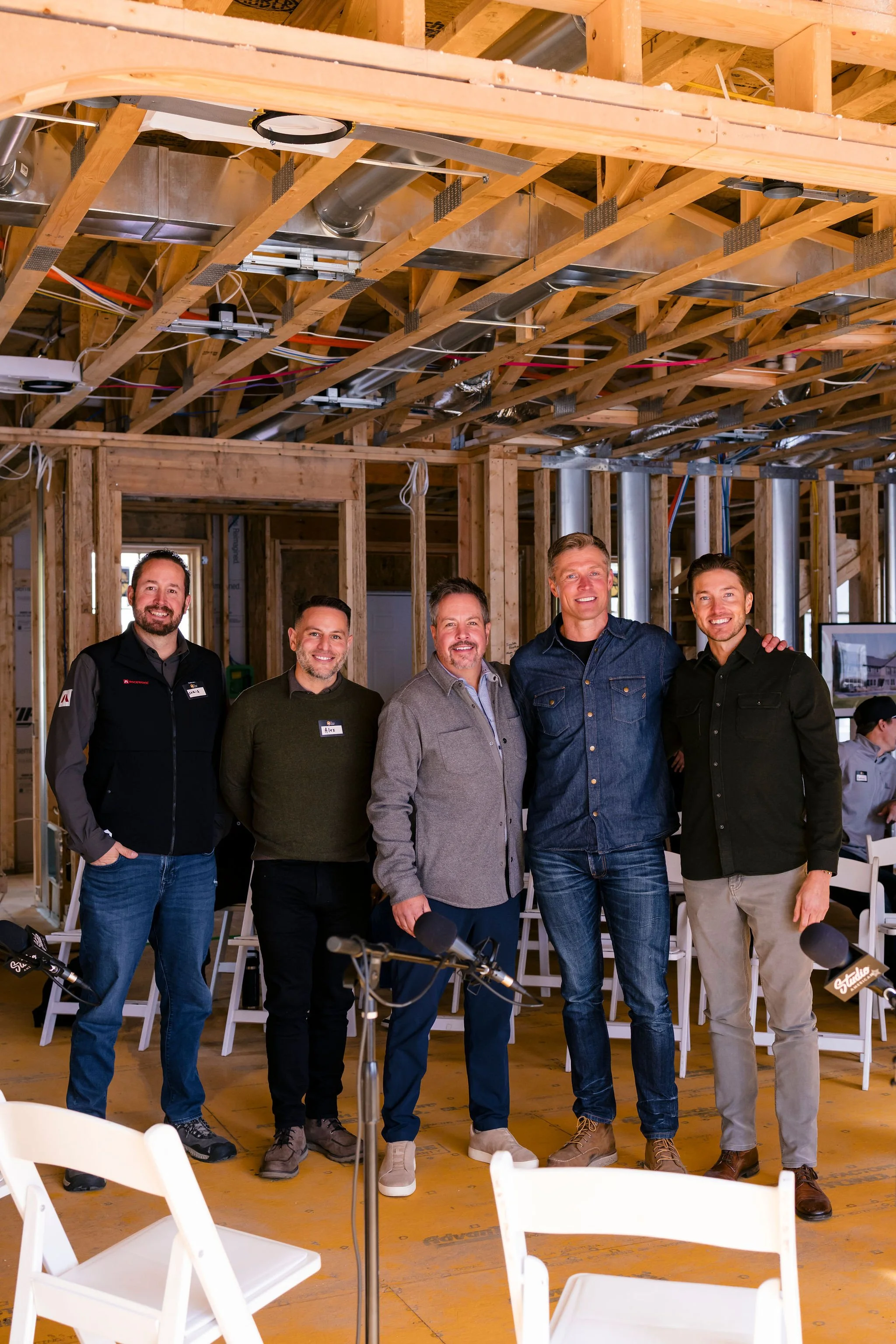
Ep #139 The Calm You Crave, The Craft That Created It: Mysa Hus
In this live episode of The Curious Builder podcast, Mark brings together his crew from Pella Windows, Huber & Zip, and Rockwool for a fun and lively chat at Mysa Hus. They dig into what makes this build stand out—think cozy vibes, wellness-driven design, and the power of working with partners you actually like. It's all about pushing home building forward with teamwork, quality materials, and a genuine passion for creating spaces that just feel amazing.
-
Mark D. Williams 00:00
We're excited to announce that we're bringing back Sonic camp 2.0 on March 20, from two to 8pm we had this last year. We had 42 owners. This year, we're maxing out the capacity of the camp, which is going to be 60 people. We're going to have a wellness panel with some Everest summiters, as well as some iron men and women to compete and all about wellness and how they prioritize their health and wellness, not only in training, but in their lifestyles and in their business. And then we're gonna have a two hour window of sauna and cold plunging in the lake, and then an amazing wood fired grill, Mediterranean style food at the end of that. So if you're interested, please head to cures, builder.com
Mark D. Williams 00:35
under retreats, you'll find everything there is about sauna camp on March 20 in Minnesota,
Mark D. Williams 00:45
even though I know the product super well more than maybe a lot do, I don't know what's coming out next. I mean, you guys know what's coming out six months from now, one year from now, five years from now, some of your long term initiatives. And so I think one of the messages that I'd like to get out to builders is talk to your partners that you already are working with and find out how you can collaborate on things together. Welcome
Mark D. Williams 01:11
to curious builder Podcast. I'm Mark Williams, your host, and we're doing a live podcast at Misa house in cottagewood to a live audience. Let's hear your audience. How many we got here.
Mark D. Williams 01:22
It's standing room. Only 100 people invite the ticket. Cover charge was 100 grand per ticket. Thank you for your donation. We've got about 20 people in the audience. And what I want to do is do a live podcast where I cross over the curious builder and Mark Williams custom homes. So I'll just do an introduction, left to right. I've got Mark Cabrera from Pella windows, Mark Brandon Hoff from Pella windows. I've got Alex unknown last name, yep. Alex CERN, thank you, sir from Huber and zip and I've got Chris Jessen from rockwool. And so what I want to do was just talk a little bit about why, why we're partnered together on this home, not only for the audience at large, but also for the audience that's here. Everyone that is here is a sponsor of this home. And we're gonna do two more of these. We're gonna do one in the spring where, you know, let's say this part, we're kind of at the infrastructure phase, and towards the end, when we're all done, we're gonna have, like, House of role. We'll have amsterdale, we'll have pent air, and we'll reverse this. And I thought it was just a good way for everyone. I've had so many conversations with each one of you, and you've been huge supporters of what we're trying to do here, but I wanted you to hear from your other counterparts, like, why are they interested in partnering in MISA house? And because we've spent so much money and time documenting and marketing Misa house at large, I thought it'd just be a fun way to engage our audience and kind of hear from your point of view, why you're excited to be a part of this project. So why don't we start with that? We'll start with you, Mark, when you first heard the word Misa, who's What was your first reaction? Like, what is mark up to now? Yeah, well, let's start with we get calls all the time, like, I've got this crazy idea, call me back. So that's generally how it goes with you. So anything is on the table, but I had to google it to understand what it was. We'll talk about cozy today. But, yeah, I think for me it was, we've done so much work together over the years that I have a faith, and there's, there's a vision to it. And we'll talk, obviously, about the concept and everything. But that's what got me excited, was something that could be repeatable. Yeah, how about you Mark? Yeah. I mean, when I first heard did the same thing as Mark is, looked it up to see what we're talking about. But after that, really, you know, over the last three years, we've been really focused at Pella Northland on, you know, looking at our mission, and what is our mission, and our mission is to improve people's view of the world and their place in it. And I couldn't think of a better project that really exemplifies what we're trying to do and what you're trying to do in a different way. No, I think that's well said. I mean, for those that don't know what Mises means, it means cozy and Swedish, and so we spent a ton of time sort of, I wanted to come to market with something different. And you know, just talking to builders out there across the country that listen to the podcast is like, whatever you're passionate about, there's a market for it. In this particular case, we sort of discovered, I won't go through the whole journey of how we came to Mesa, but it really pivoted hard from energy efficiency, which is still important to wellness. And so we'll talk a lot today about how each one of your companies sort of reinforced that, why I picked you and why you're excited about that. Alex, why don't you give us a little shout out to zip and Huber, yeah, absolutely. Thanks again for the opportunity. And our relationship just started a few months ago, relatively new in this position, but hopefully it, you know, gets to a couple of years like the fellow colleagues on this panel here. But I think Huber
Alex Sernick 04:44
is really excited about this partnership because it really represents what the future of home building should look like. Whether you talk about sustainability, you talk about wellness, high performance, I think that really signifies everything that.
Alex Sernick 05:00
We believe in, and I think that you believe in as well as a home builder, so we're very excited to partner with you and hopefully replicate that in the future as well.
Chris Jessen 05:08
Chris, yeah, well, obviously we've been trying to partner with Mark D Williams custom homes for quite a while. So when this opportunity came up and you kind of explained it, I don't think I even knew what the MISA who's was yet. I didn't even look it up, but I was like, Well, that sounds cool, like, we'll give it a shot, but
Chris Jessen 05:24
basically just kind of building better. We saw that you wanted to do a house that's more cozy, as you said, but built better than code, built better than the standard house. And I think that's where rockwool fits in quite well. That's kind of why we wanted to partner with you guys on this one, you know.
Mark D. Williams 05:38
And one of the things too, and this is a message that I like to for every builder in the country to think about, too, is that I didn't, you know, pretty much everyone in this room I have had previous relationships with there's a few that are new. But really, I mean, I've been using zip for quite a while. I've wanted to use Rockwell forever. I just haven't been able to get my clients. I haven't figured out the right sort of angle. You know, sometimes as builders or people, we're passionate about something, but we haven't figured out a way to sort of get beyond our own passion. And it's interesting that a number of my clients that have seen what we're doing now say, Well, are you putting in that in my house? And I've told this to Pella corporate a number of times. I've never done triple pane windows in any home in 21 years, I now have of the next four homes that I have under construction, three of them have triple pane windows, and it's because of doing something like this, where people see how passionate the team is about it, but it's a lot of it's education, right? And you know, one of the things that I've tried to do the best Ian, is I go to part I want to go into battle with people I already know, right? Like I have this really long relationship with Pella, 21 years strong, and that's one of the longest ones that I have in my career. And so, you know, you get this really great relationship. Or do you come to your brand partners and you say, Hey, this is what I'm doing. What do you have? Because I don't, even though I know the product super well, more than maybe a lot do. I don't know what's coming out next. I mean, you guys know what's coming out six months from now, one year from now, five years from now, some of your long term initiatives. And so I think one of the messages that I'd like to get out to builders is talk to your partners that you already are working with and find out how you can collaborate on things together. Do you remember some of those early conversations, Mark and Mark, when we were discussing, like, what we wanted Misa, who's to be you know,
Marc Cabrera 07:22
specifically I knew I wanted triple pain. But do you remember when it switched to quiet and that became kind of a big focus? Yeah, I mean, I think you were kind of on the forefront of healthy home concept, and so that was another thing that caught my ear when you started talking about it, is, there's, there's only one other builder that I had had conversations with that was talking about healthy home. And so, you know, I immediately went to our corporate team and said, What do we have today, or what's coming down the road that can tie into this? And I was kind of surprised. I mean, Paul is a company that's really focused on innovation, but for them to say, yeah, we've heard that we are. We're doing this in the innovation lab. These are things we're thinking about or talking about.
Marc Cabrera 08:07
So, yeah, I think for us, early on, it was triple pain, obviously, and the health benefits that come with less condensation, with better energy efficiency, just comfortability in the home. You know, you want to be reading in a nook that's comfortable. So that's just a small piece of how many trades Do you work within our home? Like 60 hundreds. Okay, so if we can all come to the table with something that kind of ties into that concept, to help,
Mark D. Williams 08:35
when you when we looked at, you know, glazings, or to me, it was really about quiet. And I think wellness means something different to every person, for me specifically, and since, you know, it was kind of, I was spearheading it, along with our oho and Ka design team was, you know, for me, I like this idea that you go off the grid, you go somewhere, like a cabin where no one can get a hold of you. It's restorative. You're reading a book, the snow is falling, you're sitting in a well lit room, and it's just quiet. And I want to know, like, could you do that in an urban environment? You know, just a minute ago, it was blowing like crazy outside, and I could hardly hear anything, and we don't even have rock wool in here, yet, imagine how quiet it's going to be when our walls are full of rock wool. What is it about that messaging or that ideology that sort of attracted each one of you, you know, to this product, other than the fact that obviously you're very excited about your own brands, what about Misa, who specifically has sort of elicited a response from you that's like, I want to be a part
Mark Brandenhoff 09:31
of that. Well, I was really worried about your passion for these types of projects, and so I figured we better interject some passion for Mark. But it's interesting because when I grew up, my mom did a lot of Feng Shui, and was very intentional about what she did in the home. And so for me, from a very young age, has been very aware of that, and hearing what you and the team are trying to do was very exciting, something different, something unique, right? Something to stand out, and being very intentional, you know, and you mentioned about. The you know, trying to reduce the ambient noise and really control your environment. And so maybe it's not solitude and complete quiet, but you can actually do what you want within the home, whether it be soft music, whether it may be somebody's playing the piano, that allows you the option to have what you want and not be impacted by something that's outside your control, and that's where we can come into play in that,
Mark D. Williams 10:25
you know, with, you know, with zip, specifically, I've been using our six for, I suppose, three, four years now, this was our first opportunity to go to an R 12. So that was an energy decision that we made in our market. I mean, how often are people and builders using our 12?
Alex Sernick 10:41
Not as often as so we have four different thicknesses of our zip R all the way from an inch all the way to two and a half inches, which you used the zip R 12 is probably the least common one that we definitely see on residential homes. With that being said, it is something that is becoming more and more common here, especially in the Twin Cities. I see it a lot up north, in the Fargo area as well, in Grand Forks. But there are some, you know, learning curves to using our 12, you know, with with that being said, I think one of the things that attracted Huber's, you know, specifically myself, in the products that we represent here, is that our part, our products, really push the industry forward. And I think the way that you build and the way that you come to market with your custom homes does the same thing. So we, I think we align definitely, on pushing the industry forward to use more of those premium products that really do save on energy efficiencies. Yes, they may pay a little bit more, the homeowner may pay a little bit more upfront, but they will recoup those costs, you know, over, you know, X number of years, depending on how long they stay in the home, just to briefly touch on sound and how our product really performs with sound barriers. Zip R is technically not tested for any sound efficiencies or any sound barrier properties whatsoever, so we don't test for it. We don't put it in our literature. But I've had custom home builders all over the three states that I cover, you know, really tell me, Hey, Alex, you know, you would be hard pressed to hear anything outside of the home, you know, except for an explosion right outside of your front door because of the zip R so our poly ISO phone that's attached to our, you know, our struck one OSB panel and the, you know, and then the house wrap on top of that really does inherently provide a much better sound barrier than using it without the poly ISO foam. I mean,
Mark D. Williams 12:27
one of the things you know that you've heard that terminology belt and suspenders, you know, how can you work with systems? I mean, it's one of the reasons why we're pairing it with rock wall as well, right? Rock Wall is very well known for its sound abilities. And, you know, pairing it with the R 12 and, you know, pairing it with the triple pane. To me, I'm looking at, you know, the four of you as sort of a system to make my envelope, you know, just rock solid, if you will. Pun intended. I thought you'd like that one. Why? You know, from your point of view, shifting the narrative a little bit, because this isn't meant to be just a whole Misa, who's, you know, let's go rah rah, rah thing, although we can do that later, is from brands point of view. Why is it worth investing in, not only me specifically and in this project, but like, what? What should builders across the country aspire to do to sort of attract brands to partner with them? Because I get a lot of people that say, Oh, I've never heard of that before. I've never done that before. And a lot of it is just teaching them to be, to think differently. And I know my point of view, but I'm kind of curious, from your point of view, and maybe Chris, we'll start with you. What are things that builders and remodelers can do to sort of engage brand partners, you know, to have a cohesive relationship while they're in design. Because a lot of this doesn't happen unless we're designing, so, you know, our architectural designer Carl is here. You know, we're talking about this product, you know, a year ago, right? I mean, so misused was really born a year ago today, roughly, you know, I think we came to market with the brand sometime in November. I had to convince a lot of people to let me go forward with it. That took four or five months and but, you know, my point is, is, like you can't get to where we're at without having your whole team involved early on. This isn't something you can just slap together last minute and say, oh, you know, I want to change this spec. It's, it's, it has a huge ripple effect. So it needs to start really early on, which starts with discussions with your brand partners,
Chris Jessen 14:14
for sure. And I think with like our company, I know all companies up here, we're out there in front with these builders that want to build better like yourself with their architectural and design teams running AIAS and calculations for them, really getting them involved. And we're trying to get out to these builders that want to they're thinking of going in a different direction, like you did, and maybe build better than the codes are requiring, because that's codes are changing all the time, but you want to build better than that. So we've been really successful with builders like yourself getting into those architects and getting into their design teams, and then them reaching out to us when they see us at product shows or on Instagram or the internet or podcasts like this. So I think us as brands, we're we market to a lot of those type of builders, and. And do a lot of those type of events.
Mark D. Williams 15:01
What about how, you know, one of the ways to, you know, I heard this old sales adage that I like that if you want to catch a fish, you know, cast your bait where the fish eat in this idea that, you know, we all have the same client like, none of this works unless people want to buy this house when we're done, right? And so, you know, a lot of the products that we're talking about right now, we can see, because we're in a house that, you know, a week from now, will be completely insulated with rock wool and will be, you know, we'll start to sheet rock and all. You won't see any of your product anymore, right? I mean, you will obviously see the windows, but we're not going to see any of the Advantech flooring. We're not going to see any of the zip sheeting on the outside. We're not going to see any of the rock wool. But you feel the difference. How? How do we educate the buyers of these homes? Because there is an investment to this. I don't like the word cost, because I think the value is outstanding. What do you think is the best way for us to convey that value to a future homeowner?
Alex Sernick 15:57
I can take this one mark. You know, we really at Huber engineered woods. We really talk about two different ways that we can convey the value to a homeowner. Energy costs are continuing to rise every single year. Energy costs are not coming down. They're just getting more and more expensive. We live in a climate, and I'm sure, you know, a lot of people do around the country, where it's very cold in the winter and very hot in the summer, and there's really no in between, when you can convey the energy efficiency and the energy savings that they will see on the backside, and calculate that, you know, depending on the size of the home, how long they think they'll stay in the home, I really think that does put a, you know, monetary value on, you know, in their heads. And they say, Hey, you know what? It makes sense to pay a little bit extra now, but recoup those savings, you know, a few years down the road. And I think another thing that we talk about, and I think this might go for all of us here, and maybe, you know, tell it to some degree, but we always like to, excuse me, use the analogy that you can always change the kitchen, or you can always remodel the kitchen or the bathroom, but it's very hard to remodel the rock wall or remodel the zip and the subfloor. So get, you know, get the structure right. Get your engine right. And then if you've got a couple extra bucks down the road, you can always remodel the, you know, the nice, pretty
Mark D. Williams 17:07
things, you know, it's funny is six months from now, when we have this panel, I'm pretty sure some of our finished products are gonna be like, you know, what? If you hadn't spent so much money on the foundation, more money to put on the flash? I think you're 100% right, but I mean more is more. I mean it just keeps on leading. I'll
Mark Brandenhoff 17:25
jump in. And that was more of a quantitative analysis, but from a qualitative perspective, somebody that's built a few homes, you can't go back and change the acoustic properties. And so as someone right now that has multiple teenagers, multiple dogs being able to hear the kids and or dogs, or whatever else is going on. Unfortunately, I can. So I wish I would have invested in some of these attributes that could have been a lot more beneficial for the enjoyment of the home. Floor squeaking drives me crazy, and I've got some floor squeaking as well. So if you don't do that early on and take the time and invest and understand the value prop early. To your point, you can always change out the refrigerator, but some of the bones of those homes you can't do anything about. You're stuck with that, and so doing it early is important.
Marc Cabrera 18:12
Well, I think you mentioned brand right? And how do your clients walk into a home and understand the value that comes along with that. We talk a lot about brand, because I think you're you're a builder first, but you are a great salesman and marketer, and so you're always thinking about, how do I sell the product? Who are my partners that I align with? And I think you said earlier, feel the difference. So how do your clients come in and feel the difference? I think it starts with building a property like this, a spec home, because they can come in here and they can feel the quality, they can hear the windstorm that passes through and how quiet it is in here. And, you know, at Pella, we've got, we had a marketing Sarah's here from our marketing team. We have a team that, you know, works on brand for different product lines, but also talks about like, what is that client or consumer experience going to be? And when Triple pain came out for the first time, it was called feel the difference. So we actually had something in our showrooms where we had single pain, dual pain, triple pain, and then we had lamps behind them so people could come up and feel the difference. And so you built that on a on a massive scale, where you can bring clients through other builders, architects, and say, this is this is why I partner. And you can hear it and you can feel it.
Mark D. Williams 19:37
This episode is brought to you by Pella, windows and doors. I've used Pella for 21 years as the exclusive window company on every one of my builds. When people ask me who I trust for windows and doors, it's Pella every time. Their craftsmanship, their innovation, the top tier service, make them a no brainer for any custom home builder or designer who demand the best, whether you're designing something bold or building something with timeless L. Ian's Pella has you covered. They're also the only window company that has a lifetime warranty on all of their windows. I've gotten to know all their people at Pella corporate, as well as locally. Here at Pella Northland, I'm proud to call them our partners and our friends. Visit pella.com to learn more and connect with your local reps today. Also for more information, you can listen to episode one, where I interview their founders, as well as episode 109 where we talk about the innovation at Pella. I've said this many times on the podcast, and just to people in general, that one of the best compliments. I mean, you're seeing it as everyone in this room is a professional in their industry, and you see a lot of homes at various stages. You know what to look for. I mean, architects can go through another architects work and be like, Oh, wow. That that thought process that's amazing. Like, kudos to them. They did a really great job. That builder really hacked it up, but that architect did a great job. And but where I'm going with this is that I think the average consumer that comes through knows very little about most of that stuff. So what are you left with? You're left with feeling. I think Maya Angelou has the quote my wife says it all the time. So watch out, Maya Angelou, my wife's coming for you, and it's people forget what you say, but they'll never forget how you made them feel. And I feel like, over my 21 year career, when we have artisan homes and parade homes, when people come through our home, I'll often engage with them and ask them, I said, Well, what did you enjoy about this home? And they're like, I can't tell you what, but it feels different. And I used to beginning I used to not like that because I wanted something qualitative. I wanted something to latch on to. But as I've gotten older and more mature, slightly, I realized that that is probably one of the highest compliments I can get, because we sense things in a way that we often can't explain. Like, how do you explain love for somebody? Or, how do you especially when you especially when you dumb it down for a child, like, when I'm talking to my kids explaining a more abstract concept, I'm like, Wait, that's I got to make this really simple. And at the end of the day, you might just say, it just makes me feel really good, and I'm okay with that. And so anyway, when you said that, that's kind of what that reminded me of, is just my goal, is that even I was talking to Nancy from Stark intersource Before we were sitting down, she's in the audience right now. And you know, when someone comes in the home, one of the reasons why we're telling the story so much is, you know, sure, if someone really wants to see this house, we'll make it happen. But really, I don't want to show people this home until it's 100% done, other than the brand team that are already supporting it. Because even as much as all of you know, each one of you know 1/100 of what's going in here, collectively, there's only about three of us that know everything that's going in and until it's all the way done. You know, I keep liking this. I hope that lives up to this. But like when you sit in a Ferrari and you see the leather stitching going back and forth along the black of your hand, you know, you know, supple leather that was, you know, made in Milan. Like that's the level of craftsmanship and detail I want. How do you explain that to someone right now, when I'm looking at a, you know, a subfloor, beautiful, yellow subfloor, but it's not the same. And so that's something I'm thinking about. It's like, how do you convey that story? So
Marc Cabrera 22:57
Well, you document it all, all along the way, which is great, yeah, so we can all watch it through your glasses and Instagram. So I think that's a great way to show, especially buyers today, is the power of social media and brand ties in perfectly with that.
Mark D. Williams 23:11
So let me you know, this question wasn't on the question, but let me ask you, just because I'm curious. I know a lot of people are asking me, about me, so who's because I'm marketing it. Have Have you found other builders, either in our market or outside our market, that know that you're a brand partner of this project, and are people asking you about it?
Marc Cabrera 23:30
Well, I can say that every builder in town knows that we work together. You know, when we talk, they say, Oh, you and Mark do this or that, you know? So I do think that's that's nice, because they're looking at ways that, how can they partner with all of us? And they see the success you've had, and they see the true partnership, versus just being a supplier or somebody that's doing labor on your projects. So yeah, they come to us and, you know, like you said, three out of the next four homes are using triple pain. We've got other buyers that say, what is Mark using? I want to use that. I like the study set, etc. So yeah, they see it. And I think most of that's probably on social media.
Alex Sernick 24:10
Okay, I could not agree more with you. I see that all the time. No builder. It is a very small world that we live in. And a lot of the builders know all the other builders. I feel like, in the custom home builder world, no home builder wants to be left out using a product that no one else is using. You know, Mark, you use something. Everybody takes, takes notice of that. Why is Mark using that? Maybe I should look into, into that. You know, what does he know that I don't know? And so, just by virtue of you using a product, maybe a newer product, that does go a long way, you know, to put the feel good, you know, into another builder that might be on the fence or hesitant to use the product.
Mark Brandenhoff 24:46
And I think it'll pick up speed, right? I mean, it's pretty early on. You're just getting things out. These things are happening. And as you button it up, and as you said, you're not going to really open it up until it's done. I think once you do that, and people can see and feel for themselves, that'll really move things.
Mark D. Williams 25:00
Quickly, from a, from a brand value standpoint, we've touched on this a little bit, you know, if you were, if you were to speak to other builders out there, what should they be thinking about? What, what should they be doing to sort of attract you to them? Because, I mean, I approached all of you because it was kind of my idea that I really wanted to help in partnership with, how often are you going to these brands and saying, Hey, we think you're we think you're a great builder. We'd love to showcase Rockwell in it, for instance. Or what are things that other other businesses can do? Because this might seem really daunting to somebody. They might say, well, I don't, I don't have a Misa who's I don't have this idea. And I know what I would say to them, but I'm curious what you would say to them.
Chris Jessen 25:47
I think with, like, on our side with Rockwell, we were really early investors in the social media network, so we were going to builders like yourself and talking to them and getting sponsorships and working with them. So when this came about, that's was kind of like an easy transfer for us, and we get a lot of questions. We get a lot of builders that see what we're doing on line, on social media, working with builders like yourself, and want to know how we can partner, how we can build better with them. And that's kind of seems to be the best thing we most builders that are looking to build a better house are usually more active on the social media. Not everybody, obviously, but it seems like a lot of the ones that we work with, they're just active out there. The homeowners are seeing it. More homeowners are buying and looking online. So we're placing ads online. So it seems to work out pretty kind of a hand in hand with some of these better built homes.
Mark D. Williams 26:39
I think that, you know, correct me if I'm wrong. But I think once this house gets buttoned up, it's up to us to educate or entertain. It's kind of the two ways that I think about it, and I like both, right? I mean, both are fun. I mean, who doesn't want to go somewhere and get entertained or smile or laugh, or, you know, something like that, because life is too boring. Otherwise, that's my own personal mission statement. I guess I'll get off my soapbox in a minute. But my question is, how do I lost my way, cracking up my own joke.
Marc Cabrera 27:09
Are we gonna do like another sauna experience? Actually,
Mark D. Williams 27:14
that's a great idea. That's pretty small sauna. We're not gonna have that many rooms. That's only like a five person sauna. That's true.
Marc Cabrera 27:20
But we've had that experience before where we've done, you know, sauna cold, yeah, what was it? Ian
Mark D. Williams 27:26
sauce, yeah, we did that a few times with you guys. I mean, so, and we also have sauna camp. I mean, so, part of it, I think, you know, speaking to the builders of America, or just people in general, it's like, whatever you're passionate about, like, you can find a way to incorporate into your bit in your business, right? I haven't thought about doing a wellness thing out here. It's good idea. We'll have to talk about that offline.
Mark Brandenhoff 27:43
I think he's looking for sponsorship, Mark. I think
Chris Jessen 27:46
like Friday, like you said it Friday, if you're open. I think once insulation in this house is done, there's a lot of stuff that as a builder and as a product manufacturer can do with this. It's going to be a fun house to walk through. And the installation is done, it'll make your ears pop when you walk in the door. I remember
Mark D. Williams 28:01
I was going to say before I derailed myself, educate and entertain. You know, it's up to us as builders and as industry professionals to educate. You know, the end homeowner, the problem is we only have so much time that they're gonna give us, rightly so. Like, each one of us only has so much time in our attention span to like, make a value proposition. Like, is this worth it? You know, you know. I know when you feel the difference. Again, going back to Stark like, I know, like, if you feel the wool rug, you know that has no dye in it, because it fits the wellness theme. Like, how do I explain that with other but once it's in, I'm like, touch that that's different, you know? And there's, there's a value to it. Again, I think no one is going to see what this looks like on the inside, other than we can go back to video, and we have, obviously, we're documenting everything too, but I think at the end of the day, like we need to showcase as professionals, our value to the clients. And I don't know if they need to know everything, because I don't think they're going to give us the opportunity to do you think someone's going to spend five days in here with a team of three letting us explain every single nuance? Or do you think they'll be like, Please, let me just buy the house. I don't want to hear you talk anymore. I don't know. Let's talk. We talked mostly about relationships, which I think is important. One last question there is, how do you find working with other partners? You know, typically, let's say Chris with Rockwell. You're working with builders. How often are the people in this room, like I said, there's about 25 of you here. How often are you guys interacting as brand partners, saying, I think we should do this project together, or, Hey, there's an event coming up, like a cures builder collective or a contractor coalition Summit. Or, I feel like the world is getting more and more collaborative, not only between builder and builders and designers and architects. But I also think between brand, different brands, are you seeing that and how are you utilizing that as part of a business strategy?
Chris Jessen 29:49
Yeah, quite a bit. That's basically our whole team, or my whole job, is out collaborating and just building the building the network with builders. And obviously we work a lot with. A van take and Huber and those guys. It seems like we're always in the same houses. And then obviously, Anders with Pella too. It's the same thing. So like people that are building better, that's we're all together, and that's our whole job is to get out there and put these, put this type of stuff together. Yeah,
Alex Sernick 30:15
I was speaking to the Pella guys earlier, and I I stopped them, because I do run into the Pella commercial reps, excuse me, a lot on commercial projects. So not only am I responsible for residential, but I'm also responsible for the commercial side as well. And there's been numerous times where I've seen a representative from Pella meet me on a, you know, a large commercial multi family project where you're where they are using our house wrap, our zip and our tapes for the window, and then installing a Pella window. And they've got both of us on there to make sure that first window install goes correctly. And there are some nuances, you know, depending on how they want to do it, you know, what adheres to their warranty versus our warranty and things like that. So it is very, very important. And I'll, you know, back, continue to back off the subject. We are actually doing an event on on Thursday with another window manufacturer in conjunction, you know, a dual window manufacturer. And disappointing. So we do try to get out there as often as we can with different brands and whatnot that interact with our systems as well. And we more than happy to, you know, have a conversation with you guys and set something up for sure. But I get questions all the time about rock wool, and I'm glad that, you know, we'll have to exchange numbers after this, because I do get questions very, very often about how our system integrates with rock wool, and there are some unknowns, so we'll definitely have to exchange context after this.
Mark Brandenhoff 31:37
Yeah, yeah. I'll jump in. So one thing that comes to mind for me is like intentional is not transactional, and so really fostering that relationship and spending the time Mark and I were just comparing notes on our calendars for the next two weeks, we spend a lot of time interacting, and not because we feel like it's just what we have to do, but we generally really like to work with the people that We partner with, and we view them as true partners. And many of them, I think you're in this category to become friends, right? I mean, it's not just about a window and a home. It becomes knowing about each other's families and kids, and that's the ultimate for us. And that happens a lot. I mean, we, we, but we, it's very intentional. We spend a lot of time, because we don't want to just be a supplier. We definitely want to be a partner.
Mark D. Williams 32:20
And I've mentioned this many times on other podcasts as well. Of I think loyalty begets loyalty, right? And I use our relationship as a prime example that. But you know, there's a lot of brand companies out there that say, Well, how do we partner with, you know, ABC builder, or whoever it might be, and vice versa, the builder saying, Well, how do I partner and have that same relationship with, you know, whoever. And ultimately, I think that's why whoever you're currently using go to them first. You already have a relationship with them. And so, you know, you can go further with that relationship. And if that relationship no longer serves either one of you, but both parties owe it to the other to kind of say, Hey, I think where you're going might be a different place than we want to go. We had someone on our team who had been with us for a long, long time, and, you know, I won't go into all the nuances, but they said, You know, I think you're going to a place that I don't want to go to. And I said, that's totally understandable, totally respect that we've had, you know, 15 years together, and that's, you know, that's no problem, and that's fine, as long as you're clear, clearly communicating. And there's plenty that say, oh, man, we'd love to do that. But I think just understanding, just saying, Hey, do you want to work together? Yes, we can figure it out. And I think that's true of builders too. I mean, right now, you know, shout out to, you know, my partners at honey Hill, you know, aspect, you know, they came to me and they said, you know, a lot of people say collaboration over competition, but not that. Many people truly do it, believe it, and, you know, execute on it. And they said, Let's work on this together. And I can't tell you how invigorating it is to work with true partners, especially, you know, quote, competitors, if you will, if you're willing to sort of lower your guard and ask someone for help, or lower your guard and say, Hey, how can we work on this together? I'm telling you, the world is just way more exciting and way more enjoyable, because doing this alone would be really, honestly boring, and it couldn't even happen honestly alone, because this doesn't happen without hundreds of people physically working on it, but also all the support that we have from each one of you in this room, it can't be done. It's not possible. And so it's like, if you want to go farther, you need, you need to incorporate more people into it
Marc Cabrera 34:19
and leverage, you know, le leverage, the relationships that you have, because we know Sean and Tom, and so it was a natural Connect for us to work, you know, exclusively with you guys on that development. And we started conversations early on. And I think the other thing that you're trying to do for the industry is get you connected to people that are like minded that will push their business forward so the collective or leverage the relationships that we have with architects or other suppliers that can potentially change your project or, you know, the way you market your builds. But I that's something that this industry, although there's social media, which is powerful, the relationship. Piece of it, the components of the the loyalty, the true partnerships, the people that get your brand, that get get what you're trying to do, keep those relationships strong, because that's what this industry is built off of. And we, we all know that because we're in it. But I think the the consumers see so much of the social side, they don't necessarily understand what it takes to build it.
Mark Brandenhoff 35:21
I think the passion piece too, when you talk about that Mark, I mean, we all can, none of us are here because we have to be. We're here because we're passionate about the building community. We're passionate about building beautiful homes. We're passionate about some of the projects. And I'm new to the industry, relatively new, and I absolutely love what I do every day, and I love the people I work with, and I love working with the builders, and we do a lot. It's, it's definitely not for the faint of heart of how much time I'm sure builder experience is the same thing. But if you love it, it's, it's just part of your DNA. And I'm there, and it's been a lot of fun. I think
Mark D. Williams 35:53
it also represents our industry. I mean, you're, we're building a home for people. I mean, other than, I've often argued that, other than getting married, and, like, the planning around a wedding, what else do you spend more time, effort and energy and expectation into, other than a home? So I think our industry is sort of primed for that deep relationship, because if you're really honest with like, who you're building for, it's way beyond, like, a, you know, four walls and a roof and it's, it's a family. Someone's gonna have memories there. Someone's gonna raise their children there. You know, they're gonna have, you know, Christmases and Thanksgiving and all the things that matter to us outside of work happen, you know, in this space, like, right now we're in this space, some point in the future, someone will be having, you know, their monumental life moments in this exact space. And so I think thinking about a home differently than just like, it's a place that I dwell, you know, it's a place that you, you know, you dwell well and like you have all these memories, and also with a lot of the products that we have in this home, specifically with the four of you up here is, you know, and this isn't a warranty, because it's going to exceed, my lawyer would hate this, but like, I want this house to last beyond 100 years. I mean, why in Europe were they using, you know, stone and, you know, whatever else you know, 1000s years ago, and those buildings are still standing. So, you know, obviously time will tell. We're using a lot of new technologies, you know, and we're still evolving. I mean, what worked 20 years ago? The products are so different and so superior, but we still have to try them and vet them and test them. And I think for builders, it's really helpful for me to talk to Chris and say, Hey, Chris, you know, Rockwell has been around forever in this application, you know, what can we do here? Like we actually had that on this house, you know, I wanted to put the rock wool. I wanted Rockwell everywhere. So I wanted rock wool up under sub slab. And I didn't like the way we had our stego poly, you know. And so we work with the manufacturer, and said, Well, I don't want it on the top. I want it on the bottom. Are you okay with that? And so I think you know, not always just doing what you're told is probably well, at least that's not what I do. I want to know, but I also respect people. If you tell me no three times, I will listen, but I'm not going to take no, you know, at least twice. Just twice. Ask Carl, he tells me, he tells me no plenty, but he appreciate his patience. He definitely knows how to get through to me. So I think, I think we all need each other. Like, I'm going to push you as brand suppliers, like, Can I do this? But I also depend on you to push back and say, Mark, it's not in your best interest. Like, you know, for Pella, like, you know, the wellness studio, we have this really cool multi slide door out there. The original design was a bifold and as we worked with the architecture team and oho team on what it was going to become, it kept evolving like none of this, again, happens without a team concept. You know, when I go to I'm just looking at Nancy, so I keep referring to her in the audience. But you know, it's like, you know, when I'm picking a I say, Hey, here's my philosophy. I want this house to be based on wellness. I want what to my not, it's not perfect, because we're still iterating here, but like to the best ability possible. I want this to have, you know, natural, no off gassing, things that I can control. And Nancy's like, well, then you want this product. She's She knows more about her product than I could ever hope to know. And so I would challenge builders out there, like, when you have an idea, like, again, depend on your people. Have them. You don't have to know it all like I know very little. I just know to ask all of you for help. And so far, you guys keep on answering the phone, so that's on you. What would be like a goal out of this? When this home is done, what would make this a successful, a successful venture for each one of you.
Marc Cabrera 39:24
Well, I think first that you sell the house, then be successful for all of us. But I think as you look at I talked a little bit about, you've documented the whole build process, and so for us to collaborate and use that to gain future business and push the industry forward would be a success, at least from from my lens, I
Mark Brandenhoff 39:46
was thinking the same thing. I look, you know, we're a little bit lucky when our product and that it typically is like a statement piece or a showcase showcase piece, something you really can't avoid not seeing you. But being able to get people to say, Hey, Mark is doing triple I should do triple marks, doing multi slide I should do multi slide marks, doing this. We should do that. That's awesome for us. And that's, you know, the whole partnership really works well that way, Mark.
Alex Sernick 40:14
I mean, my hope is that you really set the benchmark for what a custom home can be going forward with with all of our products involved in that I, you know, really sent that set that benchmark for future builders that have an idea of building that, you know, great, custom home. They're saying, they're, you know, they're thinking that, hey, these products were used. I'm going to use those products as well. So, yeah,
Chris Jessen 40:35
I think the same kind of continue on that is just what, when we partnered with you, we were like, Okay, we want to partner with Mark D Williams custom homes going forward. I think you kind of set that benchmark for the Twin Cities, which definitely needs to build better than code, and they're moving in that direction. So having our product, having the continuous exterior insulation with the zip bar the windows, is just stuff that's not normally done in Minnesota very often, and I think that'll trickle down to obviously, more custom home builders, but down to more standard home builders. Every every house, especially low income housing, could use a lot of these products to save money for that homeowner, renter, individual, for years to come. So I think that we're pushing in that direction in the Twin Cities, and that's kind of why we wanted to jump on board with you guys to
Alex Sernick 41:23
help that if this home could be proof that sustainability and design can go hand in hand, you don't have to compromise on either.
Mark D. Williams 41:32
Yeah, I mean, I think it does come down. It's funny, because I'm thinking of all the things I said no to, believe it or not, I do have to say no to some things, you know, in terms of cost and value, you know, we're making value decisions based on what we think, and the proof will be in the pudding. I mean, we'll find out six to seven months from now whether this vision and the goal that we had in collaborating together will someone appreciate the way we do. We don't know. And when it does sell, and talking to that buyer. I'm very curious, for all of our sakes, like, what will be the thing that drew them in? Like, what's their why? Like, I know my why. You know each one of you represents your brands. You know your why. I'm very curious to know if a homeowner will really know what their Why is, or do they have to discover it. And even, like, checking in with somebody, you know, I tend to stay just because this is only five, you know, six minutes from our office, I'm very curious to check in with them a year, five years, 10 years down the road, because we've put so much passion into this home, I'm really curious to sort of stay in touch with all of our homeowners. We do that. But this one, it'll be a little bit different, obviously, because I want to know, like, how's my child doing? You know, you know, are they taking good care of her? Like, you know, is she going to grow up? Like, what is she going to be? Gonna become? I'd have no idea. But I think you need things like this to get passionate about, because honestly, for me, you know, I've mentioned this a lot with the podcast as of three years ago, when I started the curious builder, like, I was completely burned out, like I was kind of like, I'm done building, like, I'd consider going to work for another builder. Just like, what I'm just like, I'm done. And really, this type of collaboration just completely relit a fire, you know, for kind of, you know, probably, God willing, the next 20 years. And then this home is because of that. I wouldn't be here today doing this home without the curious builder. And so in that sense, both of them are very much intertwined. And so doing something like this, I think, is really inspiring for me, and I hope that other people listening to it, regardless of what you do, like you do, you don't try to copy me, and if you want to, great. I'll give you the blueprint of what I'm doing. But that's not really the point. The point is like each person has something in them that I think is special, and the partners that they work with, like this house could not be completed again without everybody here. And I think, to me, it's a little bit like when you go to a family gathering and get a little woo on everybody. But, you know, as you walk through the house, and I'm thinking like, you know what I wouldn't have done that? You know, if Kristen from Edmund one hadn't recommended I do that, or, you know, Ian from Pentair said, hey, you know, for your pool design, you really should do this. And this water clarity and this purification system, you know, is this, and so it's like, that's honestly, what's exciting for me, because I'm getting introduced to new products from all of you. Or, you know, I've been partners with Anthony from Alpine for, you know, what, 20 years, 15 years, a long time enough that he's gonna have to get a restraining order on me. And but, you know, like, when I when I tell people what the goal is, they're coming to me with the ideas. I don't have to keep iterating all these ideas. So that, that, to me, is why it's so fun to have partners. Because this isn't really my vision. It's collective, you know, vision together. Not much to say about that wasn't that was pretty terrible question, by the
Chris Jessen 44:35
way, but I will jump in a little bit there. We've done a house kind of like this, down in the Kansas City Market. They call it the pretty good house. So it was
Mark D. Williams 44:42
basically terrible brand, the pretty house. It's making a pretty good offer.
Chris Jessen 44:47
Doesn't burn it was pretty good. It wasn't passive level, but it was a pretty good house. Let's go back to the pretty good Yeah, so, but it was the same thing. There was the European style triple pane windows. It was. Continuous extra insulation, rock wool inside. And they it was great. You walked through it, it felt good. But then they went back and they interviewed that homeowner about six months later, or we did. We had a whole, like, video shoot on it, and that home was like, I can't tell you, but you like you said, you can't, I can't tell you, but I don't my I don't hear anything. I feel better. I wake up better. I can just yeah, that just the sound quality of the feel of the house, with all those things put together was so much different, and we use that a lot. So I think that's something for you to do when come back to this homeowner, when they're done and just be like, Hey, can you do a testimonial? What it's like to live in a house that you could put in the middle of this inner city or next to an airport, and you still
Mark D. Williams 45:37
wouldn't feel any different. I'm just still tripping over their name. That is terrible. Well, there's a book
Chris Jessen 45:42
called The pretty good house. What's that Emily mantra? She wrote a book called The pretty good. Oh, really. It's basically not passive, because, like, not everyone can pay for passive, so they call it the pretty good. That's kind of where they kind of played on words there.
Mark D. Williams 45:54
So I'll take a pass on that one. Okay, rapid fire. If you could use one phrase to describe misehus, what's a word that you would use to describe it? This process or this? Build
Alex Sernick 46:11
intentional? Yeah, yeah. Every, every aspect design choice has been intentional. Yeah? Has serves a purpose.
Mark Brandenhoff 46:21
I'll go. I like flow. The Home will have great flow and great energy.
Chris Jessen 46:25
I think serenity. I think when this house is done and you're just gonna walk and you're just gonna feel different, I'm
Mark D. Williams 46:33
just glad you didn't say pretty good, decent.
Marc Cabrera 46:37
Well, I'm not gonna use cozy, because that's the actual word, but I think a good word for it will be comfort,
Mark D. Williams 46:45
if you were when you when a homeowner moves into this home, when they're done, what do you think would be a meaningful interaction for all the brand partners that have been sort of a part on this journey? You know, you don't want to overwhelm you know, it's kind of like, you know, they've adopted your child, and you're like, you know? It's like, Well, okay, we also want them. It's like their home now it's no longer really our home. What do you think would be a meaningful way to sort of interact as a collective team, you know, for future homeowner? Any ideas,
Mark Brandenhoff 47:19
could you a video expose of each vendor's contribution to the property, and kind of follow that over time with many interviews, and wrap that up and do a nice, short, two or three minute video for the homeowner to have.
Mark D. Williams 47:34
Leah, we got to write that down. That's a great idea. I'm thinking about like a wedding video. Like, and then your idea of just like, two minute, like, Hey, you're gonna enjoy going to Iceland, you know, this is from, you know, the three marks, you know, enjoy this, you know, hotel, or whatever. I'd like that idea a lot.
Chris Jessen 47:55
Actually, call out what we think is gonna be special about this house and say, Hey, walk through the cells. How's that feel? How's that quietness, how's the windows and whatnot. So it's, I think, definitely could be a cool idea.
Mark D. Williams 48:10
I'm really hoping that you know, somebody that you know is going to see how much care we put into this home, how they'll let us use it for future clients. You know, because once the home sells, and you know, it'll be on the artisan home tour. And so obviously, anyone that wants to come see the home is certainly going to see the home. That'll be the first three weeks of June. And we're going to do a number of industry events. We'll probably use, if you're part of the curious builder collective, raise your hand. How many people are either a sponsor or part of the curious collective in the room right now? So maybe 70, 80% of the of the room. We're probably going to do a mixer here where we'll have the architect, design and builder collectives, because so many of my partners and sponsors in the curious builder enterprise, obviously, are the same ones as they are in, you know, Mark Williams custom homes. But I think I want to do some sort of a meaningful mixer here. I'm not sure what that looks like yet. We're still sort of iterating, and then even involvement with the neighborhood. I mean, obviously, neighborhood. I mean, obviously the entire neighborhood knows about this house. It's funny because one of my other designers that I work with a lot down the street, she lives three homes down. They refer to the house as MISA. How's Misa doing today? So I gave her, I gave her a water bottle, like, not quite like this one. This one's pretty cool. Pentair, you guys should check this out, by the way. Lark, have you seen this? They have a UV filter in it that it clarify, it purifies the water. Check this out. Sorry. Audience, that's not cool. It purifies the water. So I'm going to give the homeowners their own custom water bottles. So the house is cheap, but the water bottle is very expensive. I got one
Mark Brandenhoff 49:37
more twist for it. I was just thinking this would be a fun one to have everybody that's involved sign like a three by three square and then hide it. And then during the video that you give them, let them know to open this panel up, or, you know, remove this, and they could see all the people that contributed to the build. Oh, look at you. Autographed it. There
Mark D. Williams 49:56
it is. That's not my autograph. That's admin one autograph.
Mark Brandenhoff 49:59
So I have. Hard to see that, though, after it's built, that's true. You gotta find a place where you can put it that they're not gonna know about it, but you can surprise them six months in. So
Mark D. Williams 50:07
we've been documenting it so you're you, I like the way you think. So what we did is, I've been asking anyone that's worked on the house to sign their work. And the idea is that if you sign your work, you're putting your name on something, there's going to be a little bit more care, a little bit more intention, a little bit more you're just going to be authentic about what you're doing. You're going to think a second time before you, before you do something that's not great.
Mark Brandenhoff 50:33
Which pane of glass would you like Mark and I to put our signature on a handprint front or back, maybe a door. Tell you what
Mark D. Williams 50:40
no one we're done today, I got a Sharpie in the trash, and everyone's gonna sign something in this house, you know, not a window that I can see. Otherwise, I'm gonna be replace it. But anyway, the idea is, again, it's a story in, you know, it was funny because I had one of our HVAC guys was downstairs, Lennon, and I had him on camera. It was just the guy's great. I love his energy. And I never met him before. And I said, Hey, Lennon, do you mind if I get a video of you signing the, you know, the tin and the duct work on the plenum? He's like, Absolutely. He's like, this is awesome. I've only been doing this for a couple months, but I love this. Oh, crap. I was like, You know what? In for a penny, in for a pound. Let's do this, buddy. I think he'd been there for a couple years, but I remember touching his boss being boss being like, someone's overseeing Lennon, right? Like, two months and so. But I say that sort of, I want to tell that story, a, to put a little pie in my face, but also B is like, there's this narrative that there's not young people coming into the industry. That's not been my experience. I see a lot of young people interested in our industry, and I think it's up to us to engage them differently and have them come in. Like, right now we're going to try to do a speaking tour into high schools, and so we're trying to work on a way, like, how can I get people into this? And it's interesting because I was sort of told by a number of people, like, keep this home a little bit more secretive. Don't let people in till it's done. Because my original idea was actually, after this, we were going to have 100 people in the house for the hard hat tour. It was going to be it was going to be all the kids in the neighborhood. And we actually have like little checklists of all the things to look through and educate them. But I was convinced that that was not in my best interest. Is that by your lawyer, the team that was by a number of people that that? I said, no number. So anyway, not all my ideas get greenlit.
Mark D. Williams 52:29
This episode is brought to you by adaptive. If you're still chasing checks and juggling spreadsheets, it's time to upgrade. Adaptive is revolutionizing how builders get paid with AI powered bill pay, automated draws, one click payments and built in Lean waivers, Faster Payments, fewer headaches and total visibility. Adaptive takes care of the back end chaos, so you can focus on what you do best, building. We've used adaptive for two and a half years, and trust them to keep our projects moving and payments flowing. Learn more at Adaptive dot build and simplify the Pay Process today. For more information, you can also listen to episode 10 and episode 15. Maybe we'll take a few questions from the audience. We're out of questions, and right now we're just riffing. So does anyone have maybe we'll do three questions. Does anyone have a question in the audience that they'd like to ask anyone on the panel or anything about the house? I mean, for the audience, there's like, everyone's hand is up. It's I can't, I can't decide who to pick. Ian, go ahead.
Speaker 1 53:25
So we talked a lot about the materials that are in the house today, and someone had mentioned a warranty. So as we're thinking beyond just move in day, how do you also delight homeowners when it comes to seeking out a warranty or calling about service concerns, curious what your philosophy is with the type of buyer.
Mark D. Williams 53:47
So the question was from Ian from Pentair, and she basically just said, how do, how did the brand partners up here view warranty and reassure the clients long term that while they're in their home, like, what is? What is warranty? What does commitment to a home of this caliber mean, like from their point of view?
Alex Sernick 54:06
Alex, go ahead. So this was on my mind when we were talking about partnerships, and it was something that I did want to speak about. So Thanks for Thanks for bringing this up. And hopefully I can make it quick. And this is just coming from Huber, but I think any manufacturer of any product that that you're going to use on this home, you know, has a pretty good lawyer behind the scenes that can get out of just about any warranty situation that comes up at the end of the day. In my opinion, it really does come down to a partnership and a relationship. I want you to feel extremely comfortable knowing that when you are using our products, not only do they come with a 30 year, you know, non prorated warranty, or 180 day of exposure rating, where you can keep it open for 180 days. That's all good and dandy, but when it comes time to act on that warranty, how do you know that we're not going to find the fine print that says, Hey, you didn't do this one little thing, therefore we're washing our hands of the entire situation. In my. World. And in my position, I know Huber, being a family owned company, is never going to wash their hands of any situation, depending on whose fault it is, we are always going to work with you know, work with you. Partner with you, build that relationship. Because I know as soon as I say, hey, too bad. So sad you guys didn't do this one little thing. Are you ever going to use my product again? Probably not. I'm here to build a long term relationship. And so that means not only educating you on the product, giving your guys the you know, your team, the product knowledge, training sessions, etc, but also helping you out and working as a team if a warranty situation were ever to come up in the future.
Mark D. Williams 55:36
I mean, I think that speaks a little bit to what Mark was saying, too about the power of relationships, and I think it's more interesting anyway, and more rewarding as a person, just working in this world, is just like having relationships that are meaningful, that, like you said, Mark as well, too many marks up here. You know that just that you might actually like someone, that you might be friends with them. And you know when you when you know someone cares about you and they care about your reputation, you know they're gonna go a lot further than just what is stated. Or they'll tell you, say, I'm sorry that my hands are tied, but I think we need to do this. And so they really, if it's a transaction, it's black and white, and it's, it's to your point, the fine print seems to be in everything but my contract. And so Thanks for laughing at that. And so, you know, I think a homeowner, at the end of the day, they're very few homeowners, read our contracts. At the end of the day, they're saying, Mark, we trust you to build our home, and we trust your reputation. And that's enough for me. And as long as I stand behind that, the contract is only there if I don't. And honestly, if we're coming to if it's going to that, then I'm not really the builder I want to be anyway. And I'm sure we need those things for certain situations, but at the end of the day, like, I think I don't know anyone that's like, yes, contract, can't wait to read this thing. This is going to be some great bedtime reading that's just not enjoyable. People don't like it. They like real people. And I think that's why you see people go back to relationships, and why people continue to work with the same people over and over again. I can tell you, as a builder, there's been situations where maybe things were 5050 maybe it wasn't even 5050 maybe it was definitely not the manufacturer's issue, but they took care of it anyway. Think about it this terms. If you're if you're a family and you have children and you see someone do something kind for one of your children, how do you think you're going to feel about that person? You're going to feel very strongly towards them. They did the right thing, even when they didn't have to. Now that is something you can't you can't not only put it, not put a price on it. You really can't, hardly even quantify it. You can only tell the story.
Marc Cabrera 57:37
I think it's a good question. I think you've you've got to partner with brands and with builders that have a reputation to uphold the warranty right, even beyond what's maybe written. Pella specifically, has been around for 100 years. Is our 100 Year Anniversary, which is pretty cool. And locally, we've been here 85 years, and we've worked together 21 of those years, and we've run into things along the way where we've had to address them. And I just think that people will see what you advertise for warranty, but I think when clients come in and can have a conversation with the builder that you worked with for decades, or a brand partner that you've worked with for so long that they know that that reputation in that market is strong. So I would just encourage clients to look for relationships that are lasting, that are loyal to each other.
Chris Jessen 58:31
Yeah, I think same thing with products like when you mentioned warranty, I'd come from another background before Rockwell, and it was always about warranty. What's your warranty? And I'm really not sure what rock was. Warranty is, it's made from rocks, so it's just how much you could do to it that's gonna be that's gonna hurt it and whatnot. And we've been around for almost 90 years. Started in Denmark, so I've just, and we mentioned earlier, Europeans build stuff out of stone. That's 80% of the market in Europe. And so it's, we've got 65 year old product that's still the same r value and still touch on the top of the stud 65 years later. So it's not even sure what our warranty is. So we'll have to get back to you on that one.
Mark D. Williams 59:09
Well, I mean, I think you we just told us what it is. Yeah, the fact that you don't know it and it hasn't been a problem tells me that the warranty is enough that it's not a problem. Anyone else have another question?
Speaker 2 59:23
Anthony, where did you find your inspiration to come from? You know, one certain country in Europe. Sort of say that one more time, where did you find your your inspiration? How did it develop into one country from Europe? Besides, point of cozy and like, where did it come from? Like, inside of you. You came up with this, or a group of people, or whatever, how did you feel, or how did you like? You're trying to elicit some sort of response from clients, not just what's on paper. And we all do that with all of our just our trades and everything that we're a part of, we want to be a part of, like, develop some sort of emotion that people come in. You know, they. A memorable this right math. And then, how did you, how did you come up with that, with the one country, I guess, more or less, and then was just mainly because the word cozy,
Mark D. Williams 1:00:10
or so, I think the question to repeat it was so Misa, like, how did I come up with the term, or we come up with the term Misa, who's and, like, I guess, how did it start? Man, I'd have to think about that for a little bit. It's been talking about, talking about for so long. Sometimes forget about the beginning. It's like telling, oh, that's a little too woo, woo. I was gonna be like, go back and be like, when you first went on your first date with your wife, like, what were those first feelings like, when you knew she was the one? I mean, just off the cuff, I knew that I didn't want to, so I haven't done a spec home in 16 years, and I didn't want to come to market like everybody else, no disrespect to what they're doing. It's just not me. It wasn't creative. It wasn't interesting to me, and I didn't want to do it. So then you can't really make someone do something they don't want to do. As I already mentioned, I was kind of burned out. I sort of needed to be burned out in order to have this idea. So I think for me, it was just part of the process. And so for me, through the curious builder, and working with a lot of other people, I just, I've been kind of obsessed with brand, you know, the curious builder, like I about three years ago, I was going through this brand exercise of like recreating Mark Williams Custom Homes, because no one tells you, at 23 years old, don't name your company, Mark B Williams custom homes so long, and it's like, how am I gonna sell that? And so anyway, I can't even get my wife to agree to it. So, you know, let's go. I need a different name. And so for me, I'm going through the story of, just like, I was really keyed in on brands. So when the curious builder came along and I'm interacting with all these different brands, and like, you know, and I think it's really common now, people say, like, What's your why? And I just became really interested in, like, knowing what I wanted it to be. And so for me personally, I just this house. If I could afford my own work, we'd be, you guys would all be in my own personal home. And I'm certainly not the first builder to build their own personal home and then market it and then move into it. The difference is, I can't afford my own work. And so what I did with that is like, well, how can I take because I had to choose, is this going to be a main level living for an empty nester, or is this going to be a family home? It can't be both. It has to be one or the other. And so I really struggled with deciding what we were going to build. And so for me, sitting down with Carl, sitting down with I knew who my team was actually. I think maybe even before I knew the concept. I'll have to fact check this with them later. I can't remember if I had the idea first, or if I came to them. I knew I wanted to work with Carl. Carl is my neighbor. It's how I got into Ultra running and the wellness really took a big turn towards that. I've always been into athletics and things like that, but that was a, let's say, call it 1/3 of the idea. I knew that if it was just Carl I designing, it would probably get too modern. And most of my my women, people who buy my homes, are the women. You know, my designers used to say, Happy wife, happy life. Like, if I can't relate this home to women, and guess what? They want something that's cozy, approachable, traditional in our market. So I'm like, Okay, I knew for certain that it was going to be Melissa from olent interiors, and so it was really that collaboration, and then kind of coming up with this idea of like I was the last piece, like I was called the archetype. I wanted to have a philosophy that without a client, like designing a home on a blank piece of paper is actually really hard, because it can be anything, and if it's anything, it's kind of nothing, and it's not special. How can it be special if it appeals to everybody and but you kind of have to dive off the diving board and say, like, it's going to be this, and that's a lot of pressure. And so I wanted to develop a philosophy that the philosophy dictated every selection. And so once we had that, oh, this was so freeing. It was the that's why this project has been so rewarding and so freeing. We worked with a local company. Shout out to Molly windmiller from lab, and I kind of presented all these ideas to her, and she helped me. I'm really good at the idea creation, but as you can imagine, it's a little bit like a shotgun. I mean, there's bullets everywhere. Like, I needed someone to help me, like, focus this on a thing. And so we did some brand names. And, you know, I'm a Scandinavian, Norwegian mutt of, you know, 15 different bloodlines. And I'm like, Well, we did our honeymoon in Iceland in Norway. And I was like, you know, I love going back to this cabin, this intentional. I wanted this home. If it was my home, to be a place where my family, my children, I could be in common spaces, the rooms would be smaller. So I'm giving you a long answer, but that's how it all. It just kept coming. All these inputs just started coming together and together and together and together. And so I didn't pick a country, I picked a philosophy. And the philosophy sort of worked around and plus, Misa is very catchy, so that helps too. It's not pretty good homes, I'll tell you that. And so that was don't know if I answered the question, but that was really how I came to it. There's a lot more there. We'll probably do a, we could do a whole dedicated podcast, probably on it, but did I answer your question, last question, and then we'll respect the time for the audience and Mark's travel plans and. Other questions. Ian, all right, our producer, I love it. Any of your conversations on the curious builder podcast affect what you did here at visa? That's a good question. So Ian, our producer from Studio Americana, asked if there was any conversations that had happened on the curious builder podcast that influenced, I'd say all of them, but in ways that I couldn't like name. You know, I interact with owners across the country, designers, architects, builders, and, like any interaction with somebody, people leave an impression on you. I couldn't say specifically. I could say a little bit like, you know, shout out to Nick Schiffer from out in Boston. He's one of my business partners with the contractor coalition Summit. He's much farther along and his spec home, and his is, like 5x mine. He's got something called 45 white oak. If you've been following it, it's out in Boston, an insane his, his motivation is a lot different than mine, but I saw his passion, and I saw his dedication to like, a specific thing. So it impacted me, from that point of view, how we got to I'd be curious to ask someone else how similar they think our end goals are. I think they're quite different. But he was so motivated by he wanted to build the highest and most pure home, like everything to the nth degree. I mean, I'm like a one out of 10 compared to that home. I mean, that home is insane. If you're not familiar with it, you really need to go give it a look. I'm actually flying out there in two weeks to go look at it. One of my business partners told me I could go look at it, because he's afraid what will happen. Don't worry. Don't worry. I said, we're already too far down the road to change. But I think everyone impacts you. And so you know, Misa, who's could not come about without every single person involved. And really it's an evolution of it all.
Marc Cabrera 1:06:41
So I think I'm gonna go with you so I can keep you in check. Oh, yeah, you guys will appreciate
Mark D. Williams 1:06:47
that too. Okay, yeah, you can come. Why not? I'd like to, actually, I think
Chris Jessen 1:06:50
you should do whatever he does on the exterior of his houses. I'm sorry, just do whatever he does in his house and on the exterior of his house. Yeah,
Mark D. Williams 1:06:56
Rockwell has been working with NS builders for a long time. And so, you know, I think that's you know. Back to your question, Ian, I think you know, as you interact with people, you know, people are asking me, Hey, why are you using our 12? What do you think I did when I called Chris Cook, so he's one of the head people at Huber, he put me in touch with someone on the East Coast, not Nick but somebody else. I called him and said, Hey, tell me about our 12. You know, Rockwell. I'd seen Nick use it for years, and I was just kind of obsessed with, if you see it every trade show, and then someone have a big flamethrower on, it never burns. I'm like, that's cool. I love fire and it's not burning. That's awesome. I don't know why I want that in my house, but I want it in my house. And so I think you just ask a lot of questions, and I think that's obviously what the curious builder is. That's who I am. And so that's how all of it sort of came to be a big blender of relationships and crazy ideas and adrenaline. Well, why don't we wrap it up that because we'll talk forever, and you guys all have better things to do. Thanks for tuning in the curious builder podcast, and we'll see you next week.
Marc Cabrera 1:07:55
Thank you.
Wellness and Lighting: How Kristin Reinitz Lights Up Mysa Hus
Let there be (better) light. In this episode, Mark sits down with Kristin Reinitz of Admit One and Aurora One Lighting—one of the powerhouse partners behind Mysa Hus—for a deep dive into what actually makes lighting feel good. From warm dimming and circadian rhythm support to the truth about LEDs, EMFs, and kill switches, they unpack the details most people overlook. Along the way, they bust a few myths (no, you don’t need a Faraday cage), share how lighting shapes wellness at home, and answer the real question: why do electrical walkthroughs always happen on the coldest day of the year?
Part One
-
Mark D. Williams 00:00
We're just weeks away from the International builder show down in Orlando, and like we do at every international builder show the Monday night, we do a meet up of contractor coalition alumni. So if you're interested in attending, we've got a great event from about six o'clock to nine o'clock. Stop by anytime you're gonna see builders from all over the country. You've got Brad Levitt, Morgan, Molitor, Tyler, Grace myself, and Nick Schiffer, as well as all of our sponsors over the years. If you've never been to the contractor coalition summit before, but you've heard us talk about it, it's a great place to come meet everyone, see what it's all about. So you can register for our May event in Colorado, or our November event in Charlotte, or just come and meet and greet and see if you like the vibe. All the details are a contractor coalition summit.com under the Monday night meetup at K biz, we hope to see you there.
Kristin Reinitz 00:49
Typically, what I have found is, once electricians work with us, they realize we're doing all their paperwork. We're doing all the ordering. So like, they get to show up on site and do install and like not have all kind of the back end BS work. I'm trying to take care of that for them, so I want it to be worth it for them too.
Mark D. Williams 01:15
Welcome to curious builder Podcast. I'm Mark lane, your host today, I've got a very special guest. I've got Kristen Reince from admit one and Aurora one lighting. Welcome to the studio.
Kristin Reinitz 01:24
Thank you. Welcome to the office. I can't believe never been here before. I can't believe
Mark D. Williams 01:27
I've never been in. I mean, we're only, like, six months into Misa who so I guess we just meet there. We do usually. Or your office, I guess, or my office, yeah. Well, that's amazing. You're one of our sponsors as well for the architect collective and the builder collective, which is amazing, yeah. And I wanted to start bringing on our partners for Misa, who is here. We're about probably six months away from the artisan Home Tour, when the home will be completely ready for the public to come through. And you know, we've really had, wellness has been a huge part of my life journey. But also really Misa, who's in specifically as it relates to building an entrepreneurship. And I was recently, I think I was sending you some articles and whatnot a couple months ago, just talking about lighting and LED has been thrown under the bus pretty hard over the last six months to a year, maybe longer you're in it. So you probably heard it a lot more, but I was just talking to someone, and they're just talking about, you know, the warmth of incandescent light bulbs and how they miss it. We've chased energy efficiency so far, but we've lost sort of, like how light affects us. And someone was mentioning how it affects your mood. So, like, they've done studies about, oh, I know I was talking to a superintendent of at Orono High School, actually, and for whole nother lighting issue and stadium light issues, real fun and anyway, they were just talking about how, like the LEDs that are in schools, they have found terrible and there's huge problems with kids moods exasperating. I would imagine ADHD all the normal things that are difficult anyway, especially as a young adult and adolescent. Anyway, I say that with a preamble for the whole audience, is that we're talking mostly about lights. I'd love to talk specifically about why we chose the lights that we did, kind of what the broad spectrum is and how lighting affects, you know, your wellness, yeah.
Kristin Reinitz 03:13
And so I could start by just saying LEDs are not all the same. And to your example, there's called color rendering index. Is what it's called. It's how we, like, test the quality of an LED light. And the ones in the schools, yeah, they test really low.
Mark D. Williams 03:31
What's the range on that? Like, because a one to 10, one to 100 like, one to 100 like, what would a bad school like a cheap light? What would it
Kristin Reinitz 03:39
what would Ian residential like? I won't use anything under, like a 95 No, wow. 90 plus for residential. I don't do commercial work. I'm just guessing. It's nowhere near that. Would I just am assuming, honestly, because they're going for the price, like, that's their their driver, versus on the residential side, we have other factors we can take in to consideration. It's not usually just about price. We're looking more about the health and wellness aspect. And so like when you when you started telling me about Misa, who's in your goals around it, I knew I wanted to be involved, because I knew we could do better with lighting and we I just knew I could, I could use products for you that would help, help your goal, not take away. And so I didn't want to just, oh, there's just lights in the house on and off. It was, I want to be much more intentional. We can have that incandescent look that people are missing by using the right product. So I knew right away, you you talk in wellness on Misa whose I was like, get me involved.
Mark D. Williams 04:47
You know, one thing that's sort of interesting. Early on in my career, I like a lot of lighting. I like to see. But now as I've gotten older and I'm more aware of how I feel about it. So I live in a 1919, House, and now I cringe at what I'm about to tell you is like when I bought the home, we did a huge remodel on it about four or five years ago, and in the great room, there were no overhead lights. And so I the classic builder mentality, more light is better. And so as well, before I met you. And so you get to get a jail free card for this. And so I put six recess cans, and they're, you know, nice, I mean, not like the DMF or ketra or anything that didn't even exist back then. And so I anyway, now it's like, I'd never have them on unless they're dim. And most of the time I wish I just had lamps. And we do have beautiful lamps, so a lot of times we don't even turn them on anymore. But now I've got these six holes in my ceiling that I'm not excited about. I love the idea that we have lighting that we can't see. And one thing that I've appreciated about working with you over the last six months is seeing how intentional you are with not only traffic patterns, which most builders and electricians are aware of, but more like indirect lighting and architects are light years ahead, pun intended, of where most builders are. And I love working with our talented teams where they're they're thinking about architecture and crown moldings and Cove moldings and cabinet details in a way like I've always appreciated them for what they are physically and how they fit the space. But I love talented people like you. They're also thinking about, well, then how do you light them? How are they lit, and how does it make you feel?
Kristin Reinitz 06:17
Yeah, and I mean, so often you get this beautiful plan from an architect, and then you've gone through all these selections and worked out all these fine little details, and then we don't light them. We put a light in the ceiling and point it right at the floor. And so again, knowing that we go through all of these steps, let's think about the lighting a little sooner, too, so we can incorporate it where we want to. I know even for you, Misa, who's you're like, oh, there's a lot of cans. But part of that is about the placement of the can. I'm not just right down the center of a room. A lot of times they're pushed more to the exterior, like to the walls, because I'm trying to light more the vertical surfaces. Actually, there's other ways to light the floor. If we need to bring lighting down to the floor, it doesn't need to doesn't need to be from the can above, which creates shadow over us aging in place. That's a problem. And then part of it too is I want, I want to let the decorative, the pretty fixtures, let them just be pretty. Those shouldn't be our main source of light. To your point of eye strain, glare, they don't always like they're not always the best quality light fixture in them. And so while they're beautiful and we love decorative fixtures, we want to use, maybe it's indirect or some other light source to help light anywhere where we really have a task, right? So kitchen island, for example, a lot of times, the decorative pendants, well, they're beautiful. We need them. They anchor the space. They're not the best task lighting. And if we are working under those all day long, we would be more tired. They strain our eyes, versus having some other cans in the ceiling that really are directing light right where we need it and want it onto that cutting surface again, just helping the wellness of like, we're not so worn out at the end of the day. Our eyes aren't strained the whole day just trying to make their way through the house.
Mark D. Williams 08:09
No, it makes a lot of sense. I mean, I've always been very keen on natural light, so windows and the placement and the orientation of the home has always been my calling card. And well before I knew it was like a thing that is like, obviously, every architect is like, Yeah, hello, dumb, dumb. Like, of course, we're, you know, doing solar orientation. But 20 years ago, before I worked with architects, it was like something I was like, I've always said that a home that has windows in the right place to capture natural light will always feel bigger and be but also be cozier than one that's not and I used to always play this game when people would come through my parade homes or artisan homes, where people would always ask the common question, how much does this home cost, and how big is it? And I would always challenge people, yeah, walk through the house and on your way out, I'd like you to guess at how big it is. And in my 21 years of building, I don't know if I've ever had anybody guess the house smaller than what it actually is. They always guess it larger than it is. Yeah, I suspect that's because of lighting, or, sorry, Windows for me,
Kristin Reinitz 09:12
but that is lighting. Yeah, it is your natural light, which, again, is you bring in a lighting designer, because we're thinking about the natural light as well. Ian,
Mark D. Williams 09:24
this episode is brought to you by Pella windows and doors. I've used Pella for 21 years as the exclusive window company on every one of my builds. When people ask me who I trust for windows and doors, it's Pella every time. Their craftsmanship, their innovation, the top tier service, make them a no brainer for any custom home builder or designer who demand the best, whether you're designing something bold or building something with timeless elegance, Pella has you covered. They're also the only window company that has a lifetime warranty on all of their windows. I've gotten to know all their people at Pella corporate, as well as locally. Here at Pella Northland, I'm proud to call them our partner. And our friends visit pella.com to learn more and connect with your local reps today. Also for more information, you can listen to episode one, where I interview their founders, as well as episode 109 where we talk about the innovation at Pella.
Kristin Reinitz 10:15
When I talk lighting design, I'm even talking about our shades. Do we have motorized shades or drapery? How are we controlling the natural light? So say, in those evenings, if we have a whole bunch of glass, and, you know, we don't want people to see in as much we know we're going to shut those down. Well, what's happening in the lighting in there in the evenings? Can it warm up? Be more incandescent? Kind of help our bodies, you know, wind down at the end of the day, and good lighting and good quality fixtures with warm dimming or circadian rhythm attributes to it, or technology within it, we help support that. But again, that's why like for us, we're trying to like, yes, we care about the placement, we care about the fixture, but then it does go into the shades. And now, how do you control all of that and keep it really, really simple? And so, like, that's our ask of we want to be in early so while the architects working on those windows, and we're thinking about what light is coming in, we're considering all of that into our own controls. What are those scenes going to be in the evening?
Mark D. Williams 11:19
What are some things talk to me a little bit about LEDs that, like we said, mentioned earlier on, have taken, you know, a lot of hits. Are there any What is good about LEDs, and how can we still feel good in this space? If that, let's call it that 95 so you said that's a scale of zero to 100 and let's say at misus We're at 95 how would that relate to like an incandescent light bulb. Is it incandescent light bulb 100 or it wasn't even 100 either? Or is it hard?
Kristin Reinitz 11:46
You can't compare them. Think you can compare that. Okay, and so the incandescent feel isn't so much like you can't compare an incandescent bulb to an LED. Sure, led uses a lot less power. Things like that has some real benefit. But like Misa, who's, for example, we're using a warm dimming technology. That's what makes it feel like the incandescent and so instead of,
Mark D. Williams 12:08
because the Calvin's are changing, yeah, because then incandescent light bulb is, I mean, I know they come in different ones, but like they
Kristin Reinitz 12:13
come in different ones, but there's a curve of, you know. So if you think about lighting control, as simple as putting a dimmer on so you can dim your light down. That's light control, right? What LEDs have been kind of the bad rap they get is they look really blue, and even as you dim them down, that color temperature doesn't doesn't change, it just less output, right? Less bright. So with warm dimming, what we can do is, as you dim down that light, the actual LED chip is warming up, so it looks more like an incandescent bulb as you dim it down. So at Misa, who's in the evenings, for example, I bet they'll never have their lights on over 50% and it's going to be like a beautiful, warm orange kind of glow throughout their home. I have that in my own house, and it's been like, the best example for me has been living with it, and even down to, like, How Low Can the LED dim? So not all LEDs can dim down to a 1% many cut off at 10% Well, I promise you, at three in the morning, if you go to turn on a few lights to go find your restroom, one versus 10% of light, it makes a very big difference. So just living with it has been a very good example. Like my house feels so warm and cozy in the evenings, it's just like my favorite place to be, but it's all because of the lighting. And Ian my own house, my lighting very much goes around the perimeter, kind of of each room, lighting each wall, I don't have a bunch of glare in my eye as we're sitting around the house. Even in the kitchen, lights are where they should be, and it's just the entire environment is so comfortable to be in. That's what we wanted to create at Mises like you walk in and you're instantly comfortable, whether you know it's the lighting helping you do it or not. Don't care. I just want you to feel that warmth as you walk in, that Scandinavian like you. I just picture like a cold winter, and you want to go in and be cozy by the fire and the lighting, one would very much help with that.
Mark D. Williams 14:19
Yeah, that's I'm getting cozy just hearing about it. You know, I was thinking about, you know, there's a lot of, there seems to be a lot of feelings around lighting. And I think, like, back to, let's call it, 10 years ago. I mean, really, up until lighting design, until I knew it was a thing, yeah, so let's say three, four years ago. So paint the picture for that. Let's say it's, yeah, 2020 I've been building for 1718, years. I mean, the traditional path was the electrician would map out where they thought the recess cans were on the bid. Yeah, so I'd set out the plan to bid. The electrician. Would they would, you know, give me a bid. How many cans, those kinds of things. This is what before we had, you know, the interior designers is just bid phase, and then at that point, you know, when they knew we had the job on our contract. Fact, I'd reach out to the electrician. I say, Can you please put together a lighting schedule so that we can react to it before we get there? Then we would go do an electrical walkthrough. And on site, we're walking through a lot of times, for whatever reason, they're always cold walkthroughs. I'd never remember a warm electrical walkthrough. I was remember the really cold ones in January, February, your toes are freezing. Everyone's like, just so cold. You know, you'd have a little space heater following the client around to go warm up your towers. Long. Oh, they're like, it's the longest meeting you'll have. It's like a three, four hour meeting. I don't know why we always did it that way, as a dumb in hindsight, it's like, just the dumbest way to do it. But anyway, that's what I was, guess. I was a dumb builder, and so was past tense, so much smarter now and and so anyway, then you would, didn't if you want to adjust them, you would light them, but you really, the electrician was 95% maybe the interior designer, depending on their straddle, would say, Oh, this is what we're trying to do it. And I'm not discounting electricians were, I thought were pretty good. Now you enter in lighting designers. You're a lighting designer, yeah. And you have a lot of electricians that are like, wait a minute, this person, so there's to paint that. Well, I'll let you. I know what my thoughts on it. Why are there so many feelings around lighting design? Because I feel like sometimes you'll ask, like, it's my job to educate the client what the process will be. So they're kind of fine with whatever I say. It seems like most of the feelings are between the builder, the electrician, the AV company you're working with, the architect, and the designer somehow, between the five of them, there's a lot of feelings going on. What's your Am I wrong?
Kristin Reinitz 16:25
No, there's so many feelings. I hear a lot. I hear everyone's feelings.
Mark D. Williams 16:30
So give the audience some perspective. And we have builders all over the country. A lot of people don't even work with lighting designers.
Kristin Reinitz 16:35
Some do, yeah, what I would say is, what it my best projects? If I say that, like, best process is a lot of times again, electricians do a great job. And there's price points where they should be the ones just doing it and walking through it. And your home will be great using just your electrician and not having lighting design. But in some of these, like, again, these larger homes, more per square footage, people are starting to think about the wellness factor with lighting in their home. And so they want us involved, just like just like their architect, thinking through these things a little higher level. And so what works really well is if an architect and a builder say, All right, we're doing this project. What works best is if I can see that plan really, really early, and give even a rough idea of, like, here's here's a first pass that lighting design just on 2d just on paper. Then when we get that stage of a walkthrough, the electricians already see, everyone's already seen this. So we're not just walking through like, pointing where, what feels right? We're walking through being like, Okay, we kind of have a plan here, what works, what doesn't, because it always changes when you're actually in 3d space and see, see the scale of things. And we just try. There are some electricians that make money on fixtures. There's some electricians that don't.
Speaker 1 17:59
Is that really unique to each business practice. Yeah, depends
Kristin Reinitz 18:02
on their business and like, just like some electricians can do a lot of lighting control, others are like, I don't want anything to do with it. It's just really up to them. We just try to be good partners with them. I'm not trying. I'm not out there trying to steal their work, right? I'm trying to partner with them. So let's put stuff on plan. Am I selling some of it? Is the electrician selling some of it. Typically, what I have found is, once electricians work with us, they realize we're doing all their paperwork. We're doing all the ordering. So, like, they get to show up on site and do install and like, not have all kind of the back end. Bs work. I'm trying to take care of that for them, so I want it to be worth it for them too
Mark D. Williams 18:43
well, and I would suspect too from a labor standpoint, they actually, most electricians would probably light like lighting designers, because there's going to be more lights shocking and there's going to be they're going to be a lot smaller, correct, right, the aperture, they're going to be a lot more intentional. And so it's not just flood the space with light and walk away. It's basically so. But there's a cost to it too. I think the client and a lot of the builders that might have will use the word feelings or whatever is like. Why do I need to pay either a for the lighting or B for the design work? But it's no different than if you are going to pay it into your designer. It's the same. It's the same proposition,
Kristin Reinitz 19:20
the same, and it does like for us, we don't make money on the design work we really like. We charge enough to cover the cost of getting it done. That's not where we make any money on it. That's just the truth of it.
Mark D. Williams 19:34
This is a mini series that we have going on with Misa house and all the different partners that we're working with, and we've been speaking to Christian Reince from admit one in Aurora one lighting. Join us next week as we discuss lighting and how it supports your circadian rhythm task, lighting and all the ways that wellness can be integrated into the home building. See you next week. Thanks for tuning in. Curious builder podcast, if you like this episode, do us a favor. Share. Share it with three other business owners. The best way that we can spread what we're doing is by word of mouth, and with your help, we can continue to help other curious builders expand their business. Please share it with your friends. Like and review online, and thanks again for tuning in.
Part TWO
-
Mark D. Williams 00:00
We're just weeks away from the International builder show down in Orlando, and like we do at every international builder show the Monday night, we do a meet up of contractor coalition alumni. So if you're interested in attending, we've got a great event from about six o'clock to nine o'clock. Stop by anytime you're gonna see builders from all over the country. Got Brad Levitt, Morgan, Molitor, Tyler, Grace myself and Nick Schiffer, as well as all of our sponsors over the years. If you've never been to the contractor coalition summit before, but you've heard us talk about it, it's a great place to come meet everyone, see what it's all about. So you can register for our May event in Colorado, or our November event in Charlotte, or just come and meet and greet and see if you like the vibe. All the details are a contractor coalition summit.com under the Monday night meetup at K biz, we hope to see you there.
Kristin Reinitz 00:49
Think about the color of light when you first get up and the sun's just coming. Imagine pink and cotton candy, right? And the light does the same. So it's not going to be that noon, 5000 Calvin at 7am at noon, one, two. It will be as our seasons change here in Minnesota, your lighting adjusts as well. It just keeps following that sun path.
Mark D. Williams 01:17
Welcome to cruise builder Podcast. I'm Mark Williams, your host. Today, we're back with part two, or episode two of our lighting, and we're back with Kristin Reince from Admin one and Aurora one lighting to finish our conversation from last week. Last week, we talked about the importance of good lighting in the home for both comfort and utility, and we also touched on how to integrate natural light into the home and incandescent light versus LEDs EMF consideration in lighting. So let's get back to the conversation.
Kristin Reinitz 01:44
We're just trying to cover our costs. But again, like when we work with electricians, they see, oh, we got more poles. We've got more labor in there. I didn't have to do any of the ordering. I was he didn't have to track all the changes on plan. We're handling all of that, so we just try to make their lives easier. And there's plenty of times, even on on Misa driven has been a great partner to work with. We like them a lot where there's just, we communicate a lot. You know, Luke will be on site and be like, Kristen, what about what do you think about this? And I'm like, You're the one on site. What do you think just because there's a lighting designer involved doesn't mean I have to be, I'm the final word on all lighting. Like he has tons of experience. We went back and forth in one situation, and I was like, No, you're right. Do it. Do what you're doing. Like, I agree. And I think with interior designers, like, they want to provide the decorative fixtures, I just stay out of it. So when I do lighting design, I'll make suggestions on. Here's some areas I think we need some decorative. Here's where we want some pendants. Here's some other things, but I just mark them on plan. The interior designers who who finds them and does the spec. There's some some that I can access if they want help with it. But otherwise decorative, I just stay out of it and again, try to give advice on, like, here's the lighting going on throughout the rest of the home. So do your decoratives? Are they going to dim? Well, you know, like, send me specs and I can give advice, but I know interior designers, they want that decorative package, so I'm there to help, just support them with it too.
Mark D. Williams 03:16
What you know from a wellness standpoint, what are some trends that you're seeing in lighting, like, when you go to your lighting showrooms, and like, Yeah, I'd like to shift a little bit to like EMF. We had a client recently electromagnetic fields where, and I know Lance has got that little meter and, you know, dirty electricity, some of these terms that I'm just now starting to, you know, discover and really get a big interest in, give us some broad overview of, like, the signals that are going on in the house, and we, for sure, have to get to the funny story towards here at the end that's worth waiting for. But why don't we start with EMF and just trends that you're seeing around wellness as it regards to lighting?
Kristin Reinitz 03:56
Yeah, I would say, like on the EMF front, we've just get, we're getting a lot more questions about it. And so we did. We went and got a meter, because we have another client who big home, tons of stuff going in there, and she just asked the question, you know, this AV, equipment and lighting, what's happening with the EMFs? And so we tested our own show home, went around and kind of used this meter on everything. And really, none of our stuff was a bad offender. It's more like, I don't want to hate on our appliance people, but it was some of the those big appliances that were the worst offenders, the range the refrigerator,
Mark D. Williams 04:35
only when they're being used or when they're off, to if they're plugged
Kristin Reinitz 04:39
in, if there's current going to them. So it's the current, I guess that does it. But most of our lighting got no reading or very, very minimal. The worst thing that that we found was your phones, the cell phone that's by far the worst. Even on our AV racks, we the me. Were up on like, every single piece of equipment, and none of it was anything we were concerned with. It was like, hundredths of where it would have to be before you would even start to have a concern.
Mark D. Williams 05:12
I mean, that's interesting about the phone, because most people, I mean, men, carry it in their pockets. I don't know. Where do you normally carry your phone? Do you carry
Kristin Reinitz 05:18
in your pocket? Yeah, or, like, it's on my nightstand. Yeah, at night, that's the worst spot.
Mark D. Williams 05:23
It was like, what a foot or how far before the EMF signals die off a phone, roughly
Kristin Reinitz 05:27
a foot, or something like that. I don't remember exactly what I said. I made the move for different
Mark D. Williams 05:31
reasons, because I think wellness. I think the thing I've discovered a lot about wellness is I think wellness means different things to different people, 100% and I you know, some people, for instance, reverse osmosis. They like the idea that there's no minerals. Some people are like, like, we're working with Pentair on Mises, where they're gonna reintroduce minerals back into the water after they purify it. So it's like, everyone's totally different. I heard something the other day where, like, having reverse osmosis, actually, if you're drinking it, would absorb maybe chemicals or minerals in your body and, like, leech them out of you. I'm like, well, that's interesting. So, like, there's just so much stuff I don't know that I'm really passionate about and learning about, but I actually, and maybe it's because my phone knows, you know, if you're into the big brother conspiracy theorist was, I'm really not, but like, I am being served a lot of wellness stuff on my Instagram right now, and one of the things I just bought over the weekend was they make, like, a little copper chip thing that goes on the back of your phone, okay, that it says that it harmonizes EMF signals, and then you can get one that's size of your phone you can put in your office, and it's like a 90 foot. You can get the power big it is, will block signals for like, 94 feet, or, like, harmonize them. But there was an article Ian, forget the name of the company off the top my head, but it was at the Timberwolves arena, because you have, let's say you go to a stadium and it's loud. It's hard to know if it's the environment, how many people, blah, all the lights everywhere. But they were just saying that, like with all these phones, this tech, this company, was putting these EMF Harmonizers all around the stadium, and the idea was that it would take, let's say, what, 20,000 cell phones, however, much, if MF signals coming off of those a lot, and it's somehow harmonizing the frequency into a single frequency. I don't I know. I just saw the or I just went to the company's web page, and then they had this one for phone, so I ordered them. I They're in the mail. I'm curious to see. I don't know if I'll know any difference, but it was just, I'm just really intrigued. Now, let me know if you need the meter. All right? I do. Well, I'm definitely gonna use the meter. Yeah, we'll tell you what. I'll come down when we have our next collective I'll just bring,
Kristin Reinitz 07:27
obviously, yeah, bring it, and we'll bring the meter and do a little
Mark D. Williams 07:30
little beta test on it. So, okay, so that's EMF a little bit. I there was an architect that I had on recently, the non toxic architect. She's out in Washington, DC, Travis price architects, and they're, they're starting to do, she called them kill switches. So, like, you would have basically an off switch. So like, when you're sleeping, you would turn off all the outlets. Now I think this is predicated on, you know, not having your phone in your bedroom, which I for me personally, and all this might be controversial. There's no judgment here. But like, I think it's the best practice to have it for me. I bought eight months ago, another builder and I kind of made a pact with each other when we're talking about not having phones. And so now, after my kids go to sleep, you know, I'll go downstairs, I'll check to see any text. I'll look at my schedule for the next day, because I've made the mistake of not checking my schedule once, and I totally missed a meeting because it wasn't around and but I now leave my phone downstairs. It's great you don't Doom scroll. I did mine more for time versus like EMF stuff, but then to find out, Oh, wow, not having your phone by your bed is actually probably better for you well.
Kristin Reinitz 08:31
And I think that brings up a point, like, wellness is different to everyone, but isn't a goal. I think a big part of wellness too, is just like protecting the family time like that is wellness is like having that time at home with whoever's at your home, if that's your kids, whatever. So I like the idea it would be hard to do it. My husband would love it. He'd be on board. But yeah, I think that is a piece of wellness we don't always consider part of wellness is just like, how are you shutting off? We are hit all day long. And I say it all the time. I'm communicating. I'm over communicated with all day long. My phone's buzzing all day. It's phone, it's text. I can have 20 different text chains in a day, and then I can Doom scroll. And then, you know, if you turn the radio or a TV on, it's just there's information overload, and at the end of the day I'm wiped. I am wiped by information overload. So this idea of, like setting the phone down, put like putting it away. Now let's set the mood in the home. Let's get some, like, relaxing music going. Let's set the lights. I That whole idea is just, I really like it. I can latch on to that a bit of like,
Mark D. Williams 09:45
I mean, that was a big, big, huge part of MISA houses creation. And we have to, we have to, you have to tell your version of the story that about the Faraday cage. So I part of MISA house is, you know, I'm the brand archetype of the home. I'm a family of three kids. Nine, seven and five, soon to be six, and he or he Tate, would be very excited about his birthday. That's what I'm thinking about. And anyway, the idea was, you know, we protect family time, you know, from 530 to eight. I mean, that's the time we're eating dinner, you know, all that time, games, whatever quiet time. Anyway, so I really, I wanted this house. Well, it's not my home, home. I still, I wanted to, I want to tell the story that it would attract someone to out of this. Could you create an environment like everyone, I shouldn't say everyone. Actually, I've never met anyone that has gone to like a cabin or the mountains or a place where there's no cell phone reception, like the Boundary Waters and you your phone doesn't work. So after about a couple days, you stop checking your phone all the time. You start leaving your phone, you don't need it anymore, and it's relaxing. And people, myself included, like, you wonder, like, oh man, why am I relaxed? I'll tell you exactly why you relax, because you're not being overstimulated at 24/7 and so I came to you, and I said, the fair, a Faraday cage, is an electric mesh over a house that you would feed current into. So basically, like, I think of like NSA, or like, keeping security, you know, super safe stuff from whatever. That wasn't what I was going with. What I was trying to go is like, could you protect your family so that not only could you turn off your your Wi Fi, but your kids someday, when they're in high school, they couldn't have it jump to the neighbor's Wi Fi or a cellular network. And so now you have to, but that's the premise of what I asked you, you got to go through your side of, like, what people told you? Like, who is this guy?
Kristin Reinitz 11:23
Yeah, yeah. So you called asking, just being asking me to do some research around it. And luckily, we have, you know, one of the world's most intelligent security people on our team. And so I went to him. His name is Joe Salzman, and I just asked him, like, have you heard of this? And immediately he's like, Who is this guy and why? What does he want? And not knowing, defensively, yeah, not knowing you're a builder, he was just totally creeped out, thinking you're a client, asking me to Faraday cage, a cabin in the woods. And so he immediately sent me some articles talking about like cell phone jammers being used on the highways people are driving in. It's a felony. You cannot do that. But what you and I had never even thought about that Joe brought up right away was Kristen. That's exactly what the mafia would want. That's what a serial killer would want, or like the worst people in the world would love to be able to take someone to a cabin, and now no safety service, no fire can be called out. Someone's in danger, like alarms, nothing monoxide alert, nothing will be calling out. And so, yeah, I mean, he
Mark D. Williams 12:34
was for peace and quiet. Turns out it's quiet, all right. It is
Kristin Reinitz 12:37
sure is by like, so not okay, but we learned because you and I had no idea.
Mark D. Williams 12:49
This episode is brought to you by Pella windows and doors. I've used Pella for 21 years as the exclusive window company on every one of my builds. When people ask me who I trust for windows and doors, it's Pella every time, their craftsmanship, their innovation, the top tier service, make them a no brainer for any custom home builder or designer who demand the best, whether you're designing something bold or building something with timeless elegance, Pella has you covered. They're also the only window company that has a lifetime warranty on all of their windows. I've gotten to know all their people at Pella corporate, as well as locally. Here at Pella Northland, I'm proud to call them our partners and our friends. Visit pella.com to learn more and connect with your local reps today. Also for more information, you can listen to episode one, where I interview their founders, as well as episode 109 where we talk about the innovation at Pella Well, in the time that you were looking up at this, you know, like a classic entrepreneur, I was already thinking of three businesses. But I was like, wait a minute, this might I was like, for one moment in time I was probably running at the time thinking like, I'm a genius. I have just unlocked human humans potential. I will, I'll probably make more money on this patent and be able to shut down my building company, curious, but, like, I will basically be rolling in the cash. Because how many parents in the world want to be able to have, like, their family, to the amount of money that people, and I still believe this by the way, that that if we could give people a tool to turns out it is the hardest tool that you could ever have, which is self discipline. That's the only way to still achieve it anyway. That was my
Kristin Reinitz 14:22
you were literally, like, calling your patent lawyer, I know, to see if this was, like, something you could do before you even created it, right? And then I had to shut down your dreams. I'm so sorry. I think it's hilarious. Yeah, it brought like you just mentioned, though. So I was just thinking about this, like, you know, Misa, who's is, like the Scandinavian feel we were in Norway this last summer. My husband and I went, and we kind of kept hearing that all kind of like the trend in Scandinavia, Scandinavian countries right now is even though, like the uber rich, like their weekends are spent at a cabin completely unplugged, like no running water, no. Electricity. They're not the, what we call, you know, a cabin that's like somebody's house. It's just another mansion. Like, they really are shacks that they just go enjoy the nature of. And so Misa, who's like, again, just is following that trend. So, so well. And we were there, like, just thinking about lighting in these over there too. And it's like, yeah, they're just, they're very they were minimal, like, they need the unplugged part. And I think we aren't as good at as good at that example of, like, self discipline, go away and put the phone down.
Mark D. Williams 15:33
It's funny, because I don't know if you found this, but like, for me, between Mark Williams Custom Homes, Misa house and the curious builder, because I'm obviously the same person, and all of these things, but they start, they start blending together. So like curious builder boot camp, we have it coming up, actually, 13 days from today. We're recording, and we're going down to Costa Rica, and we've got, yeah, that's right, Lance is coming, and we've got, what, 23 builders from around the country, no phones, no alcohol, two a day workout. So the whole point was, when I went to the Boundary Waters, you know, and I go, we actually, we just planned the trip. We're going out the end of September, you know, you get four or five days with no phones, and it's in your in your sleeping on the ground. Now, is sleeping in a bed more comfortable? Absolutely. But there's something about the minimalistic, like you just don't need much. It's, it's very, the simple things in life, just really center you on a lot. At least for me, it's just, I love being in the mountains. I love being in nature. That's a big part of it. But oddly enough, going back to this phone thing, the hardest thing that has been for the attendees of curious builder boot camp, and it was never meant to be the main thing. It was just a segment is people giving up their phones. I can't tell you, of the 23 people coming. Seven of them have asked, like, on the sly, for like abilities to like have their phones I'm like, and the fact that they're asking for it tells me that how important it is to keep that very sacred. And there are emergencies, of course, when we have it's not like we're abducting Costa Rica and like, there's ways, if you know you have to call back through the hotel or whatever. We'll figure it out. But it just really we have become so dependent on our technology, and I love it. You're a technology company. We love our technology. That being said, there is something really rejuvenating about unplugging from it
Kristin Reinitz 17:13
well, and I think just again, to the point of like humans connecting with nature is relaxing and calming. I tell a story all the time, but like, even with lighting, we lived outside for 1000s of years. We woke up with the sun, we went to bed with the sun, and then we moved into white boxes and put a big one, big light in the center of the room. Well, of course, we're not comfortable, right? Like, of course it's eye strain. Of course, we're having trouble sleeping at night. We're screwing up our own circadian rhythm. And so I think Misa, who's again, is a good example of like trying to bring those natural elements in. That's part of wellness. Ian, even the lighting, trying to mimic what natural light does and can change throughout the day. That's what good LEDs can also do is kind of adjust what they're doing throughout the day, adjust per time of day, because those are really, like the lighting signals our brain what we should be doing, what activity, what time of day is it? It's all by the sun. So again, now we live in white boxes and then throw one big light fixture on the ceiling and wonder why we can't relax in our home.
Mark D. Williams 18:24
So is that? So maybe we'll close with this. So like, if there's another brand, maybe there is. But like, you talk about circadian rhythm, I've only ever seen the ketra, right? Yeah, which is a manufacturer, correct? Lutron is who owns ketra, okay? And that light bulb, basically you could program in where you are in the in the northern hemisphere, which is where we are. Obviously coordinates in. You put your coordinates in, and then basically, it's gonna mimic the so if you turn it on at 6am but Okay, so like, right now it's walk us through, like, from the time you turn it on to the path of a day, yeah. But also, like, what happens when you're up before the sun is up? Because obviously, like, right now it doesn't get light till, what, seven o'clock, 705. Yeah, and so, but like, you know, I'm up at 430 like, I need lighting on now. I usually only have the, I'd like very soft lighting, as you it's 430 in the morning. I don't want to be blasted out, right? So I usually just leave on the under counter. Lights on until I make my coffee, get breakfast ready, and then, maybe I'm ready. If I'm gonna read the paper, I'll put on on the lowest dim setting the two sconces, yep. Anyway, that's my preference. Walk us through how the circadian rhythm lighting works. And like, I'm sort of hacking my own lighting sequence. But also like, how would a light come on if the if natural light, it's not even light out. Like, what would it be just always the lowest rating until sun comes up?
Kristin Reinitz 19:43
Yeah, well, it again, depends. There's so many ways I could answer that catcher itself. You, yeah, you could just turn it on in the morning, and it could be a very low, low level, more. What works really well like to again, it's gonna know where you are in the world. So. Knows what time that sun's coming up, what time that sun's going down. It's following kind of the if you think of the curve of the sun right, changes throughout our year depending what time of year it is. And so we can actually just it's based on timing. So let's say you get up in the morning and you you turn your light on, it's going to come up just as low as possible, then the sun's gonna start coming up, and your lights are going to mimic that throughout the day. So think about the color of light when you first wake like first get up, and the sun's just coming pink and cotton candy, right? It is, though, and the light does the same. So it's not going to be that noon, 5000 Calvin at 7am at noon, one, two, it will be it'll follow that. So what's nice about that is, again, as our seasons change here in Minnesota, your lighting adjusts as well. It just keeps following that sun path. Doesn't mean you can't jump in and override it. Sure I'd use my house the same way. In the mornings, it's all my under cabinet, like shelf lighting. There's none of my overheads on until the sun starts coming up then, then I turn on a little bit more. And kind of fake the circadian rhythm, sure, but yes, so quetra, we love it. It's one of the best products on the market. It's not just about the fact that it can do that circadian rhythm. Part of what makes be able to do that is most LEDs, like a really good high quality has like, four LED chips in it. A ketchup bulb has 16, whoa, correct Exactly. So there's a lot more capability there, and a lot more capability of the colors to mix to kind of get the quality we want and the right temperature we want.
Mark D. Williams 21:39
Interesting, if you were the last question. Otherwise, we'll go for four more hours. Yeah, if you are designing a school, and budget is not an issue. Oh, that would be so fun. How would you so you're in, let's say a lot of schools, they typically put the classes on the outside, so you have some natural light, but some don't. How would you, let's just assume there's no light, a natural light. How would you So, would you? Would you warm the bulbs up throughout the day, you're in a dark room, so without any light, you know, students go to start school at what, nine o'clock in the morning, 830 depending on where you are, yeah, and they finish at like, 230 is the lighting gonna be the same the whole time through? I mean, you're doing task work. You're doing, let's say, in your science class, you're doing lab, you know, lab stuff, if you're, you know, doing math. Like, how would you do that in a school setting, commercial setting?
Kristin Reinitz 22:24
So I can't think of it as just using ketra from the ceiling. So sure we could have ketra in the ceiling adjusting throughout the day, but to be successful there. Like, okay, what kind of task lighting do I have? Can if there's no budget, can I put like, a little lamp on every single student's desk. It would be amazing. My own desk at work, like we have ugly fluorescence up in the office. It is what it is. We'll get them changed eventually. At my own desk, I have lamps. And, like, my desk area looks dark if you're outside of it, you're in my area, though, I have lighting everywhere I need it.
Mark D. Williams 22:59
So, like, kind of like a like a helmet light that's down on the paper, where I have multiple lamps. Before this episode goes live, you got to give me a little video of my
Kristin Reinitz 23:09
office and using what I have. So yeah, first school would be a lot more individualized, if I could right, because you also have, like, little kids taking a nap at 11am right? So what's the lighting do in there? It would be more fun to have ketra in there. So, you know, there's ways you add little bits of color to like, maybe add a little blue, because that's really calming and relaxing. So the Nap Room gets blue in there, right? The lunch room. Brighten it up. Everyone's awake, running around, so being able to what, what each space you being used for, that's how I would start working on the lighting
Mark D. Williams 23:47
operational, yep. Well, this is amazing. Thank you for coming on. Thanks for audience a little bit longer for our Thursday session, almost double actually. Well, that's what happens when you and I get shut up. That's how it goes. If anyone wants to reach out to you, they can reach out to admit one, or Aurora one on Instagram, or obviously you can find us, yeah, just type in that. Or come to me says you'll be there, yeah, I will be there a lot. Thanks for coming on the podcast. Yeah. Thanks for having me. Thanks for tuning in the curious builder podcast. If you like this episode, do us a favor. Share it with three other business owners. The best way that we can spread what we're doing is by word of mouth, and with your help, we can continue to help other curious builders expand their business. Please share it with your friends. Like and review online, and thanks again for tuning in.